Goth AI has its fans. It's quick, it covers multiple subjects, and snapping a photo of your homework and getting a solution in seconds still feels a little like magic. But if you've spent any time reading through App Store reviews, you'll know it also has its problems - a free tier that runs out embarrassingly fast, accuracy that wobbles on complex word problems, and a subscription prompt that shows up before you've even had a chance to form an opinion.
This article is for students who've either hit Goth AI's limits or just want to know what else is out there before committing to anything. We looked at four alternatives - not to bury Goth AI, but to give you an honest picture of where each tool actually outperforms it, where they still fall short, and how their pricing compares.
4.7/5 App Store rating | Multi Subject coverage | ~$3.99 Monthly premium | 2-3 Free daily questions |
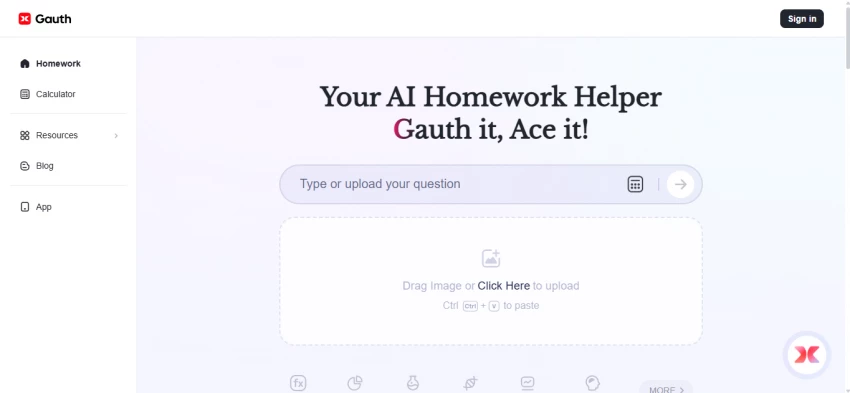
Goth AI is a photo-based homework solver made by INTSIG PTE. LTD. - the same group behind CamScanner and Gauth. You photograph a question, and the AI breaks it down step by step. Beyond math, it covers physics, chemistry, literature, and even basic coding. The question generator turns your notes into practice problems, which is genuinely useful.
The complaints, though, are consistent. Several App Store reviewers note they got one or two answers before the paywall appeared. Accuracy drops on messy handwriting or layered word problems. And the Trustpilot rating sits at 2.0, driven largely by billing complaints rather than technical ones. None of this makes it a bad app - but it explains why students go looking for alternatives.
Also Read - Goth AI
| Worth knowing: Goth AI and Gauth (formerly Gauthmath) share infrastructure, UX patterns, and pricing logic. If you've used one, the other will feel immediately familiar. |
Before going deep on each tool, here's the quick version:
| Tool | Price | Subjects | Platform | Known For |
| Goth AI | Free / ~$3.99/mo | Multi-subject | App+Web | Broad but inconsistent |
| Photomath | Free / $9.99/mo | Maths only | iOS+Android | Best visual steps |
| Mathway | Free / $9.99/mo | Maths+Science | iOS+Android+Web | College-level depth |
| Socratic | Free | Multi-subject | iOS+Android | Concept-first, free |
| Quizlet | Free / $7.99/mo | All subjects | iOS+Android+Web | Memory & retention |
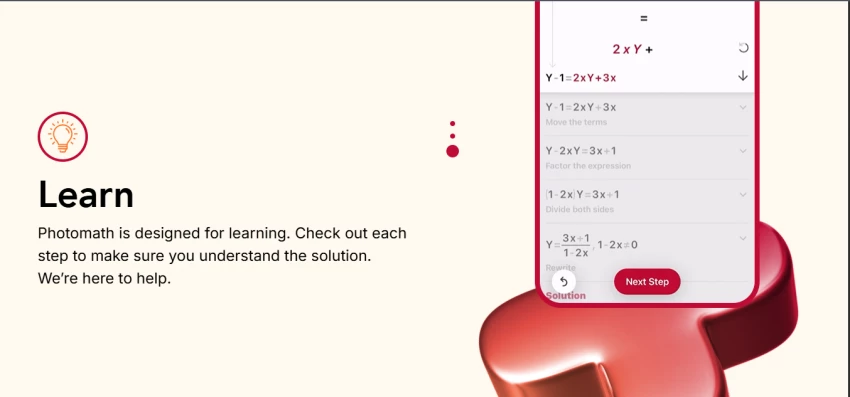
Photomath is probably the most widely recommended math homework app on the planet, and it earns that reputation by doing one thing extraordinarily well: showing you exactly how a solution unfolds, step by step, with animations that mimic how a patient teacher would explain it on a whiteboard. Where Goth AI gives you an answer with some explanation, Photomath makes the process feel like a lesson.
Open the camera, point it at any printed or handwritten equation, and within seconds you have a breakdown of every transformation - factoring, solving, substituting - each move labeled and explained. For visual learners, this format clicks in a way that text-heavy solutions simply don't. It also stores a problem history, so you can revisit past questions before exams.
What it offers
– Camera scanning for handwritten and printed problems with reliable OCR
– Animated step-by-step solutions - not just answers, but the reasoning behind them
– Covers arithmetic, algebra, geometry, trigonometry, calculus, and statistics
– Multiple solution methods shown for the same problem where they apply
– Textbook solutions database for common assigned problems
Where it falls short
– Math only - if your homework is history, chemistry, or literature, Photomath won't help
– Advanced features (animated explanations, extra topics) are behind the Plus paywall
– No live tutor option - you get AI solutions, nothing more
– Very complex multi-step word problems can still trip it up
| Best for | Students who primarily need maths help and learn better through visual, animated explanations |
| Price | Free for basic scanning; Plus at $9.99/month or $69.99/year for full explanations |
| vs Goth AI | Better accuracy and explanation quality for maths; weaker on multi-subject coverage |
Mathway is for when the maths gets harder. Where Goth AI and Photomath both handle standard school-level equations well, Mathway was specifically built for the type of problems that show up in advanced courses - calculus, linear algebra, differential equations, statistics. College students and anyone in a technical degree tend to land on Mathway because it simply goes further than most alternatives.
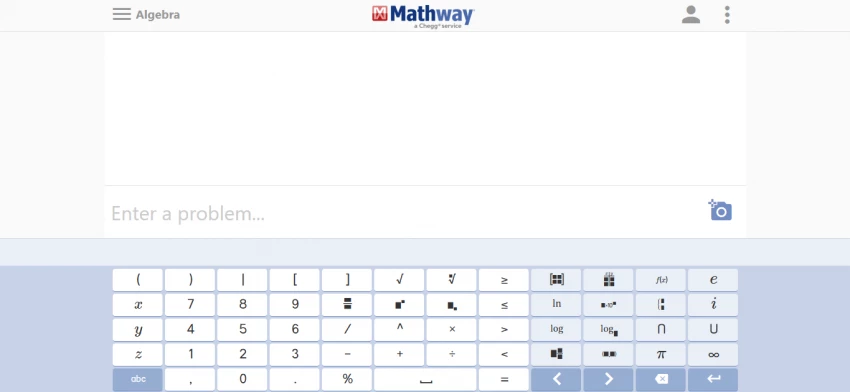
The interface is understated: type your problem, pick the subject category, and get your solution. You can also draw equations using a virtual keyboard, which works better than camera scanning for complex notation. The free version shows you the final answer; the paid tier unlocks the step-by-step breakdown.
What it offers
– Wide subject coverage: algebra, calculus, statistics, chemistry, graphing, finite math
– Strong performance on multi-step equations and college-level problem formats
– Type or draw input - useful when camera scanning struggles with complex notation
– Available across iOS, Android, and web browser - no device lock-in
– Clean, uncluttered interface with fast response times
Where it falls short
– Step-by-step solutions are paywalled - the free version only shows the final answer
– No camera scanning on the web version; photo input limited to mobile only
– No multi-subject coverage outside of maths and basic science
– Less visual than Photomath - the explanations are thorough but not animated
| Best for | Advanced high school and college students dealing with calculus, stats, or engineering maths |
| Price | Free for answers; full step-by-step at $9.99/month |
| vs Goth AI | Significantly stronger on complex maths; narrower scope for other subjects |
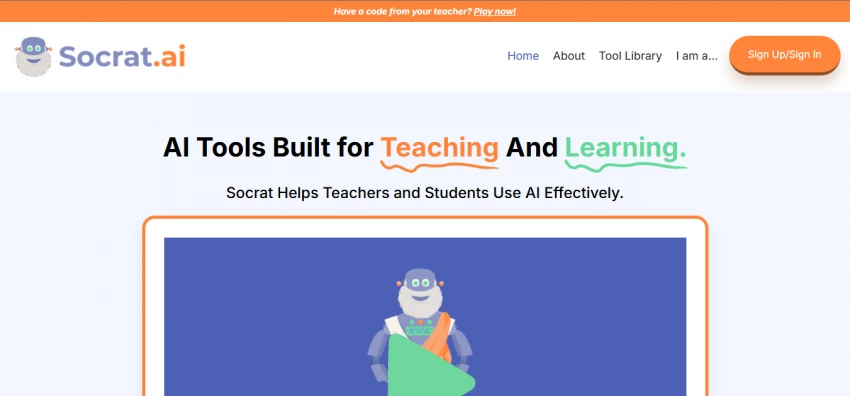
Socratic takes a noticeably different approach from every other tool on this list. Instead of just solving the problem in front of you, it asks: do you understand what's happening here? When you photograph a question or type it in, Socratic surfaces YouTube videos, web explanations, concept breakdowns, and visual guides alongside any solution it provides. The goal is comprehension first, answer second.
Backed by Google and built on its AI systems, Socratic is particularly strong on the 'why' - why is the formula applied this way, what does this concept actually mean, where does this rule come from? For students preparing for exams rather than just completing homework, that depth is worth more than a quick answer would be.
And it's completely free. No paywalls, no daily question limits, no subscription prompts interrupting your session.
What it offers
– Completely free - no subscription tier, no credit system, no upsells
– Covers maths, science, history, literature, social studies, and more
– Pulls in curated educational content: Khan Academy links, YouTube videos, guides
– Photo-based input with clean, distraction-free interface
– Backed by Google's AI - reliable on standard school-level problems
Where it falls short
– Weaker on advanced university-level content - built for K-12 and early college
– No live tutor or human support option
– Handwriting recognition is less accurate than Goth AI or Photomath
– Development pace has slowed compared to newer competitors
– Less suitable for complex multi-step symbolic maths
| Best for | Students who want to genuinely understand concepts, not just get homework done |
| Price | Free. Completely. No trial period, no hidden tier. |
| vs Goth AI | Broader and deeper understanding; less consistent on complex or niche problems |
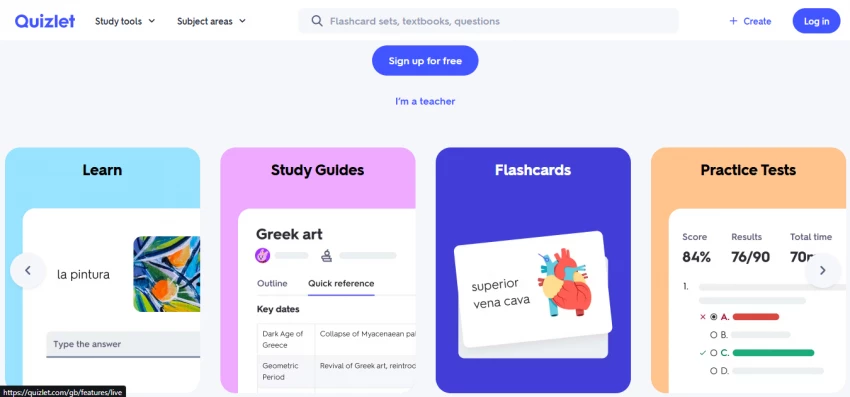
Quizlet is the outlier on this list, and intentionally so. It does not scan your homework or give you answers. What it does instead is help you remember what you've learned - through flashcards, spaced repetition, practice tests, and study games that are genuinely effective for building the long-term retention that getting answers from an AI simply cannot give you.
If Goth AI's limitation isn't technical accuracy but rather the fact that students copy answers without engaging with the material, Quizlet is the antidote. You create sets from your notes, your textbook chapters, or your lecture slides - or find millions of pre-made sets from other students - and then work through them until the material actually sticks. It covers every subject, every level.
A lot of students use both: a solver app for quick homework, Quizlet for exam prep. That combination makes more sense than either tool alone.
What it offers
– Flashcards with spaced repetition - the most evidence-backed method for retention
– Practice tests that adapt to your weak points over time
– Millions of pre-made study sets across every subject and curriculum
– AI-powered study guides that turn uploaded notes or textbook pages into study materials
– Available across iOS, Android, and web - syncs across all devices
Where it falls short
– Not a homework solver - it won't explain how to work through an equation
– Requires upfront effort to create or organize study sets
– Free tier includes ads and limits some features; Plus is $7.99/month
– AI features (note upload, smart guides) are mostly behind the paid tier
| Best for | Students preparing for exams who want to retain information, not just get through tonight's homework |
| Price | Free with ads; Quizlet Plus at $7.99/month for AI features and ad-free use |
| vs Goth AI | Fundamentally different use case - Quizlet builds knowledge, Goth AI retrieves answers |
Honestly? It depends less on which app is 'best' and more on what you're actually trying to do in that moment.
The honest takeaway is that no single app replaces all the others. Goth AI's broad coverage makes it a reasonable everyday tool, but its accuracy gaps, paywall timing, and billing practices give students good reasons to look elsewhere. Any of the four tools above addresses at least one thing Goth AI does poorly - and several of them do it for free.
| A note on academic integrity: all of these tools are best used to check your work, understand where you went wrong, and learn the method - not to replace the effort of thinking through a problem yourself. That's how they actually help your grades long-term. |
Share your thoughts about this article.
Be the first to post a comment!

$19.99Pro monthly price (May 2025 hike)$179.99Pro annual (saves 25%)30 daysOur h...
Suraj Malik2 months ago

Meta’s artificial intelligence business may be accelerating, but the company is...
Suraj Malik2 months ago

QUICK ANSWER - Why AI Chatbots Break After 10 MessagesMost AI chatbots brea...
Suraj Malik2 months ago

POLYBUZZ VS JANITOR AI: THE QUICK ANSWERPolyBuzz AI is the better choice for cas...
Suraj Malik2 months ago
Amazon has begun offering new OpenAI products directly through its cloud platfor...
Suraj Malik2 months ago
Abhyas AI vs. Gauth AI: which is better?Abhyas AI is better for Indian students...
Suraj Malik2 months ago