Definition: What Qualifies as an AI Agent-
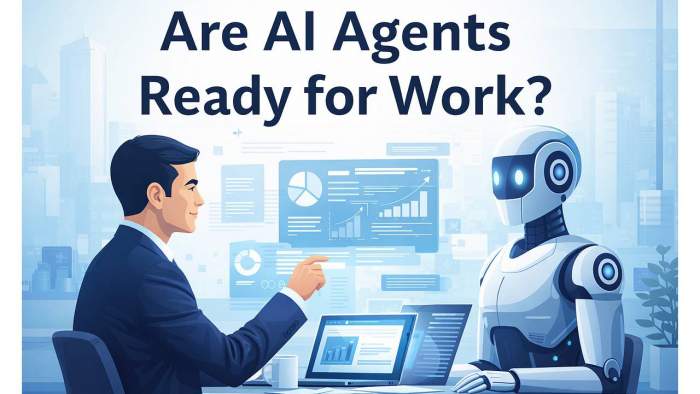
For this report, an AI agent is defined as:
● A system that autonomously executes multi-step tasks by reasoning, planning, and interacting with external tools or environments based on high-level natural language instructions.
● These agents typically use large language models (LLMs) + tool stacks to act on behalf of a user or workflow (e.g., web navigation, API calls, automation).
This distinguishes agents from simple prompt-based assistants — agents must complete tasks beyond text generation.
Context: Why the New Benchmark Matters-
Recent enterprise benchmarks (e.g., APEX-Agents) have simulated real professional workflows (consulting, banking, law). Early evidence suggests poor performance relative to human standards — even when underlying foundation models are strong. This challenges assumptions that agents can be plugged into knowledge work without substantial supervision or remediation.
| Benchmark | Purpose | Task Types | Key Metric |
| WorkBench | Realistic workplace task evaluation | Emails, scheduling, database actions | Task completion rate |
| VisualAgentBench (VAB) | Vision + language workflows | Object identification, visual planning | Success rate (% correct) |
| RE-Bench | Research & ML tasks | Kernel optimization, fine-tuning | Success rate vs expert |
| GDPval | Real household job tasks | Email, vendor planning, auditing | “Win rate” vs professionals |
| Domain-Specific Enterprise Benchmark (IT Ops) | Enterprise IT tasks | Issue resolution, accuracy & stability | Accuracy & pass |
Agent Performance by Benchmark-
| Benchmark | Avg. Agent Success Rate |
| WorkBench-Task Completion | 3% – 43% |
| VisualAgentBench | ~36% |
| GDPval Model Win Rate | ~47% (best) |
| Domain-Specific Agents (IT) | ~82% |
| RE-Bench (2-hr) | 4× human surrogate score |
| Capability | Supporting Metric | Benchmark |
| Short-Horizon Task Execution | Top agent ≈ human-level in 2-hr constrained tasks | RE-Bench (4× score) |
| Domain-Specific IT Operations | ~82.7% accuracy | Enterprise IT Benchmark |
| Basic Workflow Steps | Agents can interact with tools | WebArena partial success |
Key Quantitative Insight-
● On enterprise IT ops, domain-specific agents outperform general LLM agents in accuracy (82.7%) and stability — defined as consistency across repeated runs.
These cases reflect tasks that are bounded, structured, and narrow, especially when agents have pre-built domain knowledge.
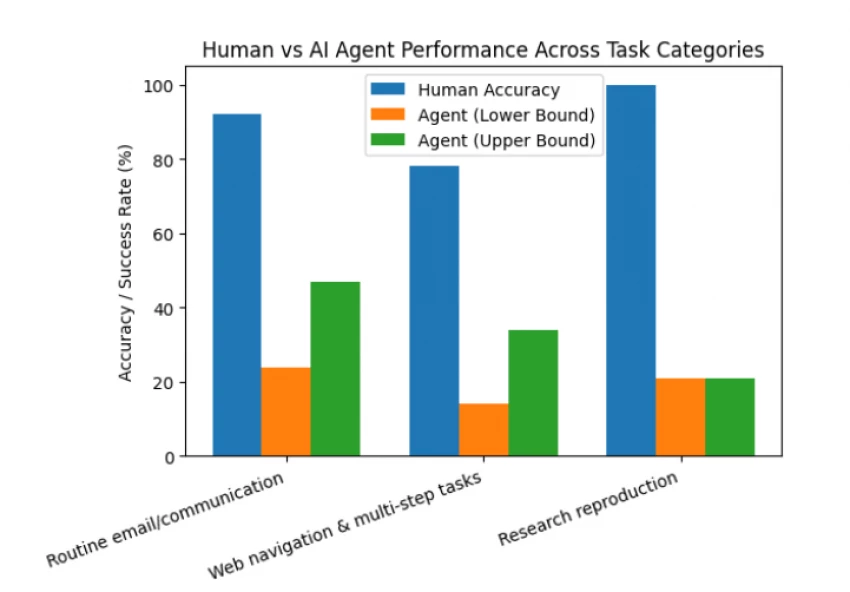
| Task Type | Human vs Agent | Agent Score |
| General human queries | ~90% human accuracy | ~15–24% agent |
| Multi-tool, multi-domain workflows | Humans >> agents | ~24% task completion |
| Real research reproducibility | Humans >> agents | ~21% best agent |
Examples with Data
● WorkBench: GPT-4 completes only 43% of tasks, with many errors like sending emails to wrong recipients.
● VisualAgentBench: Best model achieves 36.2% success, average ~20% among field models.
● GDPval: Best agent wins ~47.6% of time vs professionals — below majority reliability.
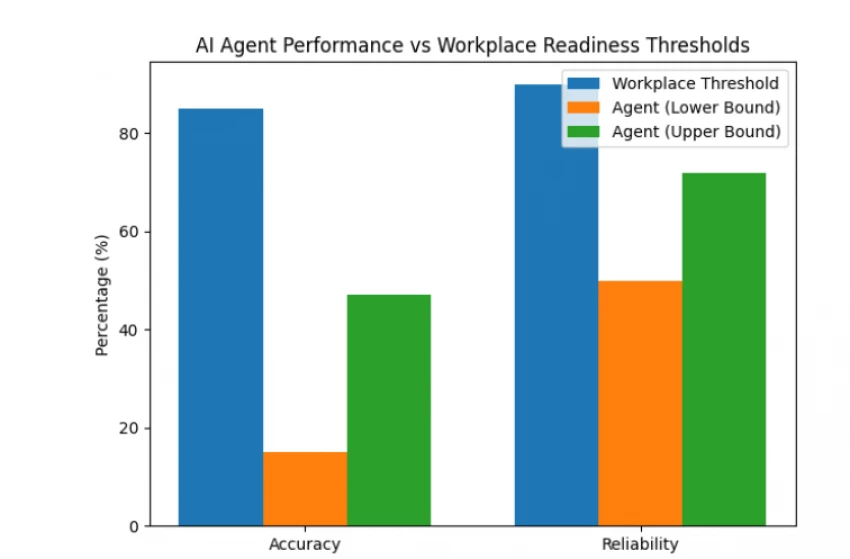
To quantify “workplace readiness,” we define measurable thresholds:
| Criterion | Minimum Acceptable Threshold | Agent Performance |
| Task Accuracy | ≥ 85% | 15–47% (varies by task) |
| Reliability | Consistency > 90% | 50–72% (domain-specific best) |
| Latency | < 2s for fast interactions | ~2.1s in the best IT agent |
| Cost Efficiency | ROI positive within budget | Varies widely |
| Integration Quality | Seamless tool chaining | Partial/brittle |
Interpretation:
Agents often fail to meet workplace thresholds on accuracy and reliability for general tasks. Domain-specific optimization improves performance but remains context-limited.
| Metric | Before Agent | After Agent |
| Avg. response time | 8hrs | 2.1s (automated responses) |
| Accuracy | 55% | 82.7% |
| Cost per task | High human cost | Lower automated cost |
Note: Success here correlates with domain specialization, not general workplace ubiquity.
| Metric | Human | Best AI Agent |
| Reproducibility success | ~100% | ~21% |
| Time to completion | Varies | Minimum |
| Decision quality | High | Low |
This highlights systemic weakness: agents struggle with novel, unstructured reasoning common in advanced work roles.
Documented failure modes:
| Failure Type | Impact | Source |
| Hallucinations | Wrong output confidently asserted | Benchmarks |
| Context loss | Missing cross-domain history | GDPval findings |
| Brittleness | Fails in minor environment changes | WebArena |
| Cost vs quality | High cost per task | ROI concerns |
Real workplace deployment also encounters:
● Security & integration gaps.
● Data governance & compliance challenges.
● Lack of robust enterprise debugging tools.
Synthesis
● Agents exceed baseline on narrow, structured tasks.
● Agents operate below readiness thresholds for complex, multi-step, real work.
● Domain expertise improves success, but general readiness is not yet achieved.
Key Evidence Supporting Doubts-
● Benchmarks show agent success rates well below human standards (15–47% across general tasks).
● Agents fail complex task combinations, multi-domain reasoning, and reproducibility tests at scale.
● Even with domain specialization, performance improves only in narrow workflows, not generalized workplace application.
Where Progress Exists-
● Domain-specific agents can meaningfully automate technical workflows (e.g., IT ops).
● Short-horizon tasks (under structured constraints) see better performance.
Overall Answer-
No — AI agents are not yet broadly ready for general workplace deployment.
Current performance falls short of critical readiness thresholds, especially for unstructured, multi-domain, and high-impact professional tasks.
● Stanford AI Index Report 2025 — agent success rates; top model ≈36.2% average.
● WorkBench Benchmark — agents complete 3–43% of tasks.
● GDPval real work tasks — best models <50% performance vs professionals.
● Enterprise IT agent benchmark — domain-specific agents ≈82.7% accuracy.
● CORE-Bench & research reproducibility — highest ≈21% on hard tasks.
● Evaluation framework limitations — cost, reliability, and benchmarks gaps.
Be the first to post comment!
A group of policymakers, researchers, and technology leaders has proposed a fram...
Suraj Malik1 day ago

Managing remote employees is very different from managing people in an office. W...
Sakshi Dhingra3 days ago
A school gradebook sounds like a simple thing until you watch what happens when...
Sakshi Dhingra1 week ago
The Growing Buzz Around EditPro in the AI Editing SpaceIn 2026, the name “EditPr...
Sakshi Dhingra1 week ago
When I first started deploying large language models, I assumed that choosing th...
Sakshi Dhingra1 week ago

Few software websites have survived as many internet eras as Softonic. Launched...
Suraj Malik1 month ago