Growth marketing today relies on a combination of experimentation, analytics, automation, and creative execution. Artificial intelligence has become the connective layer that enables these activities to operate at scale. Instead of manually analyzing campaigns, creating dozens of variations of marketing assets, and tracking performance across platforms, marketing teams increasingly rely on AI-powered tools that automate large parts of the growth process.
Industry surveys show that around 95% of marketers say AI tools help them spend less time on repetitive tasks and more time engaging with customers, which explains why companies are rapidly integrating AI into marketing workflows.
However, no single AI tool performs every growth marketing function. Successful marketing teams typically rely on a stack of tools that address different parts of the growth funnel, including content creation, search optimization, campaign automation, analytics, and customer lifecycle management. Understanding how each tool contributes to growth marketing is essential for building an effective AI-driven marketing strategy.
One of the most widely used AI platforms in marketing teams today is ChatGPT and other generative AI systems. Growth marketers often rely on these tools during the early stages of campaign development, particularly when they need to test multiple messaging angles quickly.
Generative AI platforms can assist in producing long-form articles, ad copy, product descriptions, email campaigns, and social media messaging. Instead of writing one campaign concept at a time, marketers can generate dozens of variations and test them across paid advertising platforms, landing pages, and email funnels. This dramatically increases the speed of experimentation, which is the core principle behind growth marketing.
Another major advantage of generative AI platforms is research capability. Marketing teams frequently use AI tools to summarize industry reports, analyze competitor strategies, and generate campaign briefs. Because these systems are trained on massive text datasets, they can synthesize information quickly and produce structured insights that would otherwise require hours of manual research.
In practical terms, generative AI becomes the brainstorming engine behind growth experiments. It allows marketers to move from concept to execution faster and test more hypotheses about customer behavior.
While general AI tools like ChatGPT are widely used, specialized platforms such as Jasper are designed specifically for marketing workflows. Jasper functions as a dedicated AI marketing platform that focuses on brand-consistent content generation and marketing automation.
Unlike general AI writing assistants, Jasper allows companies to train the system on their brand voice and tone guidelines. This ensures that generated content maintains a consistent identity across blog posts, advertising copy, and social media campaigns. The platform also integrates with marketing pipelines so that content creation can move directly into campaign execution workflows.
For growth marketing teams, this capability is particularly important because scaling content production often creates brand consistency challenges. When campaigns expand across multiple markets and channels, maintaining consistent messaging becomes difficult. AI content platforms attempt to solve this by learning brand style patterns and applying them automatically to new content.
In practice, Jasper is frequently used for producing blog content, product marketing copy, email marketing sequences, and advertising text at scale. This reduces the time marketing teams spend writing and editing content manually, allowing them to focus on campaign strategy and experimentation.
Search traffic remains one of the most valuable acquisition channels for growth marketing. Tools like Surfer SEO focus on optimizing content so that it performs better in search engine results.
Surfer SEO uses machine learning to analyze the top-ranking pages for a specific keyword and identify structural patterns that influence search rankings. These patterns include keyword distribution, content structure, heading usage, semantic topic coverage, and readability metrics.
The platform’s content editor provides real-time optimization suggestions while marketers are writing articles. It generates a content score based on how closely a page aligns with ranking factors derived from competing pages. This approach transforms SEO from a guess-based process into a data-driven workflow where marketers can adjust content structure based on measurable signals.
For growth marketing teams, the significance of tools like Surfer lies in their ability to accelerate organic traffic acquisition. Instead of manually analyzing competitor pages, marketers can rely on AI to extract insights from hundreds of search results and translate them into actionable recommendations.
Another emerging function of SEO AI tools is adapting content for AI-generated search environments. As search engines increasingly integrate generative AI responses, SEO tools now analyze how content appears in AI summaries and conversational search interfaces.
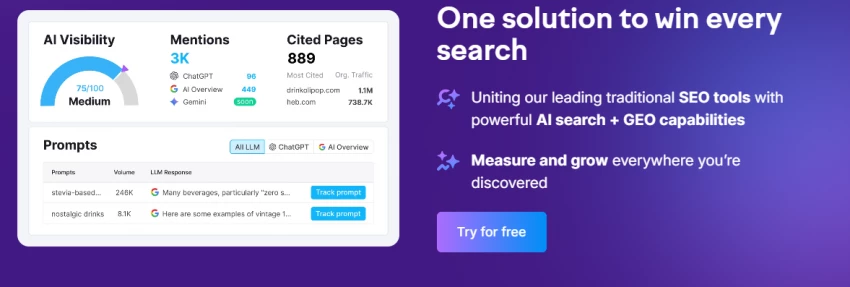
While Surfer focuses heavily on content optimization, platforms like Semrush operate at a broader level of digital visibility analysis. Semrush is widely recognized as one of the most comprehensive SEO analytics platforms used by marketing teams.
The platform integrates multiple capabilities, including keyword research, competitor analysis, backlink monitoring, rank tracking, and content optimization. Its AI features analyze large datasets of search behavior and competitor strategies to identify growth opportunities.
For example, Semrush can reveal which keywords competitors are ranking for, how their backlink networks are structured, and which topics generate the highest search demand. This information allows growth marketers to design content strategies that target gaps in the competitive landscape.
Semrush also integrates AI-driven recommendations that help marketers optimize content and improve search visibility. These recommendations are based on algorithmic analysis of ranking signals across search engines.
The strategic value of platforms like Semrush is evident in industry developments. Adobe recently announced plans to acquire the company for approximately $1.9 billion, highlighting the growing importance of SEO and digital visibility analytics in modern marketing ecosystems.
While content and SEO tools focus primarily on traffic acquisition, marketing automation platforms handle the next stage of growth: converting visitors into customers.
HubSpot is one of the most widely used marketing automation platforms, and it has recently integrated several AI features into its ecosystem. These systems analyze customer behavior across websites, email campaigns, and CRM databases to personalize marketing interactions.
HubSpot’s AI tools help marketers identify high-quality leads through predictive scoring models. These models analyze user activity such as website visits, email engagement, and product interactions to determine which prospects are most likely to convert.
Another capability involves automated content personalization. The platform can dynamically adjust website messages, email campaigns, and promotional offers based on a user’s previous interactions with the brand.
AI systems inside HubSpot also optimize the timing of marketing communications. By analyzing engagement patterns, the system determines when customers are most likely to open emails or respond to messages.
For growth marketing teams focused on conversion optimization and customer retention, this type of automation becomes essential. Instead of sending identical campaigns to every user, marketers can deliver personalized experiences tailored to individual behavior patterns.
Social media has evolved into one of the most influential growth channels for modern digital businesses. For consumer brands, SaaS companies, and creator-led businesses, platforms such as Instagram, TikTok, LinkedIn, and YouTube are not only communication channels but also major customer acquisition engines. Managing campaigns across these networks requires continuous content creation, performance monitoring, and audience analysis. This is where artificial intelligence tools designed for social media marketing have become essential.
AI-driven social media platforms allow marketing teams to automate repetitive tasks, analyze engagement patterns at scale, and detect trends that may influence campaign performance. Instead of manually reviewing thousands of interactions, AI systems process engagement data in real time and generate insights about audience preferences, optimal posting times, and content performance patterns. These tools are particularly valuable for growth marketing teams because they enable faster experimentation with content formats and messaging strategies.
One of the most widely used AI-enhanced social media management platforms is Sprout Social. The platform integrates analytics, scheduling, and AI-driven audience insights into a unified interface. Through its social listening engine, Sprout Social analyzes conversations across social networks to identify sentiment patterns and brand mentions. Marketing teams can monitor how audiences react to campaigns and detect shifts in perception over time. The platform also uses machine learning to suggest optimal posting schedules based on historical engagement data, ensuring that content is published when followers are most likely to interact with it. These insights allow growth teams to adjust campaign timing and messaging strategies based on real behavioral data rather than assumptions.
Another widely used platform in this category is Hootsuite, which has incorporated AI features to support campaign planning and social media automation. Hootsuite’s AI capabilities analyze historical engagement metrics to recommend posting schedules and content formats that have historically performed well. The system also integrates sentiment analysis that evaluates whether social media reactions are positive, neutral, or negative. For marketing teams managing multiple brand accounts across different networks, Hootsuite provides centralized campaign monitoring that allows performance comparisons across platforms. This helps marketers understand whether a campaign resonates differently on Instagram, LinkedIn, or Twitter and adjust their strategies accordingly.
A newer generation of AI-driven marketing tools focuses on content ideation and creative development for social media campaigns. One example is Lately AI, a platform designed to transform long-form content into social media posts automatically. Lately analyzes previously successful posts and learns which types of messaging generate engagement for a specific brand. Based on this training data, the system generates new content that mirrors the patterns of high-performing posts. For growth marketing teams, this capability significantly accelerates content production while maintaining brand consistency across campaigns.
Another influential AI platform used in social media marketing is BuzzSumo, which focuses on content intelligence and trend discovery. BuzzSumo analyzes billions of social interactions to identify topics that are gaining traction across the internet. Marketing teams use the platform to discover trending themes, analyze competitor content performance, and evaluate which types of articles or videos generate the highest engagement. By understanding what audiences are already sharing and discussing, growth marketers can create campaigns that align with existing trends rather than trying to predict them blindly.
Influencer marketing has also become an important growth strategy for many brands, and AI tools are increasingly used to identify suitable creators. Platforms such as Upfluence and Modash analyze influencer audiences using machine learning to determine follower demographics, engagement authenticity, and brand alignment. These systems evaluate whether an influencer’s audience matches the target market of a campaign. Instead of manually reviewing influencer profiles, marketing teams can rely on AI-driven analytics to identify creators whose followers are most likely to convert into customers.
AI-based influencer discovery tools also help detect fake followers and engagement manipulation, a persistent challenge in influencer marketing. By analyzing patterns such as follower growth anomalies, engagement ratios, and interaction authenticity, these platforms help brands avoid partnerships with influencers whose audiences may be artificially inflated.
Another emerging capability within AI social media tools involves predictive engagement analytics. Platforms like Sprinklr and Brandwatch use artificial intelligence to forecast how audiences might respond to upcoming campaigns. By analyzing historical engagement patterns and sentiment trends, these systems estimate whether certain messaging strategies are likely to perform well before a campaign even launches. This predictive capability allows growth marketers to refine campaign concepts early in the planning stage.
AI-driven social analytics tools are also valuable for identifying emerging trends before they become mainstream. By analyzing engagement spikes across social networks, these platforms can detect sudden increases in conversations around specific topics. Marketing teams can then develop campaigns that capitalize on these trends while they are still gaining momentum.
In practice, growth marketing teams rarely rely on a single social media AI platform. Instead, they combine multiple tools that address different aspects of campaign management. A typical workflow might involve using BuzzSumo to identify trending topics, Lately AI to generate social media content variations, and Sprout Social or Hootsuite to schedule posts and analyze engagement performance. Influencer discovery platforms may then be used to amplify campaigns through creator partnerships.
The integration of artificial intelligence into social media marketing represents a major shift from intuition-driven strategies toward data-driven decision making. Instead of guessing what audiences want to see, marketers can analyze real engagement data and adapt campaigns accordingly. As social media platforms continue to evolve and user behavior becomes more complex, AI tools are likely to play an increasingly central role in how growth marketing campaigns are planned, executed, and optimized.
The most advanced applications of AI in growth marketing involve predictive analytics. These systems analyze historical customer data to forecast future behavior patterns.
Predictive models can estimate metrics such as customer lifetime value, churn probability, and campaign conversion rates. Growth marketers use these forecasts to allocate budgets more efficiently and prioritize high-value customer segments.
For example, if a predictive model identifies users who are likely to cancel a subscription, marketers can trigger targeted retention campaigns before the churn occurs. Similarly, AI models can analyze which acquisition channels generate the highest lifetime value customers rather than focusing solely on short-term conversions.
Research in marketing analytics shows that personalized marketing strategies powered by machine learning can significantly improve engagement and revenue performance. In some experimental models, personalized offer systems have demonstrated improvements of around 17% in offer acceptance rates compared with traditional approaches.
This type of predictive intelligence represents one of the most transformative aspects of AI-driven marketing.
An important observation from modern marketing teams is that growth marketing rarely relies on a single AI platform. Instead, organizations typically combine several specialized tools.
Content creation platforms generate marketing assets. SEO tools optimize those assets for search visibility. Automation systems manage customer interactions, while analytics tools measure campaign performance and identify opportunities for improvement.
This layered ecosystem allows marketing teams to experiment rapidly while maintaining data-driven decision-making across every stage of the growth funnel.
AI tools do not replace marketers; they amplify the marketer’s ability to test ideas, analyze results, and adapt strategies in real time.
After working with multiple marketing stacks and experimenting with different AI platforms over time, one thing has become clear to me: AI tools are not replacing growth marketers, but they are dramatically changing how we work. The biggest difference I noticed while exploring these tools is the speed at which marketing experiments can now happen. Tasks that once required days of planning, content creation, and analysis can now be executed within hours using the right combination of AI systems.
However, using AI tools effectively requires more than simply adopting the latest software. Growth marketing is fundamentally about testing hypotheses and understanding customer behavior. AI tools accelerate those processes, but they still depend heavily on human judgment to interpret the insights and make strategic decisions. When I tested several of these tools while analyzing growth campaigns, I realized that the real advantage comes from combining multiple tools into a cohesive workflow rather than relying on a single platform.
For example, generative AI tools can help generate marketing ideas and campaign copy, but those ideas only become meaningful when combined with SEO analytics platforms that identify real search demand. Similarly, social media AI platforms may reveal engagement patterns, but interpreting those signals requires an understanding of audience psychology and brand positioning. The most effective growth teams treat AI tools as analytical assistants rather than automated decision makers.
Another observation that stood out during this research is how quickly the AI marketing ecosystem is evolving. Many of the tools mentioned in this article are continuously expanding their capabilities with predictive analytics, automated experimentation, and deeper integrations across marketing channels. As these technologies mature, marketing workflows will likely become more interconnected, with AI systems managing everything from customer acquisition to retention campaigns.
From a practical perspective, my takeaway is that AI marketing tools are most valuable when used as part of a structured growth strategy. Instead of chasing every new AI product that appears in the market, marketers benefit more from selecting a few tools that align with their growth objectives and integrating them into a repeatable experimentation framework.
For anyone building a modern growth marketing stack, the real challenge is not finding AI tools, because there are now hundreds available. The real challenge is learning how to combine them in a way that produces measurable results. When used thoughtfully, AI tools can transform marketing from a reactive activity into a proactive, data-driven growth engine.
Be the first to post comment!
Online reviews are often framed as a decision-making tool for buyers. But behind...
Suraj Malik1 week ago
What Is Marketing Automation?Marketing automation is the use of software to...
Cheshta Upmanyu1 month ago
Magento stands out as one of the most robust solutions for growing brands that w...
Mighva Verma1 month ago
Paid survey apps are everywhere now, but most people are unsure which ones actua...
Sakshi Dhingra3 months ago

Emoji Kitchen, Google’s experimental yet wildly popular mash-up tool built into...
Sakshi Dhingra4 months ago

Why Everyone’s Talking About TikTok Watermark RemovalTikTok is everywhere; it’s...
Sakshi Dhingra4 months ago