
Artificial intelligence has learned how to write essays, generate images, and even help with programming. Naturally, the next logical step was obvious: building AI companions you can talk to.
That is exactly the idea behind Dream Companion AI.
Instead of using AI to answer questions or summarize documents, this platform focuses on something much more personal. It allows users to create digital characters and hold ongoing conversations with them. These companions can be customized with their own personalities, interests, and visual appearance.
In simple terms, Dream Companion tries to turn AI into something closer to a digital character than a productivity assistant.
Whether that sounds fascinating or slightly strange probably depends on how comfortable you are with the idea of chatting with an algorithm that remembers your favorite hobbies.
After spending some time testing the platform and reading user reviews, Dream Companion turns out to be both entertaining and occasionally a little unpredictable.
Dream Companion is a conversational AI platform built around customizable characters.
Instead of interacting with a single assistant like you would on most AI chat platforms, you create your own digital companion. The companion can be designed with specific personality traits, interests, and behavior patterns.
Once the character is created, the AI generates responses based on that profile.
If you describe your companion as adventurous, optimistic, and obsessed with coffee, the conversation will generally reflect those traits. In other words, the AI tries to stay “in character.”
The platform also includes visual elements. Users can generate images of their companion, which adds a visual layer to the interaction.
The result is something that feels closer to interactive storytelling than traditional chatbot interaction.
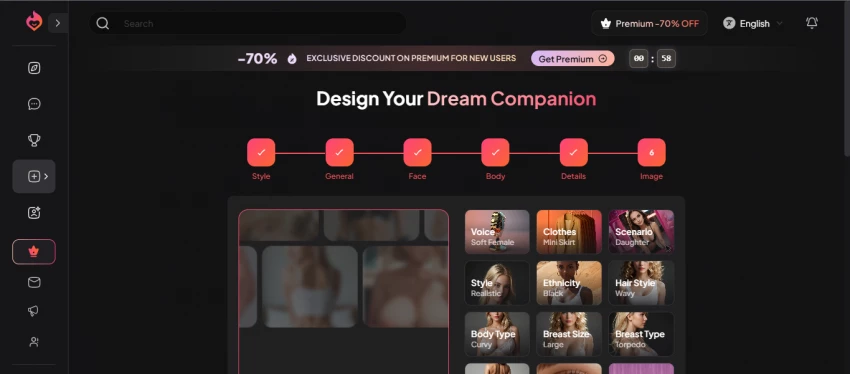
Using the platform is fairly straightforward.
First, you create your companion by defining personality details and appearance. Some users keep this simple, while others write elaborate character descriptions that could probably qualify as short novels.
Once the character exists, conversations take place through a chat interface similar to a messaging app.
The AI then attempts to respond in ways that match the character profile.
During testing, one thing became very obvious: the more effort you put into the character description, the better the conversations become. A detailed personality leads to more consistent dialogue.
A companion created in thirty seconds tends to behave more like a regular chatbot.
Dream Companion focuses on a few core capabilities that shape the overall experience.
The most important feature is character customization. Users can define personality traits, interests, and visual appearance.
Another key component is conversational AI that adapts to the personality of the character being used.
The platform also allows image generation, which lets users create visual versions of their companion.
Finally, Dream Companion attempts to maintain conversation continuity through a memory system that remembers parts of past interactions.
| Feature | What It Does | Why It Matters |
| Character customization | Users design personality and appearance | Makes each AI companion unique |
| Conversational AI | Generates dialogue based on character traits | Creates more immersive chats |
| Memory system | Retains some previous interaction details | Conversations feel more continuous |
| Image generation | Produces images of the companion | Adds visual immersion |
| Roleplay interaction | Supports narrative-style conversations | Great for storytelling |
Testing Dream Companion felt more like experimenting with a digital character simulator than using a typical AI chatbot. To understand how well it worked, I created a few companions with different personalities, including a travel enthusiast and a sarcastic character.
One thing became clear very quickly: the more detailed the character description is, the better the conversation becomes. When I created a companion with only a short profile, the responses felt generic. But once I added specific traits, hobbies, and interests, the AI started responding in ways that matched the character much more consistently.
For example, the travel-focused companion often brought up photography and destinations when conversations drifted toward hobbies or weekend plans. This made the interaction feel closer to chatting with a character rather than a basic chatbot.
The image generation feature was another interesting part of the experience. Being able to generate visuals of the companion adds a layer of personality, although it relies on Dream Coins, which means frequent image generation can use credits fairly quickly.
Voice responses work as well, but they currently feel less polished than the text chat. Some responses still sound slightly robotic.
Overall, Dream Companion works best when you treat it as a creative conversation platform rather than a quick question-and-answer tool. Longer conversations and roleplay-style dialogue produce much better results than short prompts.
Dream Companion offers a free plan for users who want to explore the platform before committing to a subscription.
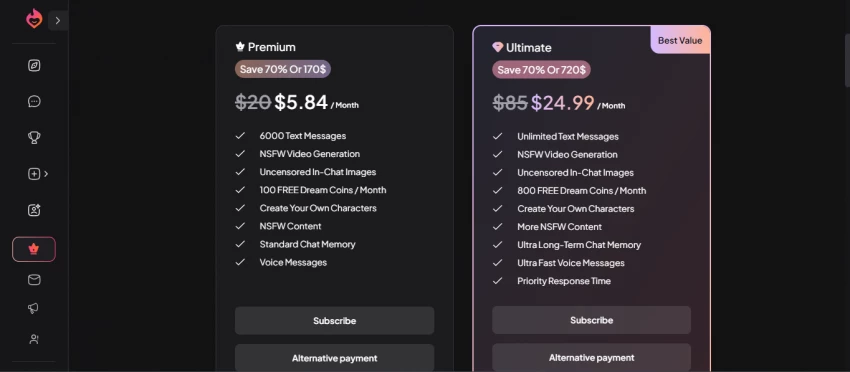
Paid plans unlock additional messaging capacity and media generation features.
| Plan | Price | Message Limit | Coins Included | Best For |
| Free | $0 | Limited | None | Testing the platform |
| Premium | $5.84/month | ~6000 messages | 100 coins | Regular users |
| Ultimate | $24.99/month | Unlimited messages | 800 coins | Heavy users |
Dream Coins are used for certain features such as image generation, voice playback, and multimedia content creation.
If you generate a lot of media, you may find yourself keeping an eye on the coin balance.
Looking through user reviews across several platforms reveals a few consistent patterns.
Customization is widely praised.
Many users say the ability to design a companion with specific personality traits makes the platform more engaging than typical AI chat tools.
Visual generation adds a fun element.
Reviewers often highlight the image generation feature because it gives the AI companion a visual identity.
The credit system receives mixed reactions.
Some users appreciate the additional features unlocked by Dream Coins, while others feel that frequent image generation can quickly consume monthly credits.
Voice interaction still needs refinement.
Several users mention that voice responses occasionally sound robotic compared with text conversations.
Overall user sentiment.
Most reviewers agree that Dream Companion works best as an entertainment platform rather than a productivity assistant.
| Review Aspect | User Sentiment | Notes |
| Character customization | Very positive | Users enjoy designing companions |
| Conversation quality | Positive | Personality-driven dialogue |
| Image generation | Positive | Adds immersion |
| Voice interaction | Mixed | Some responses sound robotic |
| Pricing / coins | Mixed | Media features consume credits |
| Pros | Explanation |
| Highly customizable companions | Users can design detailed personalities |
| Engaging conversational style | Dialogue adapts to character traits |
| Visual generation features | Adds immersion |
| Creative roleplay potential | Good for storytelling |
| Cons | Explanation |
| Voice responses vary in quality | Some interactions sound robotic |
| Coin-based features | Heavy users may need extra credits |
| Context occasionally lost | Long conversations may drift |
| Limited productivity use | Primarily an entertainment platform |
Dream Companion is not trying to compete with productivity-focused AI tools. Instead, it focuses on creating conversational characters that users can interact with over time.
For people interested in roleplay, storytelling, or experimenting with AI personalities, the platform can be surprisingly engaging.
However, like many AI companion tools, it still has areas that could improve. Voice quality and credit-based features may not appeal to every user.
Still, if you are curious about how conversational AI can simulate personality, Dream Companion offers a glimpse into what digital companionship might look like in the future.
And at the very least, it proves that AI has now reached the point where it can discuss travel plans, favorite hobbies, and possibly remind you that your digital companion also enjoys coffee.
Be the first to post comment!

Let’s be honest.Online learning has come a long way from static video lectures a...
Suraj Malik1 week ago
The NSFW AI companion market is no longer small or experimental. It has become s...
Suraj Malik1 week ago
Merlin AI is often installed casually,usually as a browser extension someone wan...
Suraj Malik2 weeks ago
There are generally two categories of people when it comes to presentations. Tho...
Suraj Malik2 weeks ago
Ever stared at a photo and thought, “This would be hilarious if I could just swa...
Suraj Malik2 weeks ago
Autodraft AI entered the AI writing tools market with a clear promise: structure...
Suraj Malik2 weeks ago