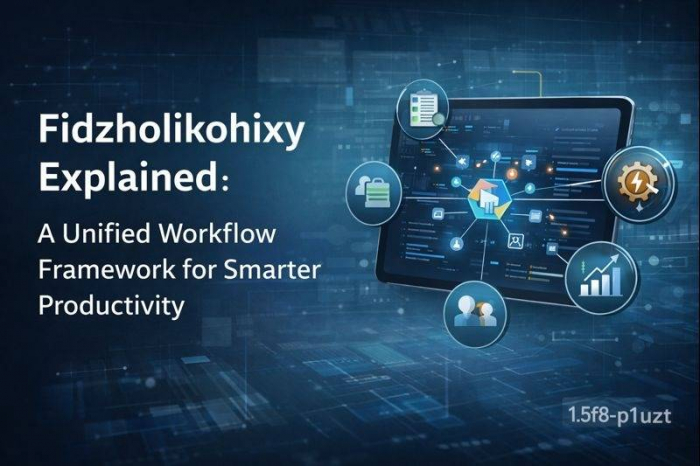
Fidzholikohixy refers to a conceptual productivity framework or next-generation workflow ecosystem, not a single app or software you install. In current usage, it describes an idea: bringing fragmented work functions—tasks, automation, collaboration, and analytics—into one unified system.
The core idea is simple:
Instead of managing work across dozens of disconnected tools, Fidzholikohixy represents a centralized structure where everything related to work lives, connects, and informs each other.
It’s often discussed as a model or approach that organizations aim for when designing smarter, more efficient workflows.
Modern work is fragmented.
A typical knowledge worker may switch between:
● email for communication
● a to-do app for tasks
● a calendar for scheduling
● chat tools for quick decisions
● spreadsheets or dashboards for reporting
This constant context switching slows people down and increases mistakes.
Fidzholikohixy exists to address problems like:
● duplicated work across tools
● information scattered in multiple places
● manual updates and follow-ups
● lack of visibility into progress
Simple example:
If a task is discussed in chat, assigned in a task tool, tracked in a spreadsheet, and reviewed in a meeting, you’re managing the same work in four places. A unified workflow model aims to remove that redundancy.
While Fidzholikohixy itself is a concept, several real platforms aim for parts of the same goal.
| Tool | Primary Function | Strength | Limitation |
| Notion | All-in-one workspace | Flexible structure | Limited automation depth |
| ClickUp | Task & project management | Highly customizable | Can feel complex |
| Asana | Team task coordination | Clear task tracking | Less centralized data |
| Monday.com | Visual workflow management | Easy to adopt | Automation can be shallow |
| Zapier | Tool-to-tool automation | Powerful integrations | Not a full workspace |
Fidzholikohixy is often described as what happens when these ideas are unified, rather than choosing just one tool.
Even as a framework, its operation is usually explained in a clear sequence.
● Unified dashboard – one place to see tasks, messages, timelines, and data
● Automation engine – repetitive actions handled automatically
● Shared workspaces – teams collaborate in real time
● Built-in insights – progress and performance are visible without manual reporting
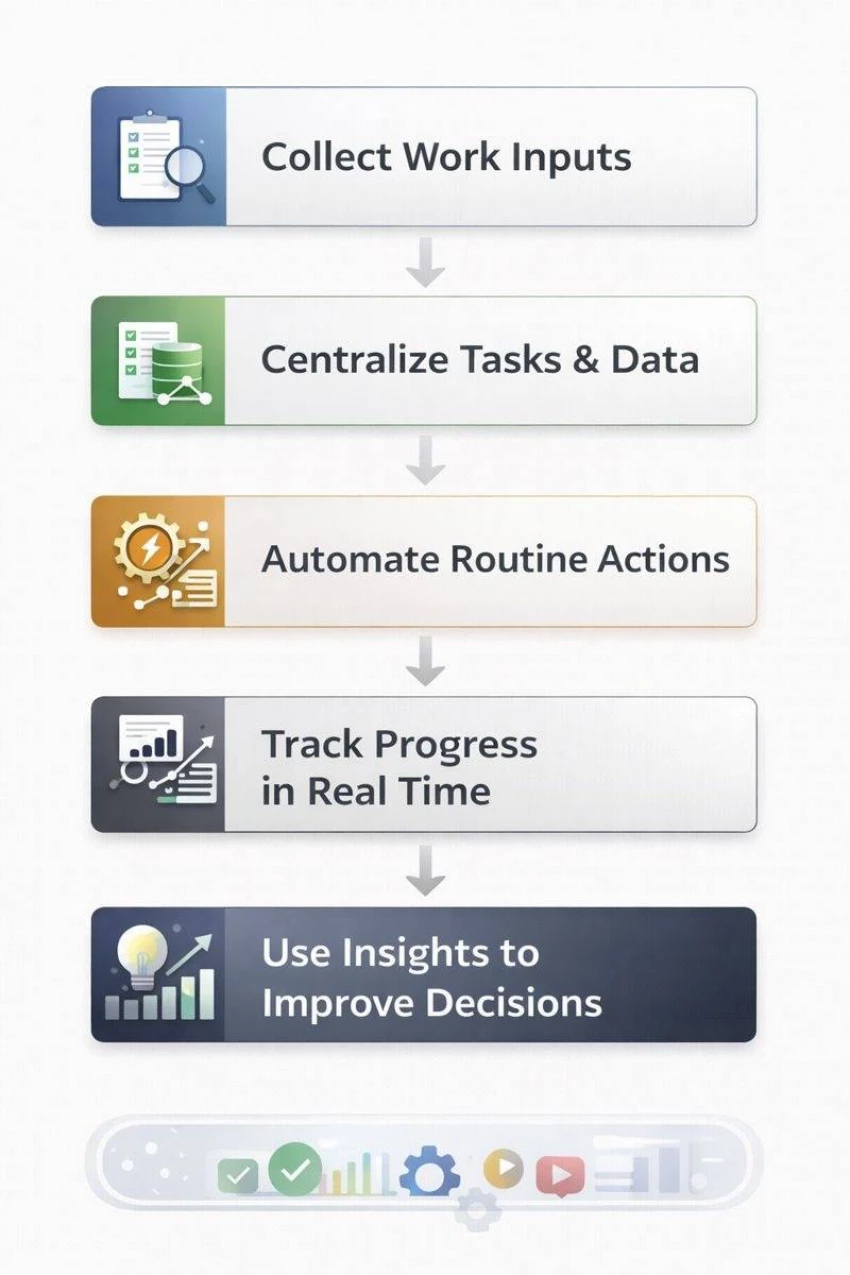
This flow replaces scattered tools with a single source of truth.
Centralized workflows improve productivity because they:
● reduce context switching
● lower the risk of missed updates
● improve coordination across teams
● make accountability clearer
When everyone sees the same system, fewer things fall through the cracks. Decisions are based on current data, not outdated reports.
● One central work hub instead of many tools
● Less manual updating and follow-up work
● Clear visibility into tasks and progress
● Flexible structures that adapt to different teams
| Benefit | What It Improves |
| Centralization | Fewer disconnected tools |
| Automation | Saves time on repetitive work |
| Visibility | Better tracking and accountability |
| Flexibility | Works across teams and roles |
The concept itself is safe—it’s just an idea or framework.
However, users should be cautious of:
● unknown websites claiming to be “official” Fidzholikohixy software
● unverified downloads or extensions
● vague tools with no documentation or company details
● use well-known platforms
● check HTTPS and privacy policies
● avoid installing anything that lacks transparency

What this means in practice:
Instead of treating tasks, communication, automation, and reporting as separate systems, the Fidzholikohixy approach promotes one connected workflow. This makes it easier to see how work moves from idea → execution → outcome.
Why it matters:
Teams spend less time figuring out where things live and more time actually doing the work.
What this means in practice:
Routine actions—such as status updates, reminders, handoffs, or data syncing—are designed to happen automatically rather than manually.
Why it matters:
Automation reduces repetitive effort, lowers the risk of human error, and frees up time for higher-value tasks like planning and problem-solving.
What this means in practice:
Work is shared in a central space where updates, discussions, and progress are visible to everyone involved.
Why it matters:
Teams stay aligned without constant meetings or follow-ups, and collaboration becomes more transparent and less dependent on individual memory or manual updates.
What this means in practice:
Instead of jumping between multiple apps for related work, information is linked and contextualized within one workflow.
Why it matters:
Less context switching leads to better focus, fewer missed details, and a clearer understanding of priorities.
What this means in practice:
Fidzholikohixy is a conceptual framework, not an app you can download and start using immediately.
Why it matters:
Teams must build or approximate the approach using existing tools, which requires planning and intentional setup rather than instant adoption.
What this means in practice:
Because it describes how systems should work together, new users may struggle to understand it without concrete examples or guidance.
Why it matters:
Without clear onboarding or documentation, people may find it difficult to translate the idea into daily habits or workflows.
What this means in practice:
The framework relies on integrating current platforms (task managers, communication tools, automation services) rather than replacing them outright.
Why it matters:
The quality of the experience depends heavily on how well those tools integrate and how consistently the system is maintained.
What this means in practice:
Designing a unified workflow means deciding:
● what gets automated
● where data lives
● how teams interact with the system
Why it matters:
Poor setup can lead to confusion instead of clarity, so success depends on careful planning and periodic refinement.
Unified workflow ecosystems are gaining attention due to:
● remote and hybrid work
● growing automation needs
● demand for real-time visibility
Plausible future directions include:
● smarter automation using AI
● deeper analytics built into workflows
● tighter integrations across platforms
Rather than disappearing, frameworks like Fidzholikohixy are likely to influence how future productivity systems are designed.

| Fragmented Approach | Unified Workflow Model |
| Tasks in one app | Tasks in one hub |
| Communication in another | Communication linked to tasks |
| Reports built manually | Insights generated automatically |
| Frequent context switching | Continuous flow of work |
Fidzholikohixy is not a product—it’s a way of thinking about work.
It represents the shift toward centralized, automated, and insight-driven workflows, helping teams reduce friction and focus on meaningful outcomes instead of managing tools.
Be the first to post comment!

Managing remote employees is very different from managing people in an office. W...
Sakshi Dhingra1 week ago

A school gradebook sounds like a simple thing until you watch what happens when...
Sakshi Dhingra1 week ago
The Growing Buzz Around EditPro in the AI Editing SpaceIn 2026, the name “EditPr...
Sakshi Dhingra1 week ago
When I first started deploying large language models, I assumed that choosing th...
Sakshi Dhingra2 weeks ago
Few software websites have survived as many internet eras as Softonic. Launched...
Suraj Malik1 month ago
PDF files are everywhere, from business contracts and academic papers to invoice...
Suraj Malik1 month ago