
There is a particular kind of disruption that the technology industry handles poorly: the kind that arrives without warning, makes no argument for itself, and simply wins. Newcomers are supposed to introduce themselves. They are supposed to explain what problem they solve and why they are better than what came before. They are supposed to give analysts time to form opinions before the market does.
HappyHorse 1.0 did none of this. In the first week of April 2026, a model bearing that name appeared at the top of the Artificial Analysis Video Arena - a leaderboard built on thousands of blind human comparisons - and beat every commercial model in both Text-to-Video and Image-to-Video categories. There was no press release. No team page. GitHub and HuggingFace links that said only: “Coming soon.”
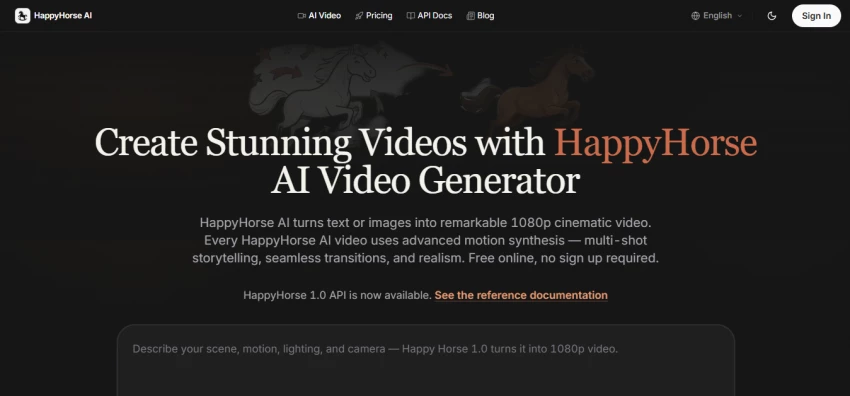
The AI community did what it always does: it speculated, dissected, reverse-engineered what it could, and gradually assembled a picture of what HappyHorse 1.0 actually is. This article compiles the most technically substantive details that have emerged, with honest flags on what remains unverified, and explains why several of its architectural choices are genuinely interesting regardless of who built it.
| “Eight thousand blind human votes don’t lie. The model won 80% of head-to-head matchups against Ovi 1.1 and nearly 61% against LTX 2.3.” |
The Artificial Analysis Video Arena works through blind A/B comparison. A human evaluator sees two video clips generated from the same prompt and votes for the better one, without knowing which model produced either. Votes aggregate into an Elo rating - the same scoring system used in chess rankings - where winning against a strong opponent earns more points than winning against a weak one.
HappyHorse 1.0 scored approximately 1,333 Elo in Text-to-Video and 1,392 Elo in Image-to-Video on its debut. For context, Seedance 2.0 from ByteDance - the prior leader - scored in the 1,250 range for T2V. Kling 3.0 Pro sat around 1,220. Ovi 1.1 and LTX 2.3 were further back. The margin was not cosmetic.
One detail worth noting: the arena’s dataset skews heavily toward portrait and dialogue content - talking heads, product spokespersons, interview formats. These account for more than 60% of evaluated clips. This is exactly the class of video where HappyHorse 1.0 is strongest, given its native audio-visual synchronization. Ask it to render a storm at sea or a high-speed action sequence, and the gap over competitors narrows. The leaderboard reflects a real advantage, but a specific one.
| Model | T2V Elo | I2V Elo | Native Audio | Open Source | Steps |
| HappyHorse 1.0 | 1,333+ | 1,392+ | Yes (joint) | Promised | 8 |
| Seedance 2.0 | ~1,250 | ~1,270 | No | No | 25–50 |
| Kling 3.0 Pro | ~1,220 | ~1,260 | No | No | 25–50 |
| Ovi 1.1 | ~1,180 | ~1,190 | No | No | 25–50 |
| LTX 2.3 | ~1,150 | ~1,160 | No | Partial | 25 |
| Wan 2.2 A14B | ~1,189 | ~1,195 | No | Yes | 25–50 |
| ⚠️ NOTE: Elo scores above are approximate and sourced from community-compiled data as of April 2026. The Artificial Analysis arena updates continuously as more votes are cast. |
Most AI video generation systems today are pipeline architectures: a text encoder processes the prompt, a video diffusion model generates frames, a separate audio model scores them, and a third system - often a specialize lip-sync tool like Wav2Lip or SyncNet - aligns the mouth movements to the audio track. Each handoff introduces latency, potential drift, and a seam that attentive viewers can spot.
HappyHorse 1.0 collapses this pipeline into a single forward pass.
The model is described as a 40-layer unified self-attention Transformer with a “sandwich” layout. The name describes the structure precisely:
| Layer Range | Role | What Happens Here |
| Layers 1–4 | Modality-Specific Input | Separate projections for text, image, video & audio tokens |
| Layers 5–36 | Shared Middle (32 layers) | All modalities share parameters - cross-modal alignment happens here |
| Layers 37–40 | Modality-Specific Output | Separate decoders produce video frames + audio spectrograms |
The critical insight is what happens in those middle 32 layers. Because all modality tokens - text, image latents, video frames, audio spectrograms - are processed together through shared-parameter attention, the model learns cross-modal alignment implicitly during training. There are no dedicated cross-attention branches, no explicit bridges between the video stream and the audio stream. The alignment emerges from the shared representation itself.
This is architecturally different from systems like Sora or Seedance, which maintain separate processing streams for different modalities and inject conditioning signals through cross-attention. The single-stream approach is more parameter-efficient for the modalities it handles and more naturally produces temporally coherent output. The tradeoff is training complexity: teaching a single Transformer to handle four modalities simultaneously requires carefully balanced training data and learning rate schedules.
Community analysis notes that HappyHorse 1.0 uses per-head sigmoid gating instead of the standard softmax attention across all heads. In conventional multi-head attention, softmax normalizes attention weights across all tokens in a sequence. With sigmoid gating, each head independently decides how much to attend to each token without normalizing against others.
The practical effect is that the model can attend strongly to multiple tokens simultaneously - useful when generating a video frame that must simultaneously reference the text prompt, the previous frame, and the corresponding audio spectrogram. Softmax attention creates competition between tokens; sigmoid gating removes it. For multimodal tasks, this reduces the risk of one modality drowning out another in the attention computation.
Standard diffusion models condition each denoising step on an explicit timestep embedding - a scalar value injected into the model that tells it “how noisy is the current input?” HappyHorse 1.0 reportedly removes this, instead inferring denoising state directly from the noise level of the input latents themselves.
This simplification reduces model complexity and removes a potential source of error (incorrect timestep injection), but it places higher demands on the model’s ability to read signal-to-noise ratios in the latent space. That the model apparently does this successfully at scale is notable.
| “The alignment between audio and video isn’t produced by a post-processing step. It emerges from the shared representation space in those 32 middle layers.” |
The other major story in HappyHorse 1.0 is not quality - it’s speed. Standard diffusion models require 25 to 50 denoising steps to produce high-quality output. Each step is a full Transformer forward pass. At 15 billion parameters, that is expensive. HappyHorse 1.0 generates 1080p video in 38 seconds on a single H100. It does this through two mechanisms.
Distillation is the process of training a smaller or faster “student” model to replicate the output of a larger or slower “teacher” model. DMD-2 (Distribution Matching Distillation v2) is a technique that trains a distilled variant of a diffusion model to produce equivalent outputs in far fewer steps by matching the output distribution of the full model rather than trying to match each individual step.
The key property of DMD-2 is that it eliminates the need for Classifier-Free Guidance (CFG) at inference. CFG is a widely used technique that doubles the number of forward passes per step - once with the text prompt, once without - and combines them to improve prompt adherence. Removing CFG effectively halves the compute cost per step, on top of the step reduction from distillation itself.
The net result: from 50 steps with CFG (100 effective forward passes) down to 8 steps without CFG (8 forward passes). That is a roughly 12× reduction in theoretical compute, which maps approximately to the observed speed gains.
| Output Quality | Time on H100 | Notes |
| 5-sec clip @ 256p (preview) | ~2 seconds | DMD-2 + MagiCompiler |
| 5-sec clip @ 1080p (full) | ~38 seconds | DMD-2 + MagiCompiler |
| Standard diffusion @ 1080p | ~55–70 sec | 25–50 steps + CFG overhead |
On top of the algorithmic speed gain from DMD-2, HappyHorse 1.0 reportedly uses a custom inference compiler called MagiCompiler, which performs full-graph compilation with operator fusion across Transformer layers.
Standard neural network inference frameworks (PyTorch, JAX) execute operations layer by layer, writing intermediate results to GPU memory between each one. A compiler like MagiCompiler fuses multiple operations into single GPU kernels, eliminating these intermediate writes and reducing memory bandwidth consumption. The reported gain is approximately 1.2× end-to-end speedup on top of the baseline - modest but meaningful in a production context where thousands of clips are generated daily.
The combination of DMD-2 and MagiCompiler gives HappyHorse 1.0 a 2-second preview path (5-second clip at 256p) that allows creators to iterate on prompts rapidly before committing to a full 1080p render. This preview-then-render workflow is practically significant for production pipelines.
| “From 100 effective forward passes down to 8. That’s the math behind the 38-second 1080p render time.” |
The most commercially distinctive capability of HappyHorse 1.0 is its native audio-visual co-generation. Most AI video systems generate audio as a separate step: the video is rendered, then an audio model scores it, then a lip-sync system re-animates the mouth to match. This relay approach introduces timing drift, and the result is often detectable - audio that sounds attached to the video rather than emerging from it.
Because HappyHorse 1.0 processes audio spectrograms and video latents in the same token sequence through the same attention layers, the relationship between them is learned during training. The model doesn’t decide “this word sounds like this” at inference time through a separate lookup; it has internalized the relationships between phonemes, facial geometry, and temporal position across all training samples.
The model reports a Word Error Rate (WER) of 14.60% for lip-sync across supported languages. WER measures the percentage of words where the generated mouth motion doesn’t match the audio signal. At 14.60%, HappyHorse 1.0 sits substantially below most competing systems, which typically report WERs in the 25–40% range for non-English languages.
Native multilingual support covers English, Mandarin Chinese, Cantonese, Japanese, Korean, German, and French. The distinction from most multilingual video tools is that HappyHorse 1.0 was trained on speech data in each of these languages directly - it doesn’t translate English phoneme patterns to other languages. Cantonese and Mandarin have different tonal structures and require different mouth geometries for identical syllables; training them separately (or as distinct language heads) rather than as a generalization of Mandarin is the correct approach.
Beyond speech, HappyHorse 1.0 generates Foley effects and ambient sound - the background audio that makes a scene feel real. A clip of someone walking across gravel generates footstep sounds. A video of rain generates rain audio. These aren’t retrieved from a sound library; they are generated by the same Transformer that generates the video frames, synchronized to the same temporal positions.
This is particularly useful for short-form content creators and marketing teams, who previously needed to source and edit audio separately even when using AI video tools.

HappyHorse 1.0 has marketed itself as open source, and this has generated significant community interest. The model claims it will release: a base model, a distilled model, a super-resolution module, and inference code - all under a commercial-friendly license.
As of April 2026, none of this is available. GitHub and HuggingFace repositories associated with the project show “Coming Soon” placeholders. Independent analysts have noted that no third party has been able to verify the 15B parameter count, the architecture details, or the inference speed claims through local deployment, because there are no weights to deploy.
| ⚠️ NOTE: The open-source release status should be confirmed before making infrastructure decisions that depend on self-hosted inference. The API at happyhorse.app/docs is the only currently verifiable access path. |
This does not necessarily indicate bad faith. Large model releases are logistically complex: weights must be sanitized of training data artifacts, documentation must be prepared, licenses must be finalized. The gap between “will release” and “has released” is normal in this industry. But it is a gap, and it matters for any team whose workflow depends on self-hosted inference.
For comparison: Wan 2.2 A14B (Alibaba’s other publicly known video model) is fully available on HuggingFace with independently verifiable weights. WAN’s T2V Elo sits around 1,189 - significantly below HappyHorse’s claimed scores. This has led some community members to speculate that HappyHorse-1.0 and WAN 2.7 (an unreleased next version) may be related or identical. No evidence has confirmed this.
| “The architecture description is specific enough to be falsifiable. When weights land, someone will verify or contradict it within hours.” |
Three days after the leaderboard appearance, a newly registered X (Twitter) account attributed HappyHorse-1.0 to Alibaba’s ATH-AI Innovation Division, a unit described as spun out of the Taobao and Tmall Group’s Future Life Lab. The team is reportedly led by Zhang Di, a former Kuaishou VP who previously oversaw the technical development of Kling AI.
The name itself is culturally significant. 2026 is the Year of the Horse in the Chinese lunar calendar. In Mandarin AI circles, the model has been described as “黑马变马首” - the dark horse that became the lead horse. The branding was intentional.
The stealth launch strategy - releasing through a pseudonymous leaderboard submission rather than a press event - reflects a pattern in the Chinese AI ecosystem. The Pony Alpha situation in February 2026 is the closest precedent: a mystery model appeared on OpenRouter, triggered a guessing game, and turned out to be Z.ai’s GLM-5 running a stealth stress test. Benchmarks as PR. Outputs before explanations.
Whether Alibaba is the actual origin or a convenient attribution remains technically unverified. What is verifiable is the output quality, as judged by thousands of blind human votes on an independent platform. The benchmarks are real. The architecture claims are specific and falsifiable. The weights, when they arrive, will settle everything else.

Based on the documented capabilities, HappyHorse 1.0 offers the most differentiated value in the following contexts:
A single model that generates synchronized dialogue in seven languages, without a dubbing pipeline, dramatically reduces the cost of localized video content. For brands operating across East Asia, Europe, and English-speaking markets simultaneously, this is a meaningful operational change.
The model’s strongest benchmark results are in portrait-format, dialogue-heavy clips. Marketing campaigns built around digital spokespersons, product demos with voiceover, and educational content are all well-served by the native audio-visual architecture.
RAPID CREATIVE ITERATION
The 2-second 256p preview mode changes the iteration loop. Creators can test prompt variations, camera directions, and style parameters at speed, committing GPU budget only to the final approved concept. This workflow benefit exists independent of the quality ceiling.
If the weights release as promised, HappyHorse 1.0 would be the first open-source model combining native joint audio-video synthesis with competitive frontier quality. The research implications are significant: fine-tuning for specific domains (medical training videos, legal depositions, game cinematics) becomes accessible to teams without closed-model API budgets.
Complex outdoor environments, high-motion action content, and abstract or stylized video (architectural visualization, abstract art) are categories where the evaluation data does not strongly favor HappyHorse 1.0 over Kling or a well-configured Seedance. The leaderboard distribution matters here.
Strip away the drama of the stealth launch, and what remains is a set of engineering choices that are worth understanding on their own terms. The unified Transformer approach for audio-visual co-generation is the right direction for the field - the relay pipeline is a historical artifact of separate research communities, not an optimal architecture. DMD-2 distillation without CFG is a proven technique that HappyHorse 1.0 has applied effectively at commercial scale. Per-head sigmoid gating for multimodal fusion is a refinement worth watching.
The open-source claim, if fulfilled, would make this the most capable open video model in existence by a substantial margin. That the model hasn’t delivered on this yet is a meaningful caveat. That it has delivered on benchmark performance, as measured by independent blind evaluation, is a meaningful fact.
Chinese AI labs have been building toward this position for years. HappyHorse 1.0 is one data point in a broader shift: the frontier of AI video is no longer located exclusively in San Francisco. The next generation of video models will be built globally, and the teams doing the most interesting architecture work are increasingly operating without press releases, without founder cults, and without waiting for permission from the existing narrative.
The horse came out of nowhere. The interesting question is what it was training on while nobody was watching.
Be the first to post comment!

Before I Get Into ItI want to be upfront about how this article came to be, beca...
Suraj Malik5 hours ago

The Moment the Magic Wears OffThere's a pattern I've noticed - and I suspect any...
Suraj Malik7 hours ago

Let's start with something most review sites won't say out loud: Gauth AI is gen...
Suraj Malik1 day ago

CrossMarket AI first caught attention because its pitch is genuinely compelling:...
Suraj Malik1 day ago

ThinkWave has been doing its job quietly for years. Grade entry. Attendance. Rep...
Suraj Malik1 day ago

The AI character chat space has grown fast. PolyBuzz has 20 million characters a...
Suraj Malik2 days ago