In 2026, AI in sales no longer means simple automation or rule-based tools. It refers to deeply integrated intelligence embedded across the sales workflow—combining predictive analytics, generative AI, conversational AI, and real-time decision support.
What’s changed is not just the technology, but the environment:
● Buyers expect faster, more relevant interactions
● Sales teams operate with massive volumes of behavioral and CRM data
● Competitive pressure leaves little room for intuition-only decision-making
AI capabilities in sales now sit inside CRMs, engagement platforms, pricing engines, and forecasting systems, actively guiding daily decisions. The question in 2026 is no longer “Should we use AI?”—it’s “How well is AI shaping our sales execution?”
Sales organizations already use AI across multiple parts of the funnel. These are operational capabilities, not experimental features.
| AI Capability | Core Value | Example Use Case |
| Predictive lead scoring | Prioritizes accounts with highest conversion likelihood | SDRs focus on top 20% of leads driving majority of pipeline |
| Automated outreach (AI messaging) | Scales personalized communication | AI-generated emails adapt tone based on buyer behavior |
| Conversational AI (chat & voice) | Engages buyers instantly | AI chat qualifies inbound leads 24/7 |
| Real-time sales coaching | Improves rep performance during deals | AI suggests next best action after a call |
| ML-based forecasting | More accurate pipeline projections | Forecast error reduced quarter over quarter |
| AI-driven pricing guidance | Optimizes deal value | Discount recommendations based on win-loss data |
These tools don’t replace sellers—they filter noise, surface insight, and recommend action.
AI doesn’t just make existing sales tasks faster; it changes the way sales decisions are made and acted on. The biggest shift is moving from hindsight-driven management to real-time, forward-looking execution.
Before AI:
Sales teams often discover problems late—after a deal has stalled, a quarter is missed, or a pipeline review reveals gaps. Action happens after damage is already done.
With AI:
AI continuously monitors deal behavior, such as:
● reduced buyer engagement
● stalled next steps
● unusual deal patterns
It can flag risk early, allowing reps and managers to intervene while there is still time to recover the deal.
Why this matters:
Instead of reacting to missed targets, teams actively prevent losses before they happen.
Before AI:
Sales decisions often rely on:
● individual experience
● intuition
● anecdotal success stories
While experience matters, it doesn’t scale across hundreds or thousands of deals.
With AI:
Machine learning analyzes patterns across:
● historical wins and losses
● buyer behavior
● deal velocity
● pricing sensitivity
Decisions—such as which leads to pursue or how aggressively to discount—are guided by statistical signals, not assumptions.
Why this matters:
AI reduces bias and inconsistency, helping teams make repeatable, data-backed decisions even as they scale.
Before AI:
Pipeline health is typically reviewed:
● weekly
● monthly
● or during forecast calls
Data can be outdated, incomplete, or manually updated.
With AI:
AI systems track pipeline changes continuously, identifying:
● deals at risk
● unusually long sales cycles
● over-optimistic close dates
This creates a living, up-to-date view of revenue health.
Why this matters:
Leaders gain confidence in forecasts and can adjust strategy earlier, not at quarter-end.
AI doesn’t replace salespeople—it redefines where their time and skills create the most value. Routine, repetitive work is increasingly handled by AI, while humans focus on judgment, relationship-building, and complex decision-making.
● SDRs manually qualify every inbound lead, spending large portions of the day researching, scoring, and filtering prospects—many of whom never convert.
● Account Executives rely heavily on personal experience to decide next steps, pricing, or follow-up timing, which can lead to inconsistent results.
● Sales operations teams spend hours building reports and forecasts, often reconciling data from multiple systems.
This model is time-consuming and reactive.
● SDRs focus on high-intent conversations because AI filters and prioritizes leads based on likelihood to convert.
● AEs receive AI-recommended actions, such as which deal to push, when to follow up, or how to position pricing based on similar past deals.
● Sales ops automates reporting and forecasting, allowing teams to shift attention from data collection to strategic planning.
The workflow becomes faster, more consistent, and more proactive.
Instead of building lists and chasing cold leads, SDRs:
● engage prospects who are already showing buying signals
● spend more time understanding needs and qualifying fit
Impact: higher-quality pipeline and less burnout.
AEs still own relationships and negotiations, but AI supports them by:
● highlighting deal risks
● suggesting next-best actions
● recommending pricing or discount ranges
Impact: shorter sales cycles and more predictable outcomes.
Sales ops teams move away from manual dashboards and spreadsheets and toward:
● monitoring pipeline health in real time
● advising leadership on capacity, coverage, and risk
● refining AI models with better data inputs
Impact: ops becomes a strategic partner, not a reporting function.
The impact of AI sales tools shows up in measurable business metrics.
| Metric | Before AI | With AI Capabilities |
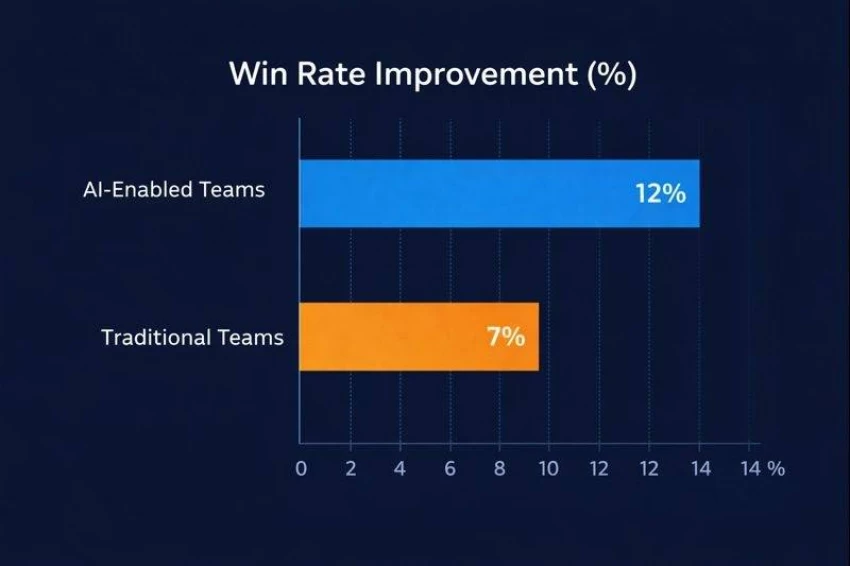
| Win rate | Baseline | +5–15% |
| Sales cycle length | Baseline | −10–25% |
| Forecast accuracy | ±20–30% variance | ±10–15% variance |
| Quota attainment | Uneven | More consistent |
| Customer retention | Baseline | +5–10% |
The gains are incremental per metric—but transformational in aggregate.
AI in sales is not plug-and-play. The risks are real—and manageable.
1. Data quality problems
AI amplifies bad data if inputs are flawed.
2. Tool sprawl & integration issues
AI loses value when systems don’t talk to each other.
3. Adoption resistance
Reps won’t trust AI if it feels opaque or punitive.
4. Ethical & compliance risks
AI-generated communication must align with brand and regulation.
● Clean CRM data before scaling AI
● Start with one or two high-impact use cases
● Make AI explainable (why a recommendation exists)
● Establish clear AI usage and governance guidelines
Leadership—not technology—is usually the bottleneck.
Looking ahead, the trajectory is clear—without speculation.
AI will increasingly act as a support layer throughout the sales funnel—from prospecting to renewal. Instead of replacing sellers, AI will assist with research, recommendations, and follow-ups, while humans handle relationship-building, negotiation, and judgment. The result is a more balanced division of work between people and systems.
AI models will become better at interpreting signals such as:
● website visits and content engagement
● product usage patterns
● email and meeting interactions
By combining these signals, sales teams can identify when a buyer is actively considering a purchase, not just who fits an ideal profile. This allows for better timing and more relevant outreach.
Rather than setting static price lists or discount rules, AI will support pricing decisions dynamically. During active deals, AI can suggest:
● optimal discount ranges
● negotiation strategies based on similar past deals
● pricing adjustments as deal conditions change
This helps sellers protect margins while remaining competitive.
AI copilots will increasingly operate inside the tools sellers already use, such as call platforms and CRMs. These copilots can:
● summarize conversations automatically
● highlight objections or risks
● recommend next steps immediately after interactions
This reduces administrative work and helps sellers act faster and more consistently.
The evolution of sales follows a clear arc:
In 2026, AI capabilities in sales are no longer optional for competitive organizations. They are the mechanism through which sales teams:
● prioritize effectively
● act faster
● forecast more accurately
● and engage buyers with relevance
Sales leaders who invest now—in data foundations, AI literacy, and responsible governance—will define the next decade of revenue performance. Those who delay will find themselves competing against teams that don’t just sell harder, but sell smarter.
Be the first to post comment!