Foxtpax is described in several 2026 web articles as a cloud-based, modular business-management platform. Most of these write-ups say it brings CRM, workflow automation, finance, reporting, team collaboration, and, in some cases, a foreign-exchange trading module into one connected system.
On paper, the idea sounds useful. Instead of a business using separate tools for customers, projects, accounts, reports, messaging, and finance, Foxtpax is presented as one platform that keeps everything under a shared data layer with conditional automation running in the background.
The claimed use cases are broad. Different sources mention retail, healthcare, finance, professional services, and even enterprise operations. Deployment is also described as flexible, with SaaS, private-cloud, on-premise, and hybrid options. Some articles also mention REST APIs, Python and Node.js SDKs, and integrations with other business tools.
But this guide is not just about repeating those claims. The main finding is about verification. Many of the biggest Foxtpax claims could not be traced back to official vendor documentation, independent testing, public reviews, or trusted software directories. In fact, the vendor’s own website appears to describe a different kind of product, focused more on encrypted decentralised storage than on a full business-management suite.
So the practical advice is simple: treat Foxtpax as something that needs direct vendor verification before any business commits money, data, or migration time to it. A due-diligence checklist is included near the end of this guide.
Editorial Note: How We Evaluated Foxtpax
This evaluation is based on publicly available information from the Foxtpax website, related third-party articles, and visible product claims available at the time of review. We did not have access to a verified live dashboard, customer account, admin panel, pricing quote, API documentation, security report, or customer reference call.
Because of that, this article should not be read as a hands-on product review. It is a practical business evaluation of the information currently available online. Wherever a feature is not confirmed by official documentation or direct testing, it is clearly treated as a reported or unverified claim.
That distinction matters because Foxtpax is described differently across the web. The official Foxtpax page appears to focus mainly on encrypted storage, client-side encryption, decentralized file protection, and data sovereignty. However, several secondary sources describe it as a broader business-management platform with CRM, workflow automation, finance, collaboration, and compliance features. Until Foxtpax publicly connects these descriptions through clear documentation, buyers should verify the product directly before making any software decision.
Sourcing and Verification Method
Because Foxtpax is discussed as a software product that businesses may actually consider buying, the quality of the sources matters a lot. A platform can sound impressive in SEO articles, but buyers need something stronger before trusting it with customer records, finance workflows, or operational data.
For this guide, public information about Foxtpax was reviewed in June 2026. The available sources were checked for authority, consistency, and whether their claims could be confirmed through vendor documentation or independent software-review platforms.
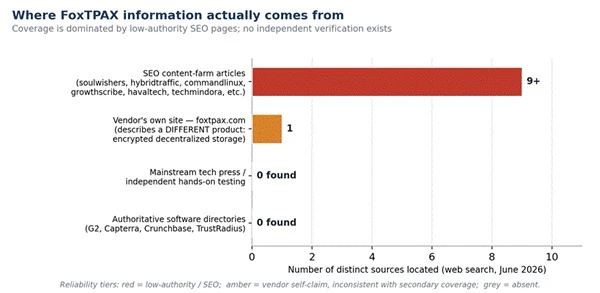
Figure 1. Distribution of locatable Foxtpax sources by reliability tier, based on web search in June 2026.
The pattern is clear. Most public coverage around Foxtpax comes from low-authority SEO-style articles. These include near-identical “Information About Foxtpax Software” posts published across websites such as Soulwishers, HybridTraffic, CommandLinux, GrowthScribe, HavalTech, TechMindora, and DailySparkMagazine.
What is missing is more important than what is present. The usual buyer-trust sources, such as G2, Capterra, Crunchbase, and TrustRadius, do not appear to show a clear Foxtpax listing. No independent hands-on review, mainstream technology coverage, or detailed customer case study was found.
The only vendor-controlled source, Foxtpax.com, seems to focus on encrypted decentralised storage rather than the broad CRM, workflow, finance, and FX platform described in many third-party articles.
This creates a trust problem. When a product is surrounded mainly by repetitive SEO content, but lacks clear vendor documentation and independent validation, it becomes difficult to know which claims are real, outdated, exaggerated, or simply copied from one article to another.
For that reason, this guide uses careful language. Words like “described,” “claimed,” and “reported” mean the information appears in secondary sources but has not been independently confirmed. When something is marked as “unspecified” or “not publicly available,” it means no reliable public source was found to support it.
Hands-On Testing Status
We could not complete a full hands-on test because a verified live product account, trial environment, admin dashboard, or sandbox was not available through the public information reviewed.
For a proper hands-on review, the following areas would need to be tested directly:
Account setup and onboarding flow
Dashboard navigation and user experience
File upload, encryption, storage, and recovery process
Admin controls and user-permission settings
Workflow automation, if available
CRM or finance modules, if available
API access, webhooks, and integrations
Export options and data portability
Support response quality
Security documentation and compliance evidence
Until these items are tested in a real environment, the article should remain a cautious evaluation rather than a final product recommendation.
What Is Foxtpax Software?
Foxtpax is difficult to define with complete confidence because public descriptions do not fully agree with each other.
The most reliable starting point is the official Foxtpax website. Its own product page presents Foxtpax mainly as a data-protection and secure-storage system built around client-side encryption, decentralized storage, distributed file shards, and data sovereignty. In that version, the product is less like a normal CRM or project-management tool and more like a secure file-storage or privacy-focused infrastructure platform.
Secondary sources describe Foxtpax more broadly. Some articles present it as an all-in-one business operations platform with CRM, workflow automation, finance dashboards, collaboration tools, integrations, and even FX or compliance-related functions. Those claims may be connected to a wider product roadmap, a separate module, or repeated interpretation from older sources, but they are not clearly supported by public vendor documentation.
The safest conclusion is this: Foxtpax appears to be a real web presence with security-focused positioning, but its wider business-software claims need direct confirmation. A buyer should not assume it offers CRM, finance, compliance, or workflow modules unless the vendor provides a live demo, written feature list, pricing, security documentation, and customer proof.
The Real Business Risk: Category Confusion
The main risk with Foxtpax is not simply whether the software has enough features. The bigger issue is category confusion.
If Foxtpax is mainly a secure storage platform, then buyers should compare it with encrypted storage, privacy-first file sharing, backup, and data-protection tools. In that case, the most important questions are encryption standards, key management, recovery, data residency, uptime, redundancy, and access control.
If Foxtpax is actually a business-management platform, then buyers should compare it with CRM, project-management, automation, ERP-lite, and collaboration tools. In that case, the important questions change completely: lead management, task automation, reporting, integrations, user roles, onboarding, workflow design, pricing per seat, and support quality.
This difference matters because a secure-storage platform and an all-in-one business operations platform solve different problems. A company looking for workflow automation may be disappointed if the real product is closer to secure storage. A company looking for encrypted file protection may not need CRM-style claims at all.
That is why the first question for Foxtpax is not “Is it good?” The first question is “Which product category does it actually belong to today?”
The Verification Picture
The biggest issue with Foxtpax is not that the claimed feature list is weak. In fact, the list sounds quite strong. The issue is that the claims are difficult to verify.
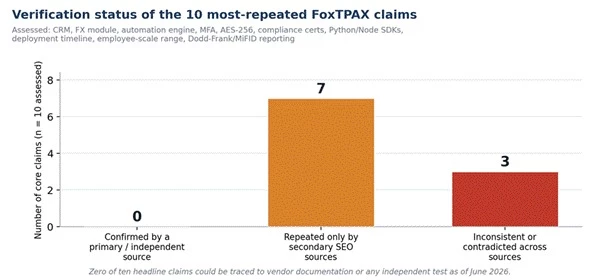
Figure 2. Verification status of the ten most-repeated Foxtpax claims.
The most repeated claims include the CRM module, FX-trading module, automation engine, multi-factor authentication, AES-256 encryption, compliance certifications, Python and Node.js SDKs, deployment timeline, employee-scale range, and Dodd-Frank or MiFID II reporting.
None of these headline claims could be clearly confirmed from vendor documentation or an independent hands-on test. Several appear only in repeated secondary articles, while others vary from source to source.
That matters because repetition is not proof. A claim does not become reliable simply because several low-authority websites repeat it in similar wording.
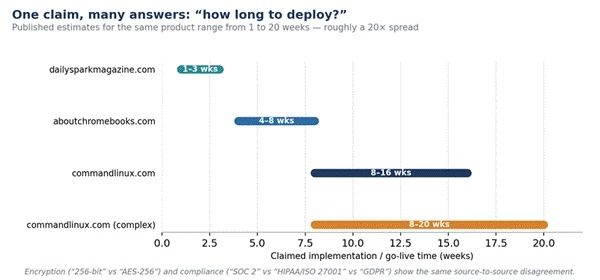
Figure 3. A single claim, time to deploy, reported in different ways.
The deployment timeline is a good example of the contradiction problem. Some sources suggest setup could take around one or two weeks. Others describe longer timelines that stretch to several months, depending on the deployment model.
That is a major difference for a buyer. A one-week setup and a twenty-week implementation are completely different business decisions.
The same inconsistency appears in other areas too. Encryption is described in different ways, compliance claims vary across articles, and the exact product focus does not clearly match the vendor site.
When multiple reliable sources describe the same product, the details usually start to align. With Foxtpax, many details do not.
Architectural Design and Scalability
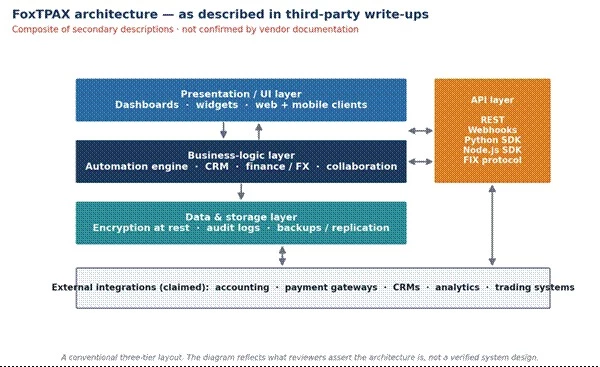
Secondary descriptions generally present Foxtpax as having a conventional three-layer architecture: a presentation layer, a business-logic layer, and a data layer. One source also suggests that the platform may support both monolithic and microservices deployment, allowing some parts of the system to scale independently during high demand.
This sounds technically reasonable, but it should be read as a composite description from third-party articles, not as confirmed system architecture.
Figure 4. Foxtpax layered architecture as described in third-party write-ups, unverified.
Presentation Layer
The presentation layer is described as the user-facing part of the platform. It reportedly includes role-based dashboards, custom widgets, browser access, and native iOS and Android apps.
Most reviews present this layer as easier to use than older ERP-style screens. The idea is that different teams can see the information most relevant to them without needing to move through complex menus.
Business-Logic Layer
The business-logic layer is where the main platform actions are said to happen. This includes automation rules, CRM workflows, finance processing, FX-related tools, collaboration features, and reporting.
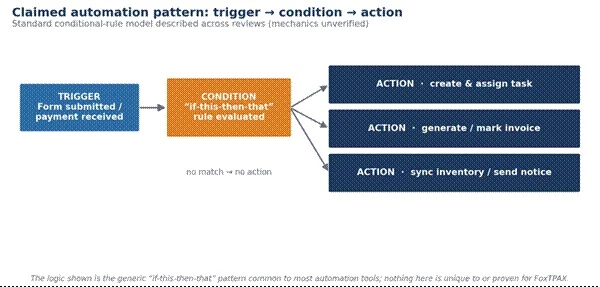
The automation engine is the most commonly mentioned feature. It is described as a conditional-rule system where a defined trigger causes the platform to perform a specific action. For example, a new customer enquiry could create a CRM record, assign a task, notify a team member, and start a follow-up workflow.
Data and Storage Layer
The data layer is described as handling encryption at rest, audit logs, automated backups, point-in-time recovery, and geographic replication.
This is also where the biggest mismatch appears. The vendor’s own site seems to focus heavily on encrypted, sharded, decentralised storage under the PaxCrypt concept. However, the third-party articles describe Foxtpax more like a business-management platform with CRM, finance, collaboration, and workflow automation.
Until the vendor clearly explains this difference, buyers should treat the broader platform description as unconfirmed.
Core Functional Modules
Most articles group Foxtpax into four main functional areas: workflow automation, CRM, finance and compliance, and team collaboration.
Figure 5. The claimed trigger-based automation pattern: trigger, condition, and action.
Unified Workflow Automation
Foxtpax is commonly described as offering trigger-based automation. In simple terms, this means one event starts a workflow. That event could be a form submission, a closed deal, a new invoice, an approaching deadline, or a change in inventory.
The platform is then said to check conditions and perform the next action automatically. For example, it may assign a task, update a customer record, create a reminder, send a notification, or sync data with another module.
This is useful in theory because it reduces repetitive manual work. However, the exact depth of this automation engine is not publicly confirmed.
CRM and Customer Tracking
The CRM module is described as a way to manage leads, contacts, customer history, deals, and follow-ups in one place.
Sources say Foxtpax can capture leads, create tasks automatically, assign ownership, and connect customer activity with projects, invoices, or reports. Some articles also mention forecasting dashboards, although the methodology and depth behind those forecasts are not explained.
So the CRM story is clear at a high level, but not yet proven at the feature-detail level.
Finance and Compliance Tools
The finance module is described as covering real-time P&L dashboards, financial reporting, and, in some sources, FX trading features.
The FX-related claims are the most unusual and potentially the most important. Articles mention order management, market orders, limit orders, stop-loss orders, position tracking, margin checks, risk evaluation, AML/KYC checks, and regulatory reporting for frameworks such as Dodd-Frank and MiFID II.
These are serious claims. If accurate, they would place Foxtpax in a much more specialised category than a normal business-management platform. But because regulated finance software needs strong documentation, certifications, auditability, and customer proof, this is also the area where verification matters most.
At present, the public evidence is not strong enough to treat these claims as confirmed.
Collaboration and Team Workflow
The collaboration module is described in a more standard way. Sources mention shared task boards, built-in messaging, calendars, document sharing, version control, and team ownership controls.
This part of the platform sounds similar to many project-management and work-management tools. It is also the claim that fits most naturally with the broader “business operations platform” positioning.
Again, the issue is not whether such features are possible. The issue is whether Foxtpax has publicly demonstrated them in a verifiable way.
Deployment Models and Integration
Foxtpax is described as supporting four deployment models: SaaS cloud, private cloud, on-premise, and hybrid.
This flexibility would be useful for different kinds of buyers. A small or mid-sized business might prefer SaaS because it is faster to start and vendor-managed. A larger enterprise may prefer private cloud, on-premise, or hybrid deployment for greater control, security, or compliance reasons.
However, the setup timelines published across sources are inconsistent, so the figures below should be treated as rough claims rather than verified benchmarks.
Table 2. Deployment models as described, with setup times unverified and contested
Deployment
Typical setup, as claimed
Scalability
Control level
Cloud SaaS
1–2 weeks
High
Vendor-managed
Private cloud
4–6 weeks
Configurable
High
On-premise
8–12 weeks
Manual
Full control
Hybrid
6–10 weeks
Flexible
Mixed
These setup ranges come from secondary sources and have not been independently benchmarked.
Integration Surface
The integration claims are some of the most technically specific claims around Foxtpax.
Several articles mention a REST API, Python and Node.js SDKs, webhooks, pre-built connectors for accounting, CRM and payment systems, and, for the trading module, FIX-protocol adapters.
If these claims are accurate, they would matter. APIs and SDKs are important because they allow technical teams to connect a platform with existing tools, internal systems, data pipelines, reporting dashboards, and business workflows.
But this is another area where buyers should ask for direct proof. Before committing, a technical team should request API documentation, SDK examples, authentication details, webhook behavior, rate limits, sandbox access, and real integration references.
Data Security and Compliance
Across the secondary sources, the security claims follow a familiar pattern. Foxtpax is described as offering multi-factor authentication, role-based access control, encryption in transit and at rest, and audit logging.
Those are standard features for serious business software, especially if the product is expected to handle customer records, financial data, or regulated workflows.
The compliance claims are less consistent. Some sources mention SOC 2 Type II. Others mention HIPAA, ISO 27001, GDPR, or general regulatory alignment. But no clear, vendor-confirmed certification list was located publicly.
This is important because compliance is not something a buyer should assume from a blog article. If a business needs SOC 2, HIPAA, ISO 27001, GDPR, MiFID II, Dodd-Frank, or any other framework, it should request formal documentation directly from the vendor.
Security Claims and the Vendor-Site Mismatch
The vendor-site mismatch is one of the biggest caution points.
The vendor’s own material appears to focus on encryption, sharding, decentralised storage, and PaxCrypt. That sounds more like a secure storage or data-protection product.
The secondary articles, however, describe a much broader business platform with CRM, workflow automation, finance dashboards, collaboration tools, FX trading, and compliance reporting.
Those two descriptions may be connected in some way, but the connection is not clearly explained in public material. Until the vendor confirms what Foxtpax currently is, what modules it actually offers, and what security documentation is available, buyers should treat both descriptions carefully.
A security-focused buyer should ask for a current SOC 2 report or equivalent assurance document before sharing sensitive data.
Use Cases and Industry Applications
The use cases below appear repeatedly in secondary sources. They should be understood as claimed scenarios, not confirmed customer case studies.
No named customers, measurable results, or public implementation stories were found.
Retail and E-commerce Operations
For retail and e-commerce, Foxtpax is described as helping with order processing, inventory sync, customer-history tracking, and automated reorder or upsell workflows.
In a practical setup, that could mean point-of-sale data feeding into inventory updates, customer records, marketing triggers, and supply-chain actions.
The use case makes sense, but there is no public customer proof showing Foxtpax doing this in a real retail environment.
Financial Services and FX Trading
The financial-services use case is built around the claimed FX and risk-management features.
Sources describe order management, real-time margin evaluation, position tracking, risk analysis, scenario planning, and regulatory reporting. This is the most differentiated part of the Foxtpax story because many general business platforms do not claim this level of trading functionality.
It is also the area that needs the strongest proof. A business should not rely on unverified online articles for regulated finance workflows. If this use case matters, the vendor should provide documentation, references, compliance evidence, testing access, and a clear explanation of how reporting works.
Healthcare Administration
For healthcare, Foxtpax is described as supporting patient-intake workflows, appointment coordination, cross-department tasks, billing, insurance claims, and role-based access.
This is another sensitive area. Any real healthcare deployment would depend on data privacy, access controls, audit logs, and HIPAA-related documentation where applicable.
Because public evidence is limited, healthcare buyers should not treat these claims as enough on their own.
Professional Services
The professional-services use case is the easiest to understand. It includes client workflow management, time tracking, invoicing, document handling, version control, and project coordination.
This type of use case fits naturally with a general business-management platform. Agencies, consultants, legal services, accounting firms, and project-based businesses often need this kind of connected workflow.
Still, the same rule applies: ask for a demo, customer references, pricing, and real workflow testing before making a decision.
Performance and Optimization Considerations
Performance claims around Foxtpax are described in general engineering terms. Sources mention horizontal scaling, caching, load balancing, and microservices support for high-transaction environments.
These are sensible patterns. Many scalable platforms use some version of them.
But no published benchmark, load test, uptime record, latency figure, transaction-volume number, or independent performance review was found for Foxtpax specifically.
So these claims should be viewed as intended design ideas rather than measured performance results.
Implementation Roadmap
Even with the verification issues, the implementation sequence described by secondary sources follows a standard and practical software rollout pattern.
Requirements gathering. The first step is to define what workflows the business actually wants to automate. This includes identifying the data involved, the teams affected, the current pain points, and the success metrics.
Data migration and validation. Before moving to any new platform, old data needs to be cleaned, mapped, imported, and checked. This is often where implementation problems appear, especially if records are duplicated, incomplete, or stored across several tools.
Pilot and feedback. A small pilot is safer than a full rollout. Sources suggest a four-to-six-week pilot, but the exact timeline should depend on the business size, modules used, integrations required, and data complexity.
Training and support. After the pilot, the platform should be rolled out gradually. Teams need training, admin roles need to be defined, and support expectations should be clear before wider adoption.
Some sources suggest budgeting around 15–20% of total cost for ongoing administration and maintenance. That number is not verified, but it is a useful reminder that software cost is rarely limited to the subscription price alone.
Pricing Factors and Cost Structure
No official public pricing for Foxtpax could be located.
That is a notable gap because transparent pricing is one of the easiest trust signals for software buyers. Many established platforms publish at least a starting price, plan structure, or sales-assisted enterprise range. With Foxtpax, most sources simply say pricing depends on deployment, features, users, and customisation.
Because no confirmed pricing is available, it is safer to think in terms of likely cost categories.
A buyer would probably need to ask about per-user subscription costs, module-based pricing, deployment-model differences, implementation fees, customisation charges, data migration costs, integration work, training, support, and ongoing maintenance.
Private-cloud, on-premise, and hybrid deployments usually cost more than simple SaaS because they involve extra infrastructure, security review, setup time, and technical support.
Any quoted price should be obtained in writing from the vendor and compared with established tools that already publish pricing and have verified user reviews.
Comparative Positioning Against Established Platforms
A normal feature comparison can make Foxtpax look competitive because the claimed feature list is broad. But that comparison would not be fully fair.
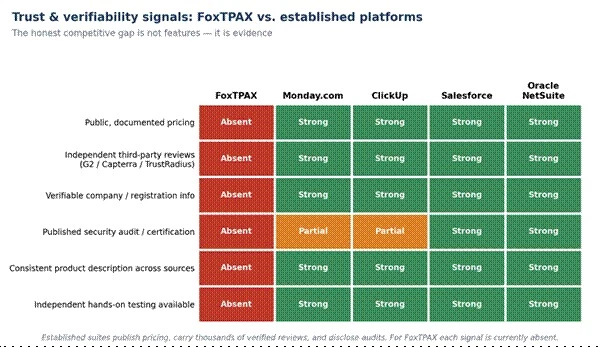
Platforms like Monday.com, ClickUp, Salesforce, and Oracle NetSuite have public documentation, pricing, verified reviews, security information, customer references, and a clear product identity. Foxtpax, based on available public information, does not show the same level of evidence.
So the more honest comparison is not just feature versus feature. It is evidence versus evidence.
Figure 6. Trust and verifiability signals: Foxtpax vs. established platforms.
On important buyer signals such as public pricing, independent reviews, verifiable company information, security documentation, consistent product positioning, and independent testing, established platforms are much easier to evaluate.
Foxtpax may still be worth investigating, but only if the vendor can directly prove the claims made about the product.
Table 3. Feature comparison as commonly framed, with the important caveat that Foxtpax claims are unverified
Dimension
Foxtpax, claimed
Monday.com
ClickUp
Salesforce
Oracle NetSuite
Unified dashboard
High*
High
High
Medium
High
Workflow automation
Strong*
Strong
Very strong
Medium
Strong
CRM depth
Medium*
Medium
Medium
Very strong
Very strong
Pricing transparency
None
Public
Public
Public
Public
Independent reviews
None
Extensive
Extensive
Extensive
Extensive
Deployment models
SaaS/on-prem*
SaaS
SaaS
SaaS
SaaS/on-prem
The Foxtpax ratings marked with an asterisk reflect unverified secondary claims, not tested capability or documented proof.
Adoption Challenges and Risks
The main risks around Foxtpax are not typical product risks like a missing feature or a confusing interface. The bigger concern is the information environment around the product.
Documentation and Trust Gap
The most important risk is the lack of clear, authoritative documentation.
There are no strong public signs of verified reviews, mainstream coverage, published pricing, consistent product positioning, public security reports, or detailed official feature documentation. Some secondary sources themselves advise caution and recommend independent verification.
For a buyer, that means the first job is not comparing features. The first job is confirming whether the product being described actually exists in the form claimed.
Onboarding and Support Uncertainty
Support quality is also unclear.
No verifiable support SLAs, onboarding guides, training resources, customer references, implementation partners, or response-time commitments were found in public sources.
That makes a paid pilot especially important. A pilot can reveal not only whether the software works, but also whether the vendor responds well, provides useful support, and understands the buyer’s real workflows.
Integration With Legacy Systems
Integrations are often the hardest part of any consolidation platform.
Even if Foxtpax offers APIs and SDKs, a buyer still needs to know whether those integrations work with their real accounting system, identity provider, CRM, data warehouse, payment stack, reporting tools, and internal processes.
The claimed API and connector surface is promising, but it needs direct validation before migration begins.
A Due-Diligence Checklist Before Adopting Foxtpax
If Foxtpax is genuinely being considered, the next step should be verification, not assumption.
Ask the vendor to confirm the legal entity, company registration, physical address, ownership, and current product focus. This is especially important because the vendor site and third-party descriptions appear to describe different things.
Request a current SOC 2 Type II report or equivalent security documentation. If your business depends on HIPAA, ISO 27001, GDPR, MiFID II, Dodd-Frank, or any other compliance framework, ask for written proof.
Get written pricing for your exact module set, deployment model, user count, implementation scope, support level, and maintenance requirements.
Ask for reference customers in your industry and at your scale. Do not rely only on logos or testimonials. Contact references directly where possible.
Run a time-boxed paid pilot using real workflows, not just demo data. If the FX or compliance module matters, ask your finance, risk, or legal team to test it properly.
Validate the REST API, SDKs, webhooks, and integrations against your existing systems before committing to migration.
Cross-check every major claim against an independent source. If a claim appears only on SEO-style content sites, treat it as unconfirmed until the vendor proves it.
Final Verdict
Foxtpax should be approached carefully because the available information is not fully consistent. The official website appears to position Foxtpax around secure storage, client-side encryption, decentralized data protection, and digital sovereignty. At the same time, many secondary sources describe it as a broader business platform with CRM, workflow automation, finance, collaboration, and compliance features.
That mismatch is the most important takeaway.
For now, Foxtpax may be worth exploring for teams interested in secure storage or data-protection concepts, but it should not be treated as a proven all-in-one business software platform without direct vendor confirmation. Businesses should ask for a live demo, written pricing, product documentation, API details, compliance evidence, customer references, and a small pilot before sharing sensitive data or planning a migration.
The safest recommendation is simple: treat Foxtpax as a product that needs verification, not as a fully proven business-software solution.