Blaze AI presents itself as an all-in-one AI marketing platform built specifically for solopreneurs, freelancers, and small teams who want to produce, design, and distribute content without juggling five separate tools.
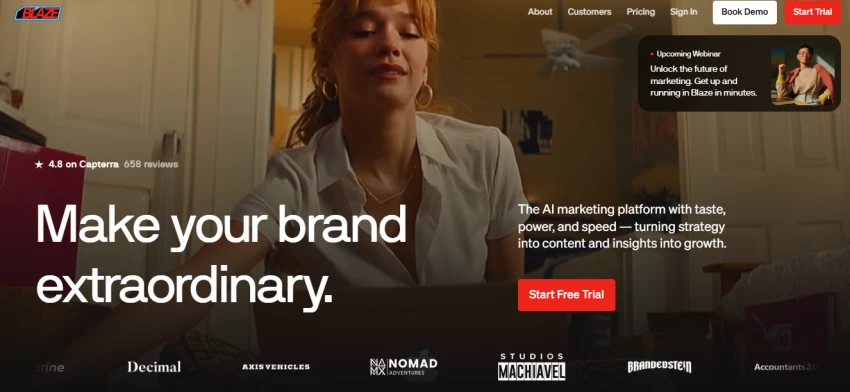
After analyzing Blaze’s official website, pricing structure, customer case studies, independent reviews, Reddit discussions, and third-party software directories, it becomes clear that Blaze is not simply another AI writing assistant. It is attempting to become a centralized marketing execution engine.
However, ambition and execution are two different things. To understand Blaze AI accurately, it must be examined across infrastructure, user experience, pricing integrity, competitive differentiation, automation claims, and real-world performance.
Blaze AI publicly identifies Adam Nathan as its Founder and CEO. Unlike many AI startups that obscure leadership details, Blaze’s About section highlights leadership identity along with growth claims including serving over thirty thousand entrepreneurs, saving more than three hundred thousand hours of work time, and generating fifteen million dollars in revenue across customers.
These numbers are vendor-reported rather than externally audited, but they provide context about scale. Blaze positions itself not as a laboratory experiment but as a commercial product with active user adoption. The platform appears to have scaled rapidly within a short period, which aligns with broader growth trends in AI-driven SaaS tools targeting small business automation.
Blaze AI attempts to unify several traditionally separate marketing functions inside a single interface. The platform is structured around brand identity creation, AI-generated content production, visual design capabilities, and multi-channel publishing infrastructure.
The brand system component allows users to input a website URL or upload existing documents. Blaze then attempts to extract tone, style, vocabulary, colors, fonts, and logos to construct what it calls a Brand Kit. This feature is designed to reduce the “generic AI voice” problem that plagues many text generators. While this sounds compelling, independent reviewers have noted that brand extraction is not always precise. Some users report inconsistencies in color accuracy and font replication, requiring manual correction. This suggests the feature functions as a starting framework rather than a fully autonomous branding engine.
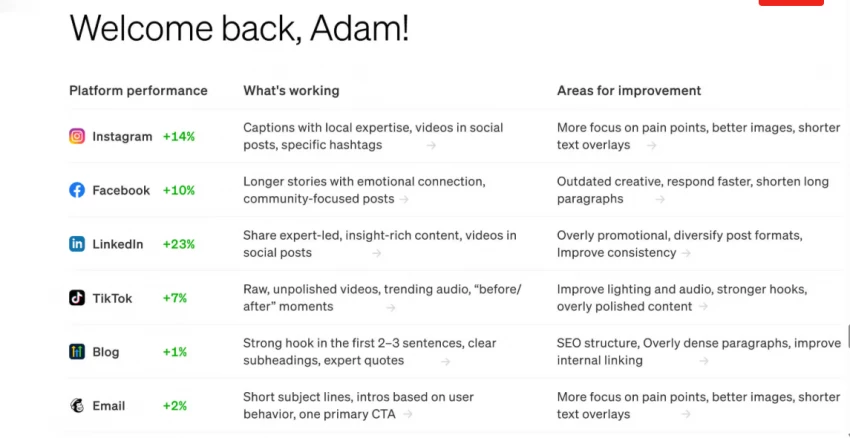
The content engine inside Blaze goes beyond blog writing. It includes generation tools for social captions, newsletters, ad copy, press releases, landing page drafts, and engagement responses. The system encourages content multiplication, meaning one long-form blog can be automatically converted into numerous short-form social variations. This repurposing capability is one of Blaze’s strongest operational advantages for time-constrained founders.
The visual design layer incorporates hundreds of templates and over thirty preset social formats. Users can create Instagram posts, TikTok covers, YouTube thumbnails, Facebook covers, LinkedIn posts, and even flyers. Yes, Blaze can create flyers. It markets this feature directly toward local service businesses and small retailers. However, Blaze’s design flexibility does not rival Canva’s advanced layout control. While Blaze excels at quick marketing-ready creatives, it lacks the deeper customization environment professional designers rely on.
The publishing infrastructure represents Blaze’s clearest differentiation from standalone AI writing tools. The platform integrates with Instagram Business, Facebook Business, LinkedIn, X, TikTok, WordPress, Mailchimp, Zapier, Shopify, Wix, and additional marketing tools. This allows users to generate content and schedule distribution without leaving the platform. For solo operators managing multiple channels, this centralized workflow reduces friction significantly.
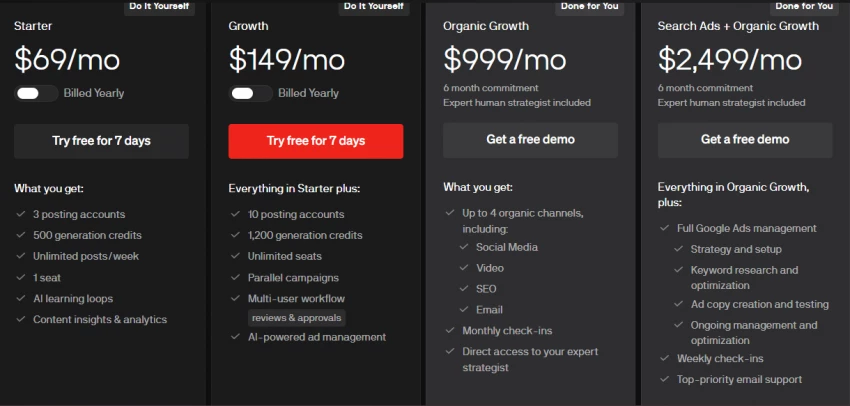
Blaze’s current pricing structure reflects a shift from earlier tier models frequently cited on review websites. The official pricing page now includes a Free plan, Starter plan, Growth plan, and higher-end managed marketing services.
The Free plan includes three posting channels with watermarked content and limited posting frequency. It is technically functional but operationally restricted.
The Starter plan, priced around sixty-nine dollars per month or discounted with annual billing, includes three posting accounts, one user seat, unlimited posts per week, analytics, and what Blaze describes as AI learning loops. This tier appears targeted toward solo founders.
The Growth plan increases posting accounts and allows unlimited seats, positioning itself for small teams and agencies. Higher tiers move into managed service territory, beginning at approximately nine hundred ninety-nine dollars per month and extending into multi-thousand-dollar plans that include advertising management.
It is important to note that third-party directories often list outdated pricing. Users have also reported confusion around past price changes. Therefore, the official Blaze pricing page remains the most accurate source for current costs.
Blaze markets an AI-driven autopilot mode that can handle strategy, content generation, and posting with minimal human oversight. This concept aligns with broader trends toward agentic AI systems capable of executing workflows semi-autonomously.
However, real-world application requires nuance. AI-generated content still benefits from editorial review. While Blaze can dramatically reduce drafting time, strategic positioning, market research, and high-stakes messaging still demand human refinement.
Autopilot functionality appears best suited for consistent social presence rather than complex campaign architecture. It automates execution, not strategic innovation.
Trustpilot reviews show a mixture of enthusiastic praise and critical complaints. Positive reviews frequently mention time savings, ease of use, and convenience of integrated scheduling. Negative reviews often center on billing misunderstandings, occasional content quality inconsistencies, or unmet expectations around automation accuracy.
Independent blog reviewers have noted that Blaze’s templates are helpful but sometimes require manual visual correction. Reddit discussions reveal skepticism from experienced marketers who question whether AI scheduling impacts algorithm reach, though this concern extends beyond Blaze and into the broader AI-content ecosystem.
Capterra listings similarly reflect balanced sentiment. Users appreciate workflow consolidation but caution that AI outputs should not be published blindly.
The pattern suggests Blaze performs well when expectations are realistic. Users seeking a productivity accelerator report satisfaction. Users expecting fully autonomous marketing transformation report frustration.
Blaze AI and ChatGPT serve different operational layers.
ChatGPT excels at deep reasoning, long-form strategic thinking, technical content drafting, research synthesis, and intellectual flexibility across domains. It is fundamentally a thinking engine.
Blaze is an execution system. It specializes in transforming content into multi-channel marketing assets and distributing them efficiently.
If the objective is strategic thinking, ChatGPT remains superior. If the objective is structured marketing execution across multiple platforms with minimal tool switching, Blaze offers convenience ChatGPT does not natively provide.
Serious marketers increasingly use both: ChatGPT for intelligence, Blaze for operational throughput.
Blaze includes visual design capabilities sufficient for social marketing and flyer production. However, Canva retains superiority in advanced design control, print precision, and creative depth.
Blaze’s advantage lies in merging copy generation and publishing within the same environment. Canva remains stronger for designers who prioritize visual craftsmanship.
Blaze can replace Canva for speed-driven social campaigns. It cannot fully replace Canva for professional graphic design workflows.
Blaze’s customer page highlights case studies showing thirty percent audience growth within weeks, five-hundred-percent increases in inbound calls, and dramatic improvements in click performance. These claims reflect optimized scenarios rather than guaranteed outcomes.
Marketing software amplifies existing positioning strength. It does not create demand in isolation. Blaze may accelerate visibility, but it does not compensate for weak product-market fit.
When I evaluate Blaze AI in real-world usage rather than marketing claims, the platform’s strengths become most visible in operational environments where speed and consistency matter more than creative perfection. Blaze performs particularly well when a solo founder or small team needs to produce content across multiple platforms without switching between writing tools, design software, and scheduling dashboards. The consolidation of workflow into a single interface significantly reduces cognitive load. Instead of drafting in one tool, resizing visuals in another, and scheduling in a third, the user can move from idea generation to publication inside one structured environment. That consolidation alone can save meaningful time over weeks and months.
Time efficiency is one of Blaze’s clearest advantages. The ability to repurpose a long-form blog into multiple social captions, newsletters, and promotional snippets dramatically shortens production cycles. For users who struggle with consistency rather than creativity, this structured repetition becomes valuable. It turns a single content effort into a multi-channel campaign with relatively little additional effort. In environments where marketing output needs to be steady rather than groundbreaking, Blaze delivers functional reliability.
Template convenience is another practical strength. The platform provides pre-sized layouts for major social platforms, reducing the technical friction involved in formatting content. For non-designers, this removes a barrier that often slows down content publishing. While the design controls are not as flexible as dedicated graphic software, they are sufficient for everyday marketing use. Blaze essentially lowers the skill threshold required to produce visually acceptable content.
The built-in distribution infrastructure strengthens its practicality further. Direct integrations with major social platforms and publishing tools mean users can schedule posts without exporting files or manually uploading assets. This matters especially for solo operators who do not have marketing coordinators. The system encourages consistency by centralizing the publishing pipeline.
However, the weaknesses become noticeable when expectations exceed Blaze’s design scope. Brand replication, while marketed as intelligent and automated, is not always precise. Extracting tone from a website does not guarantee nuanced voice matching, particularly for brands with complex positioning or distinctive linguistic patterns. Users often need to refine messaging manually to maintain authenticity. This limitation does not make the feature useless, but it prevents it from being fully autonomous.
Advanced design control is another constraint. Blaze’s visual layer works well for templated marketing creatives but lacks deep layout customization, advanced typography control, or high-end visual manipulation. Designers accustomed to tools like Canva Pro or Adobe products may find the environment restrictive. Blaze favors speed over creative freedom.
AI-generated content genericness is also a recurring concern. Like most AI writing tools, Blaze can produce text that sounds structurally correct but lacks originality or emotional depth. Without thoughtful prompting or editing, outputs can feel standardized. This is not unique to Blaze, but in a marketing context where differentiation is critical, generic messaging can weaken impact if published without refinement.
Pricing complexity during transitions has also affected user perception. Historical plan changes and discrepancies between third-party listings and official pricing pages have caused confusion for some users. While the current pricing structure is clearly presented on the official site, past inconsistencies have influenced trust among certain reviewers.
Overall, Blaze operates as a workflow accelerator rather than a creative authority. It reduces friction, speeds up execution, and organizes marketing tasks effectively. At the same time, it does not eliminate the need for strategic oversight, brand refinement, or creative judgment. The platform sits in a practical middle ground. It is stable enough for structured marketing operations but not advanced enough to replace specialized creative or strategic tools entirely.
Blaze is best understood not as a flawless automation system, but as a productivity infrastructure layer for modern small-business marketing.
Blaze operates in a competitive AI marketing SaaS landscape alongside Jasper, Canva Magic Studio, HubSpot AI integrations, and AI-enhanced scheduling platforms.
Its differentiation lies in combining content generation, design, and distribution in one centralized command center. That positioning appeals strongly to small business operators who prioritize speed and structure over perfection.
Blaze AI is neither overhyped vaporware nor revolutionary marketing intelligence. It is a workflow automation system designed to simplify content execution.
It performs best when used as a structured productivity amplifier rather than a fully autonomous strategist.
The decision to adopt Blaze should depend on operational needs. If the priority is centralized marketing execution across multiple platforms with reduced friction, Blaze provides value. If the priority is deep strategic reasoning or advanced design craftsmanship, complementary tools remain necessary.
Blaze does not replace intelligence. It replaces repetition.
In 2026, that distinction matters more than ever.
Is Blaze AI better than ChatGPT?
Blaze AI is not better than ChatGPT overall. ChatGPT is stronger for deep reasoning, research, and flexible writing. Blaze is stronger for marketing execution, content repurposing, and scheduling. They serve different purposes rather than competing directly.
Does Blaze AI actually work?
Yes, Blaze AI works for structured marketing tasks such as generating social posts, blogs, and scheduling content. It saves time, but content usually benefits from human editing for tone and accuracy.
Is Blaze AI free?
Blaze offers a free plan with limited posting frequency and watermarked content. It is suitable for testing, but regular usage generally requires a paid plan.
Who is the CEO of Blaze AI?
The CEO and Founder of Blaze AI is Adam Nathan, as listed on the company’s official website.
How much does Blaze AI cost?
Blaze pricing currently starts around $69 per month for the Starter plan, with higher-tier plans available for teams and agencies. It also offers managed marketing services at significantly higher monthly rates.
Can Blaze AI make flyers?
Yes, Blaze can create flyers using built-in templates and design formats. However, advanced customization may be more limited compared to dedicated design tools.
Is Blaze better than Canva?
Blaze is better for combining AI writing, design templates, and scheduling in one place. Canva is stronger for detailed graphic design and creative control. The better choice depends on the user’s priority.
Be the first to post comment!
Motion graphics is no longer “only After Effects.” Today I can generate motion s...
Sakshi Dhingra14 hours ago

AI video generation is no longer experimental. It has become a production workfl...
Sakshi Dhingra1 day ago

When I evaluate an AI video tool, I don’t just skim the homepage. I trace the fu...
Sakshi Dhingra1 day ago

Uber Eats is officially moving beyond simple food delivery and positioning itsel...
Sakshi Dhingra1 week ago

I’ll admit it, SpicyChat AI is one of those tools you don’t exactly open with “s...
Vivek Gupta2 weeks ago
For months, the global AI industry has lived in a state of suspended animation w...
Vivek Gupta3 weeks ago