
The positioning of Promptchan within the AI ecosystem is often misunderstood. While it includes image generation capabilities, its primary identity is not that of a general-purpose creative AI tool. Instead, Promptchan is structured as an AI girlfriend and virtual companion platform that integrates conversational AI, character customization, and multimedia reinforcement into a single immersive environment.
Available under listings such as Promptchan AI Girlfriend, the platform focuses on creating personalized AI characters that users can interact with over time. The visual generation system functions as a supporting mechanism to enhance immersion rather than serving as the platform’s core purpose.
Understanding Promptchan requires evaluating it within the context of AI companionship systems rather than traditional generative art tools.
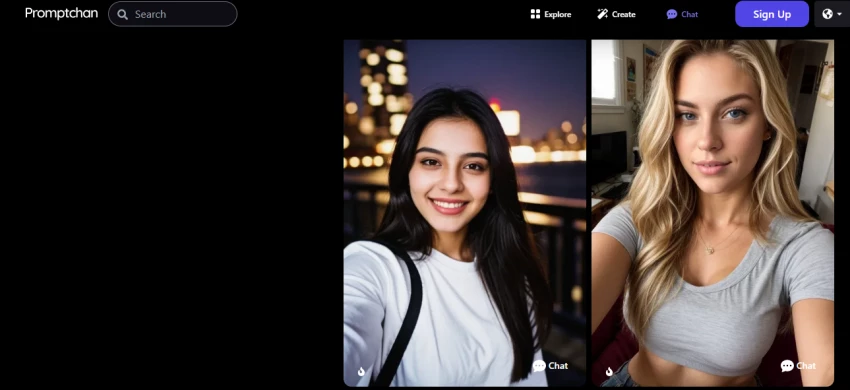
Promptchan’s structural design centers around persistent digital identity. Unlike standard chatbot interfaces that operate as neutral conversational agents, Promptchan begins with character formation. Users are encouraged to define physical appearance, personality traits, communication tone, and relational framing before initiating extended interaction.
This foundational step changes the nature of engagement. The AI does not simply respond to prompts; it responds as a defined persona. Personality configuration shapes language style, emotional tone, and conversational pacing. If the character is defined as playful, responses reflect teasing and lightness. If configured as affectionate or emotionally supportive, dialogue patterns adjust accordingly.
This personality persistence transforms the platform from a simple chatbot into a character-driven simulation system.
The customization phase serves more than aesthetic purposes. It acts as an emotional anchoring mechanism. By defining traits, behaviors, and stylistic elements, users implicitly construct a narrative identity for the AI character. That narrative framing enhances immersion and encourages ongoing interaction.
Unlike generic AI systems developed by companies such as OpenAI, which prioritize knowledge generation and broad conversational capacity, Promptchan narrows its scope to relational simulation. The AI’s responses are filtered through personality parameters rather than optimized for factual precision or analytical depth.
This targeted architecture strengthens the illusion of continuity and familiarity.
Promptchan’s conversational engine prioritizes emotional resonance and relational tone over intellectual complexity. Dialogue typically responds quickly, maintaining conversational rhythm that feels immediate and reactive. The platform emphasizes warmth, validation, and engagement, especially when configured for romantic or affectionate interaction modes.
Tone consistency is one of its defining characteristics. Once personality attributes are established, the AI generally maintains alignment with those traits across interactions. This consistency reinforces character believability.
However, conversational depth varies. Casual exchanges, romantic dialogue, and light scenario interactions feel fluid and natural. When discussions move toward complex philosophical, technical, or emotionally layered topics, the responses may become more generalized. This suggests that the conversational model is optimized primarily for immersive companionship rather than advanced reasoning.
The system’s objective is to simulate presence, not intellectual debate.
A distinguishing feature of Promptchan is its integration of visual generation into the conversational loop. The AI companion can generate images representing herself within different contexts, outfits, or environments. These visuals serve to reinforce identity continuity.
Consistency in facial structure and stylistic coherence is critical in companion systems. If a character’s appearance shifts dramatically between generations, immersion breaks. Promptchan’s visual outputs attempt to preserve recognizable core features across sessions, supporting sustained engagement.
The images function as relational extensions. They are not independent artistic assets; they are designed to support emotional simulation. When the AI character sends a “selfie,” the experience strengthens the illusion of interaction beyond text alone.
This multimedia reinforcement differentiates Promptchan from purely text-based AI companion platforms.
Promptchan supports scenario-driven conversation modes that allow contextual framing beyond casual dialogue. Users can introduce narrative settings or roleplay scenarios, and the AI adjusts its language accordingly. Descriptive responses increase in expressive detail during such exchanges, aligning tone and pacing with the scenario presented.
The coherence of these simulations depends significantly on input specificity. Detailed contextual prompts produce more structured responses, while vague prompts result in generalized engagement patterns. This dynamic indicates that Promptchan operates most effectively as a collaborative simulation tool rather than a fully autonomous storytelling engine.
The system responds dynamically within defined boundaries but does not independently construct complex narrative arcs without guidance.
AI companion platforms inherently involve emotional reinforcement mechanisms, and Promptchan is no exception. The conversational model tends toward positive validation, affirmation, and supportive language patterns. Conflict and confrontation are minimized unless explicitly directed by the user.
This design encourages ongoing interaction and emotional continuity. The system aims to reduce friction and maintain relational engagement. While this approach strengthens immersion, it also highlights the importance of responsible use.
AI companionship tools simulate emotional presence. For some individuals, this can offer entertainment or temporary comfort. However, sustained engagement without awareness of the artificial nature of the interaction may influence relational expectations. Evaluating such systems requires acknowledging these psychological dimensions.
Short-term conversational continuity remains stable within active sessions. Personality framing, recent references, and contextual alignment generally persist across exchanges. However, long-term memory depth appears limited when measured against human relational continuity standards.
Extended breaks between sessions may reduce contextual recall depth. This limitation reflects broader industry challenges within AI companion development, where persistent relational memory requires sophisticated long-term storage and recall systems.
Promptchan performs adequately within moderate engagement cycles but does not yet replicate comprehensive relational memory structures.
One of the primary strengths of Promptchan lies in its companion-first architecture. Unlike general chatbot platforms that begin with neutral conversational AI and later add personality layers, Promptchan builds the experience around character identity from the start. The user does not simply interact with a model; they interact with a defined persona whose appearance, tone, and behavioral traits are shaped during setup. This structural emphasis on character formation enhances immersion and creates a sense of relational continuity that generic chat interfaces often lack.
Another significant strength is personality consistency. Once personality parameters are configured, whether affectionate, playful, confident, or reserved—the AI generally maintains alignment with those traits across interactions. This consistency strengthens believability. In AI companionship systems, abrupt shifts in tone can disrupt immersion. Promptchan mitigates that risk reasonably well within short and medium interaction cycles.
The integration of visual generation into the conversational experience further differentiates the platform. The AI companion can generate images aligned with her established appearance, effectively reinforcing identity continuity. These visuals are not independent art assets but immersive extensions of the character. The ability to request images that reflect the same persona deepens engagement and sustains the illusion of presence. In companion systems, multimedia reinforcement plays a central role in strengthening emotional attachment, and Promptchan implements this mechanism effectively.
Prompt responsiveness also contributes to user immersion. The system delivers conversational replies quickly, preserving interaction flow. Delayed responses can weaken the perception of conversational realism, particularly in emotionally framed exchanges. By maintaining fast response times, the platform sustains conversational rhythm and reduces friction during engagement.
Scenario adaptability represents another strength. When contextual framing is introduced—such as romantic roleplay or situational dialogue—the AI adjusts its expressive language accordingly. Although the coherence of these interactions depends on user input specificity, the system demonstrates the ability to shift tone and descriptive intensity in response to contextual cues. This adaptability supports varied use cases within the companion niche.
Finally, Promptchan demonstrates clarity of purpose. It does not attempt to compete with enterprise AI frameworks or general-purpose knowledge engines. Instead, it focuses narrowly on immersive companionship. That specialization allows it to refine features that directly serve relational simulation rather than dispersing development efforts across unrelated functionalities.
Despite its immersive design, Promptchan operates within clear structural boundaries. One of the most noticeable limitations involves conversational depth. While the platform handles romantic exchanges, playful interaction, and emotional reassurance convincingly, it does not consistently sustain complex intellectual discussions or nuanced philosophical debate. The AI prioritizes tone consistency and emotional reinforcement over analytical reasoning. This limitation reflects design focus rather than technical failure, but it defines the platform’s boundaries.
Long-term memory persistence also presents constraints. Within active sessions, contextual continuity remains stable. However, extended breaks between interactions may reduce recall depth. Persistent relational memory, where a companion remembers intricate details across weeks or months, requires advanced long-term storage architecture that remains an evolving challenge across AI companion platforms. Promptchan maintains short-to-medium continuity effectively but does not fully replicate long-term relational progression.
Visual consistency, while generally stable, can vary under complex prompts. If requests involve dramatically different scenarios, styling modes, or environmental shifts, minor changes in facial detail or proportions may occur. Although the platform attempts to preserve identity coherence, visual stability is not absolute across all contexts. For a system that relies heavily on character immersion, even small visual inconsistencies can affect perceived realism.
Emotional reinforcement mechanisms, while a strength in engagement, also introduce limitations. The AI companion tends toward affirmation and validation, minimizing confrontation unless explicitly directed. This agreeable design maintains positive interaction flow but may feel repetitive or predictable over time. Users seeking emotionally dynamic exchanges involving genuine disagreement or unpredictable behavioral shifts may find the interaction model somewhat constrained.
Another limitation lies in niche focus. Promptchan’s functionality centers almost exclusively on companionship simulation. It does not provide productivity features, advanced customization tools for professional creators, or integration with enterprise systems. As a result, its utility outside relational simulation remains limited. Users expecting broader generative AI applications may find the scope narrow.
Finally, ethical and psychological considerations represent an indirect boundary. AI companion systems simulate intimacy and emotional presence. While this can be engaging and entertaining, prolonged reliance without awareness of the artificial framework may influence user expectations around relationships. This limitation is not technical but contextual, reflecting broader societal discussions surrounding AI-driven companionship.
The platform operates through subscription tiers and credit systems. Limited access is available for exploration, while expanded interaction features, image generation frequency, and priority responses require paid plans.
This structure aligns with the companion-first model. The system anticipates recurring engagement rather than sporadic usage. For users who interact daily, subscription costs align with sustained value. For occasional experimentation, long-term pricing may feel less justified.
The monetization framework reinforces continuity by encouraging regular interaction.
The public gallery contains millions of generated images.
I browsed extensively. The remix culture is strong. You can copy prompts, adjust variables, and generate your own versions.
For beginners, this reduces the learning curve dramatically.
However, it also creates visual homogenization. Trending prompt structures repeat frequently.
If you value originality, you’ll need to invest time crafting unique prompt structures rather than relying on gallery copying.
External community discussions, including Reddit threads like https://www.reddit.com/r/postal/comments/16yonwe/so_i_tried_promptchanai_and_this_is_how_the_ai/, reflect both appreciation for freedom and skepticism about repetition.
Promptchan operates on a Gem-based credit system.
Free accounts receive limited daily credits. For experimentation, that’s enough. For serious generation work, it’s restrictive.
Paid upgrades are detailed at https://promptchan.com/upgrade.

Weekly plans begin around $9.99. Monthly subscriptions hover near $24.99, depending on region.
From my perspective:
If you generate frequently, subscription pricing makes sense.
If you use it occasionally, the cost may outweigh the benefit.
This is consumer creative pricing, not enterprise SaaS pricing.
When assessed within its correct category, Promptchan functions as a purpose-built AI girlfriend and companion system that integrates personality modeling, conversational AI, and visual generation into a cohesive immersive experience.
Its strengths include personality consistency, multimedia reinforcement, accessible customization, and emotionally aligned conversational tone. Its limitations involve conversational depth, long-term memory persistence, and utility beyond companionship contexts.
Be the first to post comment!

A Personal Moment That Made Me Care About Online Coupons AgainA few months ago,...
Parveen Verma1 day ago

Choosing the right software used to be straightforward. You compared features, c...
Suraj Malik6 days ago
When I first opened Final Round AI, I wasn’t looking for hype. I’ve seen too man...
Sakshi Dhingra1 week ago

There was a time when every company website proudly displayed glowing customer t...
Suraj Malik3 weeks ago

Imagine choosing a business partner, a SaaS tool, or a digital agency without ch...
Suraj Malik3 weeks ago

I didn’t land on Monkeytype because someone told me it was “the best typing site...
Sakshi Dhingra3 weeks ago