
Toolbaz AI frequently appears in searches related to free AI tools, AI writing tools without login, and ChatGPT alternatives that don’t require signup. That visibility is not accidental. The platform is built around one core idea: removing friction.
But frictionless access does not automatically mean long-term usefulness. To understand where Toolbaz truly fits, it’s important to look beyond feature lists and examine how people actually use it over time.
That begins with the most searched question of all.
Yes, but “free” now comes with boundaries.
Toolbaz still allows most tools to be used without payment, account creation, or email verification. However, in 2025, user reports consistently point to soft limits such as daily prompt caps, verification checks, and throttling during peak hours.
For light or occasional users, these limits are barely noticeable. For heavy users, they appear quickly and shape how the platform feels in extended sessions.
Understanding those limits naturally raises another question people often search next.
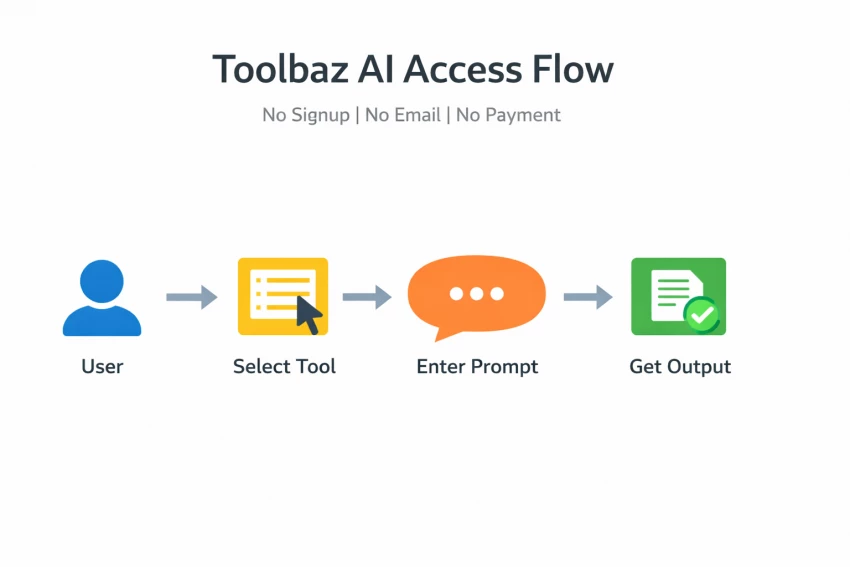
No signup is required for the majority of Toolbaz’s tools.
This is one of its strongest differentiators. Users can open the site, select a tool, and generate content instantly. This design appeals strongly to students, freelancers, and first-time AI users who want results without commitment.
The trade-off is that Toolbaz does not offer:
This design choice explains both its popularity and its ceiling — which becomes clearer when we look at the tool ecosystem itself.
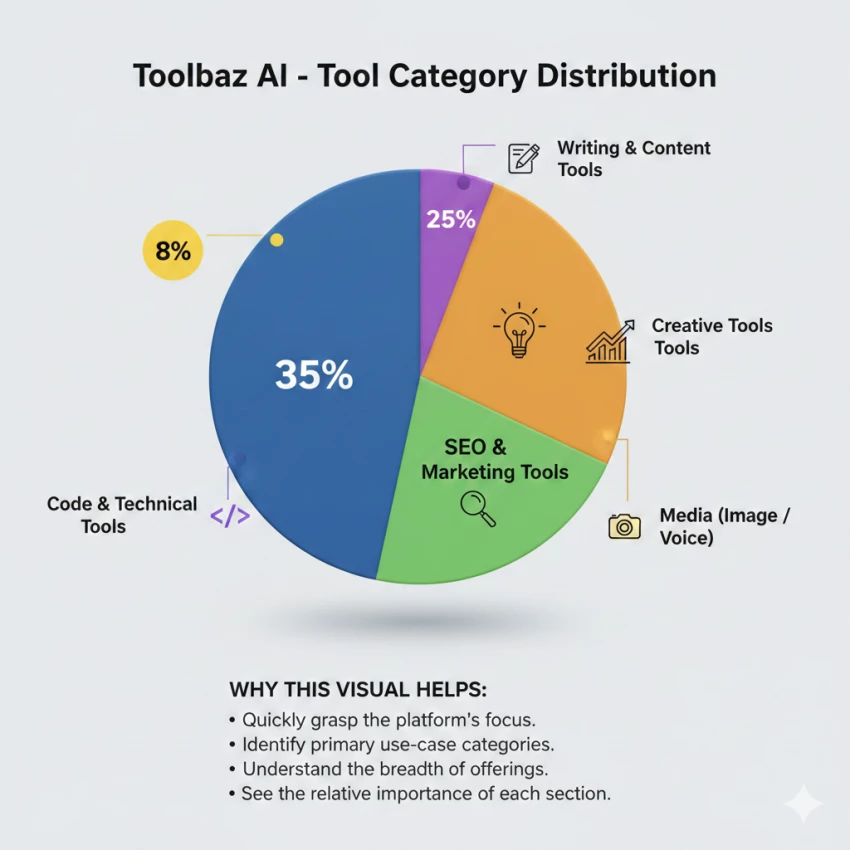
Toolbaz claims to offer more than 75 AI tools, and that number is broadly accurate. However, the value lies less in the raw count and more in how those tools are organized.
Most tools are structured around specific user intent rather than technical uniqueness. For example, multiple writing tools may rely on similar AI logic but are framed differently for essays, stories, bios, or marketing copy.
This makes Toolbaz easy to navigate for beginners, though experienced users may notice functional overlap — which becomes especially clear in the writing tools.
Toolbaz’s writing tools are designed for speed, not depth.
They perform well for:
They struggle with:
Most users treat Toolbaz as a drafting assistant rather than a final publishing solution — a pattern that becomes even more obvious in creative writing use cases.
Search interest around Toolbaz story generator is driven largely by writers looking for fast ideas.
In practice, the stories produced are:
They are useful for:
They are less effective for:
This reinforces Toolbaz’s role as an ideation tool rather than a creative replacement — a distinction that also applies to its marketing features.
Toolbaz includes tools for meta descriptions, slogans, captions, and product descriptions, all common search intents.
The outputs are usually:
What they lack is differentiation. Most generated copy sounds safe rather than persuasive. As a result, marketers often use Toolbaz to create starting points, not finished campaigns.
This same “assistive, not authoritative” pattern continues into technical use cases.
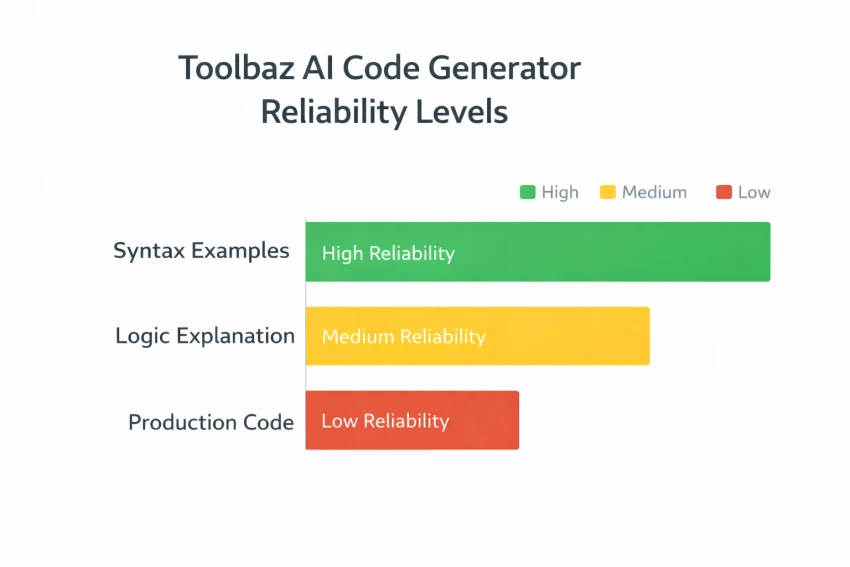
Toolbaz’s code generator works best for:
It is not designed for:
For beginners, it’s a helpful learning aid. For professionals, it’s a convenience tool — which leads naturally into questions about the platform’s media tools.
Toolbaz’s image generation tool often appears in searches for free AI image generator without login.
The results are:
It works well for placeholders, concept visuals, and casual experimentation. It does not compete with specialized platforms focused solely on AI art.
This reinforces a recurring theme: breadth over depth — even when advanced models are involved.
Toolbaz allows users to choose between multiple AI models, including GPT-4o, Gemini, Deepseek-R1, and Grok (availability varies).
This flexibility is uncommon among free platforms and can influence output quality, tone, and reasoning style. However, Toolbaz provides little guidance on when or why to choose a specific model.
As a result, advanced users benefit more from this feature than beginners — which ties directly into concerns around trust and legitimacy.
Across review platforms and community discussions, there is no strong evidence suggesting Toolbaz is a scam or unsafe.
That said:
Toolbaz is best used for general content tasks rather than confidential work — a limitation that also affects how users evaluate its paid plans.
Paid plans (around $9–$10/month) mainly increase limits:
Importantly, the free version remains usable. The paid tier improves comfort and scale rather than unlocking exclusive capabilities.
This pricing structure keeps Toolbaz accessible while still supporting sustainability — which leads to a clear summary of its strengths and weaknesses.
Pros
Cons
These trade-offs define who Toolbaz is actually meant for.
Toolbaz AI works best when used intentionally.
It is not designed to replace professional writing, deep research, or creative mastery. Instead, it excels as a fast, low-commitment AI workspace for drafts, ideas, and experimentation.
For users who value accessibility and speed over polish and depth, Toolbaz remains a practical option in 2025, provided expectations are aligned with its role.
Be the first to post comment!
I’ll admit it, SpicyChat AI is one of those tools you don’t exactly open with “s...
Vivek Gupta4 days ago

For months, the global AI industry has lived in a state of suspended animation w...
Vivek Gupta1 week ago

In today’s fast-moving digital landscape, intelligent software that can act inde...
Mighva Verma3 weeks ago

In today’s business world, customer expectations have shifted dramatically. Peop...
Mighva Verma3 weeks ago

Top AI Transcription Tools Designed for TeamsRemote and hybrid teams are drownin...
Mighva Verma1 month ago
In today’s content-saturated world, merely producing more isn’t enough. Smart cr...
Mighva Verma1 month ago