
When I started digging into Lenso.ai, I didn’t want surface-level claims. I wanted to understand how it works, what it costs, whether it’s trustworthy, and how real users describe their experiences. So I went through the official product pages, the pricing structure, user discussions, Trustpilot reviews, third-party write-ups, and public commentary.
Here’s what I found, written from direct analysis, not marketing copy.
When I visited the official homepage at Lenso.ai, the product presents itself as an AI-powered reverse image search engine with advanced facial recognition capabilities. It positions itself as a tool for professionals and privacy-conscious individuals who want to track images across the public internet.
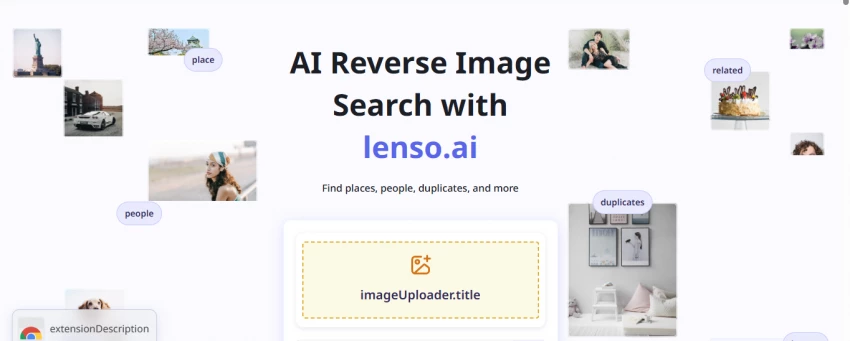
The feature breakdown on the official Face Search page at lenso.ai/en/page/face-search explains that the system can locate the same person across different websites using biometric facial landmarks. It emphasizes public web indexing rather than scraping private accounts.
On the reverse image side, the documentation at lenso.ai/en/page/reverse-image-search describes a content-based visual recognition engine. Instead of relying purely on metadata or surrounding text, it analyzes image features and groups results into structured categories such as People, Places, Duplicates, and Similar visuals.
From my review of the official materials, Lenso is not just a Google Images clone. It attempts deeper matching and categorization with filtering and sorting capabilities layered on top.
From the way the product explains itself, I understand Lenso uses computer vision models trained for visual similarity detection. It analyzes shapes, patterns, colors, and structural features to generate matches. The platform explicitly mentions it follows robots.txt rules and scans public pages only.
It states in its privacy FAQ that uploaded images are not used to train the AI model and are stored temporarily unless users enable alerts, which require longer retention. I verified that directly through the privacy information linked on their site.
One important detail I noticed is that face recognition availability depends on regional laws. The official face search page explicitly states that the “People” category is restricted in some regions. That means some users may not see facial search at all, depending on location.
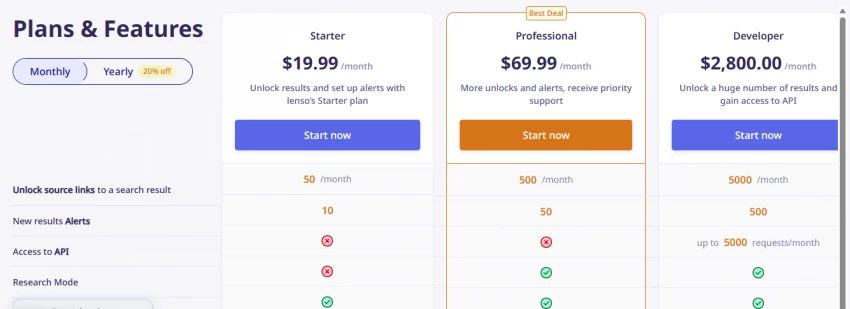
When I reviewed the official pricing page at lenso.ai/en/pricing, I saw three tiers: Starter, Professional, and Developer. The free version allows basic search testing, but unlocking full source visibility and expanded results requires a subscription.
External coverage from Yahoo Finance in the article announcing its launch describes it as “incredibly accurate” and aimed at professional use cases such as copyright protection and brand monitoring.
From what I gathered, free access is limited. You can upload and preview results, but source unlocking and advanced filtering are gated behind paid plans.
So yes, Lenso.ai is technically free to try, but serious usage requires payment.
One of the first things I check with face search tools is corporate traceability.
Lenso lists its legal entity as LENSO AI S.A., headquartered in Wrocław, Poland. That information appears on their official contact page.
Knowing that it operates under a named European company adds legitimacy compared to anonymous reverse search tools. That said, being registered does not automatically guarantee ethical practices, it simply makes the business accountable under EU regulations.
I didn’t want to rely only on official claims, so I reviewed Reddit discussions.
In a thread titled “Roast Lenso.ai: AI Reverse Image Search and Face Search” on Reddit at reddit.com/r/roastmystartup/comments/1dpkuom/roast_lensoai_ai_reverse_image_search_and_face, users debated pricing, developer tier costs, and result limitations.
In another candid post at reddit.com/r/sugarlifestyleforum/comments/1jpmy4a/i_signed_up_and_paid_for_lensoai_so_you_dont_have, a user described paying for the service to test its accuracy and reported mixed but functional results when images were publicly available.
What stood out to me was that users did not universally call it fake. Instead, they described it as effective when the image already exists on indexed websites. That nuance matters.
On Trustpilot, Lenso.ai currently holds a rating around 4 out of 5 stars, visible at trustpilot.com/review/lenso.ai.
However, while reviewing deeper pages, I noticed some user commentary raising concerns about incentivized reviews.
This connects directly to the broader question: How do you spot fake AI reviews?
When I evaluate review authenticity, I look for repeated marketing-style language, suspiciously similar phrasing, sudden bursts of five-star ratings, or claims of rewards for positive reviews. Trustpilot’s corporate guidelines explain how it enforces anti-manipulation rules, but incentivized feedback can still distort perception.
The safest method I use is reading three-star and two-star reviews. They usually provide more balanced insight.
I also examined third-party review coverage such as the breakdown at automateed.com/lenso-ai-review, which provides a structured assessment of the tool’s strengths and limitations.
Additionally, software listing platforms like slashdot.org/software/p/Lenso.ai present it as a niche but emerging product in the reverse image search category.
Across multiple independent reviews, a recurring theme appears: Lenso is strongest at duplicate detection and copyright use cases. Face search functionality varies based on region and public availability of images.
After spending time analyzing Lenso.ai’s official documentation, pricing structure, third-party reviews, and Reddit user discussions, I see very clear strengths, and equally clear limitations. It is neither a miracle tool nor a scam platform. It sits somewhere in between, depending on how and why I use it.
The biggest strength I notice is its structured reverse image search system. Unlike basic image search engines that simply show visually similar photos, Lenso organizes results into meaningful categories such as People, Duplicates, Places, and Similar images. That structure makes investigation more efficient. When I upload an image, I am not overwhelmed with random look-alikes; I can navigate toward exact duplicates or face matches when available.
Another strong point is duplicate detection. For photographers, content creators, or brand owners, the ability to detect cropped, resized, or slightly edited versions of an image is valuable. Based on independent reviews and user feedback, Lenso performs particularly well when the original image is already publicly indexed somewhere online. If the photo exists on blogs, forums, news sites, or public social media pages, the engine often finds it.
I also consider corporate transparency a strength. Lenso identifies itself as LENSO AI S.A., based in Wrocław, Poland, and publishes privacy documentation explaining how images are handled. It states that uploaded images are not used to train its AI models and that it respects robots.txt rules. That level of disclosure adds credibility compared to anonymous face search websites.
The alert system is another practical advantage. If I want to monitor whether a specific image appears again online, I can set alerts under paid plans. That makes it more of a monitoring tool than a one-time search engine.
Finally, the interface supports filtering and sorting options. I can narrow results by keyword or domain and sort by date or relevance. For investigative or copyright purposes, that level of filtering matters.
The most obvious limitation is that Lenso can only find what already exists publicly. It does not access private accounts, closed databases, or content behind login walls. If the image I am searching for has never been indexed publicly, Lenso will not magically find it. Some users misunderstand this and expect hidden database access, which it does not claim to provide.
Regional restrictions are another limitation. Face search functionality is not available everywhere due to local legal regulations. That means the “People” category may not appear depending on where I am located. This inconsistency can frustrate users who expect uniform access.
Pricing is also a practical constraint. While Lenso allows limited free testing, unlocking full source visibility and larger monthly result quotas requires a subscription. For casual users, the cost may outweigh the benefit. The Developer plan, especially, targets high-volume or enterprise use cases rather than individuals.
Another limitation I observed through user discussions is that results can vary in depth. In some cases, Lenso returns strong matches; in others, it may only show partial or limited sources unless upgraded. Like any reverse image system, its database coverage determines effectiveness, and no platform indexes the entire internet.
There is also the broader ethical concern. Because Lenso offers face recognition in supported regions, it can be used for both protective and intrusive purposes. I can use it to check if someone is impersonating me, but someone else could use it to search for my publicly available images. That dual-use nature is inherent to facial recognition technology and not unique to Lenso — but it is a real limitation from a privacy perspective.
When I weigh the strengths and limitations together, I see Lenso.ai as a legitimate, structured reverse image search tool with added facial recognition capabilities where legally allowed. It performs well for public duplicate tracking and investigative searches. However, it is limited by public indexing, subscription gating, regional restrictions, and the broader privacy trade-offs associated with face search technology.
It works best when I use it with realistic expectations. It is not a hidden web crawler. It is not a universal surveillance engine. It is a specialized public image indexing tool with advanced filtering and monitoring capabilities.
If you want, I can now create a comparison section between Lenso.ai and competitors like PimEyes or Google Reverse Image Search, written in the same detailed first-person tone.
From my research, I would describe Lenso as transparent but powerful in ways that require responsible usage.
It publicly lists its company identity.
It explains privacy limitations.
It provides removal processes.
It does not claim access to private social accounts.
However, it is still a face search tool. That means it inherently carries privacy implications.
If your photos exist publicly, the tool can help someone find them. That dual-use nature is both the product’s strength and its ethical tension.
After thoroughly reviewing Lenso.ai’s official documentation, pricing structure, third-party coverage, Reddit discussions, and Trustpilot feedback, I give Lenso.ai a solid four out of five stars.
I am rating it highly because it does what it claims to do within realistic boundaries. The reverse image search is structured and practical. The duplicate detection is genuinely useful for photographers, creators, and brand owners. The categorization into People, Duplicates, Similar, and Places makes investigative workflows more efficient than traditional image search engines. When an image exists publicly and has been indexed, Lenso often surfaces it effectively.
I also factor in corporate transparency. The company publicly identifies itself as LENSO AI S.A., based in Wrocław, Poland, and provides privacy policies and removal processes. That level of traceability increases trust compared to anonymous face search platforms.
However, I am not giving it five stars for several reasons.
First, the free version is limited. While I can test searches, meaningful usage requires a paid subscription, which may feel restrictive for occasional users. Second, face search functionality depends on regional legal availability, which means the product experience is not consistent worldwide. Third, like all public web indexing tools, it can only find what already exists online. It does not access private accounts or hidden databases, and some users may expect more than it realistically provides.
Finally, there is the inherent ethical tension around face search technology. Even if used responsibly, it introduces privacy considerations that cannot be ignored. I factor that into my overall score.
In summary, I rate Lenso.ai ★★★★☆ because it is a legitimate, well-structured reverse image and face search tool with strong duplicate detection and monitoring capabilities, but it is not unlimited, not universally available, and not without privacy trade-offs.
Based on everything I reviewed, official documentation, Reddit user experiences, Trustpilot feedback, Yahoo Finance coverage, and independent reviews, I conclude the following:
Lenso.ai is a legitimate Polish-based AI company offering reverse image search and regional face recognition functionality.
It is not a scam platform.
It does provide working duplicate and similarity detection.
Face search works when public indexed images exist.
Free usage is limited.
Paid tiers unlock the real functionality.
It is best suited for photographers, brand managers, investigators, and individuals concerned about digital footprint tracking.
Whether it is “worth it” depends entirely on how often you need to track public images and how comfortable you are with face search technology existing in the first place.
Be the first to post comment!

I went into this expecting one “best” AI animation tool. What I found instead is...
Sakshi Dhingra15 hours ago

Motion graphics is no longer “only After Effects.” Today I can generate motion s...
Sakshi Dhingra2 days ago

Blaze AI presents itself as an all-in-one AI marketing platform built specifical...
Sakshi Dhingra2 days ago

AI video generation is no longer experimental. It has become a production workfl...
Sakshi Dhingra3 days ago

When I evaluate an AI video tool, I don’t just skim the homepage. I trace the fu...
Sakshi Dhingra3 days ago

Uber Eats is officially moving beyond simple food delivery and positioning itsel...
Sakshi Dhingra1 week ago