Tips & Tricks
6 min read
Looking Beyond Gramhir.pro AI: A Practical Guide to Better Image Generation Tools
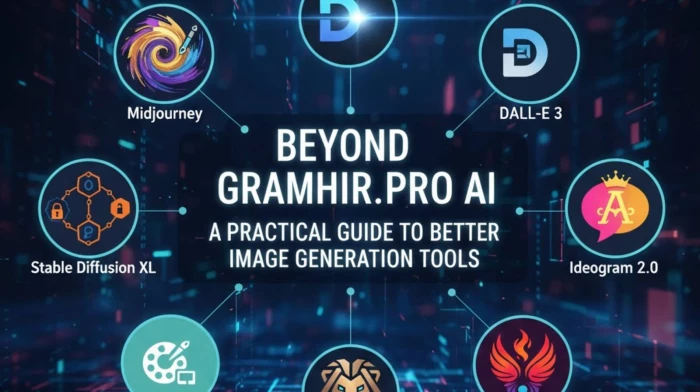
Gramhir.pro is one of those tools that frequently appears in search results, yet its purpose often feels unclear. Some sources still associate it with the old Gramhir Instagram viewer, others describe it as an AI image generator, and a few position it as a mix of analytics and creative tools.
In practice, Gramhir.pro today functions primarily as a basic text-to-image generator designed for users who want quick, beginner-friendly visuals with minimal setup.
That simplicity can be useful, but in AI image landscape, many platforms now offer significantly better quality, control, consistency, and creative depth. Rather than repeating a generic overview of Gramhir.pro, this guide focuses on stronger alternatives, explaining why they outperform it and who should choose each one.

Gramhir.pro works as a starting point, but several limitations push users to explore alternatives:
As AI image generation matures, users increasingly expect predictable results, prompt accuracy, and flexibility—areas where more specialized tools excel.
While this feature set is useful, the current AI landscape offers several platforms that outperform Gramhir.pro in quality, detail, control, and reliability. Instead of repeating the same overview many articles already publish, this guide focuses on the best alternatives, explaining why each one stands out and who would benefit most from choosing it.
Below are the top alternatives, each explained with the same content you approved, simply reorganized into a numbered list.

Many creators consider Midjourney the standard for artistic AI work. It produces visuals that feel hand crafted, with strong attention to texture, color depth, and atmosphere. If you work in branding, illustration, or creative direction, Midjourney often feels more expressive than other generators.
Users pick Midjourney over Gramhir.pro because it consistently produces images that require less polishing. The community driven environment also helps beginners learn quickly, since thousands share prompt strategies, styles, and workflows.
Choose this tool if you want highly stylized visuals or if you enjoy collaborating with a large creative community.

DALL E 3 stands out for its precision. Where Gramhir.pro may struggle with complex prompts or storytelling, DALL E 3 interprets details with far greater accuracy. It also integrates directly with ChatGPT, helping users refine ideas before generating a final image.
People prefer DALL E 3 when they need images for marketing, product showcases, or concept development. It supports image editing, variations, and context aware improvements that allow you to revise work without starting over.
Choose this tool if you want realistic output, strong prompt alignment, and an easy revision process.

For users who want full creative control, Stable Diffusion XL is one of the most flexible options available. Unlike Gramhir.pro, which depends entirely on its hosted system, Stable Diffusion can be run locally, modified, and even trained on custom datasets.
This makes it ideal for advanced users, developers, and designers who need fine tuning, model control, or private generation for sensitive projects.
Choose this tool if you want open source freedom, unlimited experimentation, and the ability to run AI without relying on a hosted platform.

Where most generators struggle with typography, Ideogram 2.0 excels. It creates clean, readable text inside images, which makes it ideal for posters, ads, product designs, and social media graphics.
Gramhir.pro cannot match Ideogram’s accuracy in headline or logo generation, and this is the main reason creators who need branded work shift to this tool.
Choose this tool if you produce visuals that require text, especially commercial or marketing graphics.

Canva AI is the most convenient alternative for users who want an all in one workspace. It generates images, edits them, and lets you drop them directly into templates for ads, thumbnails, presentations, or social posts.
What makes it more practical than Gramhir.pro is the entire ecosystem around it. Instead of exporting images and re editing them elsewhere, Canva allows everything to happen in one place.
Choose this tool if you value speed, simplicity, and a full design environment rather than a standalone generator.

Adobe Firefly is built for professionals who use Photoshop or Illustrator. It delivers clean, consistent images that blend smoothly with traditional editing workflows. Teams often trust Firefly more than smaller platforms because Adobe provides clear usage rights, commercial licensing, and enterprise security.
Gramhir.pro does not offer the same guarantees, which is why businesses tend to choose Firefly when AI imagery will be used in commercial campaigns.
Choose this tool if you need professional grade output, predictable quality, and licensed resources for client work.

For users building game assets, character art, or fantasy environments, Leonardo AI offers specialized models that outperform general generators. It allows creators to train custom models and control visual style more than Gramhir.pro’s simpler engine.
This platform is especially popular among indie developers, illustrators, and concept artists who want a tool that adapts to a niche rather than a broad general audience.
Choose this tool if you work in gaming, concept art, or specialized visual design.
Artistic depth: Midjourney
Prompt accuracy & realism: DALL·E 3
Maximum control: Stable Diffusion XL
Text-based visuals: Ideogram 2.0
Fast content creation: Canva AI
Professional & licensed work: Adobe Firefly
Gaming & fantasy art: Leonardo AI
Gramhir.pro serves as a functional entry point, but it exists in a crowded space where many tools now offer higher image quality, better customization, and clearer reliability.
The best alternative depends entirely on your goal:
Each platform listed above surpasses Gramhir.pro in a specific, meaningful way. By choosing a tool aligned with your actual needs, not just accessibility, you’ll get more consistent results and far greater creative value.
Be the first to post comment!

Introduction: Why Sales Automation Is No Longer OptionalToday’s B2B sales enviro...
Michael Hicklen2 months ago

Image search has quietly become one of the most powerful discovery, research, an...
Michael Hicklen2 months ago
Why Workflow Automation Matters in 2026Automation tools help businesses:● S...
Michael Hicklen2 months ago

1) Foundations :What software review platforms are-Software review platforms are...
Michael Hicklen2 months ago

1. What AI Automation in Daily Work Actually Means?1.1 AI automation in daily wo...
Michael Hicklen2 months ago

1. What Is a CRM?Definition-A CRM (Customer Relationship Management) system...
Michael Hicklen2 months ago