Most people ask “Which is better, Midjourney or Leonardo AI?” as if they are two versions of the same thing. In reality, this choice is less about which is “stronger” and more about what kind of work needs to be done.
One of these tools behaves like an art studio that happens to be powered by AI. The other behaves like a production house that happens to be powered by AI. Both are impressive. They just serve different instincts.
Forget names for a moment and look at the work.
If the main desire is to explore styles, discover surprising visuals, and create images that feel emotional, cinematic, and expressive, the problem is creative exploration.
If the main desire is to ship assets for products, ads, games, clients, videos, and brand systems, with control over consistency, realism, and pipelines, the problem is production.
Midjourney leans toward the first world. Leonardo leans toward the second.
Midjourney treats images like paintings. Even when the prompt is technical, the output often feels like a frame from a film or a highly stylised illustration.
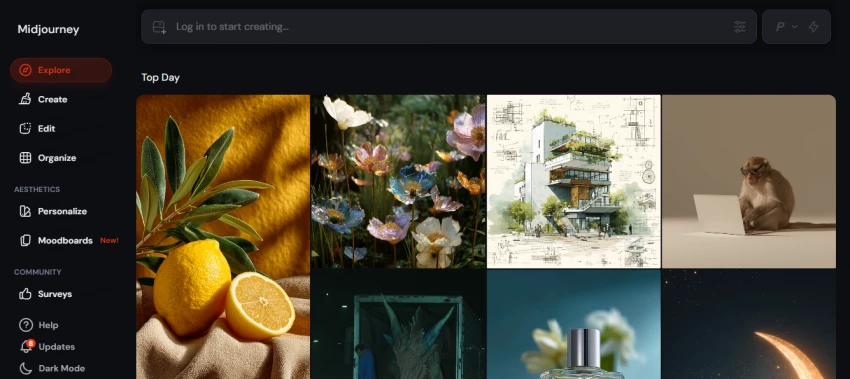
Common patterns in Midjourney work:
That is why concept artists, illustrators, and moodboard creators gravitate toward it. Midjourney is not trying to be neutral. It has an opinion.
Leonardo treats images like assets. It offers different models for different jobs: realism, anime, stylised illustration, textures, and more. Each model is tuned for a certain look so that outputs can be more literal when needed.
Common patterns in Leonardo work:
That is why product designers, marketers, game studios, and agencies treat Leonardo as a production suite rather than just a fun art toy.
Midjourney removed its free option long ago. Every serious attempt to use it now starts with a paid plan. The lower tier gives a limited pool of generation time. The higher tiers add more generation time, a relaxed mode for slower unlimited jobs, and a private mode for those who cannot expose work in public galleries.
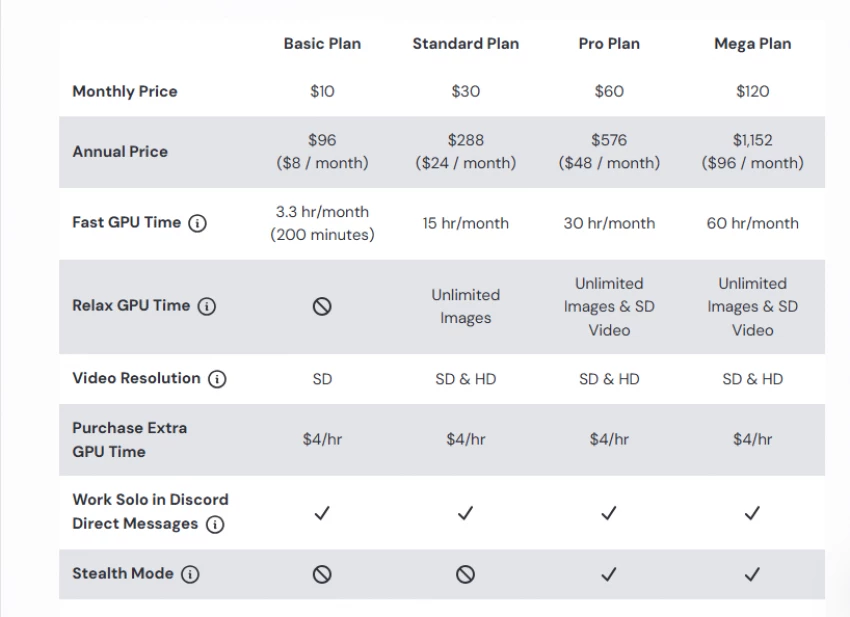
In practice, the cheapest plan behaves like a paid test run. Regular users hit its limits quickly. The mid‑tier is where most people who use Midjourney seriously end up, because it gives enough generation time and access to slower unlimited rendering. The higher tiers exist for agencies, studios, and larger buyers who need private work and more volume.
Leonardo handles cost differently. A permanent free tier makes it possible to test the platform properly without spending anything. Paid plans add token allowances each month, and tokens roll over up to a cap, which suits people who work in bursts. On higher plans, relaxed or low‑priority generation can become effectively unlimited beyond that allowance.
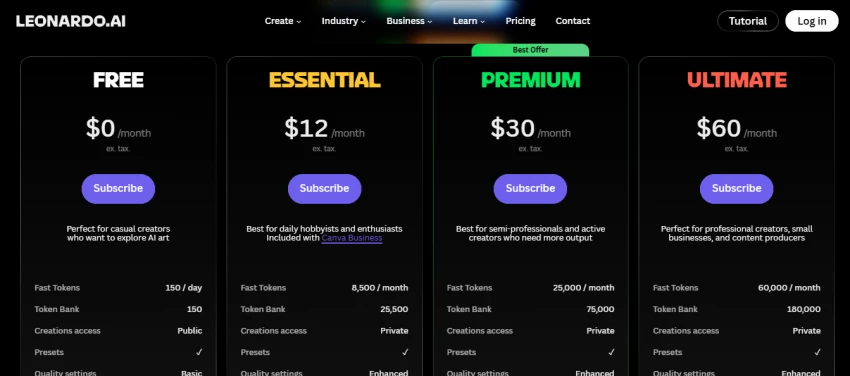
At the same headline price, Leonardo usually allows more total images than Midjourney. That matters for anyone doing volume: stores, ad accounts, content teams, and development pipelines. Midjourney is more like a boutique studio charging for its taste, while Leonardo behaves more like a factory willing to push out a lot of assets when needed.
Midjourney built its identity on Discord. Typing a prompt into a shared channel, watching ideas from other users, and seeing results appear as a grid became part of the appeal. That social stream of images still helps people learn prompt tricks just by watching. A newer web interface has made it easier to work without Discord, but the basic pattern remains:
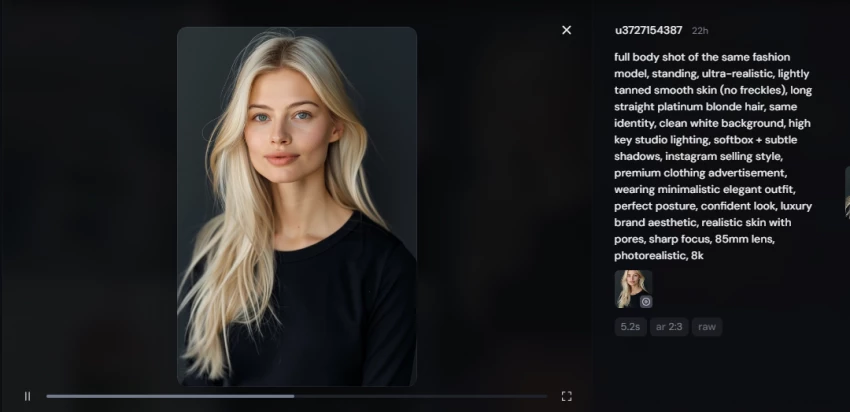
There is no built‑in canvas, no timeline, no layered editor. Once an image is accepted, heavier editing happens in other software. Midjourney’s strength is the generation moment itself.
Leonardo opens more like a design tool. There are panels, tabs, models to pick, and an editor area. Image generation is one mode. Working on a canvas is another. Training a custom model is another. Generating videos is another.
That can feel like a lot at first, but it also means:
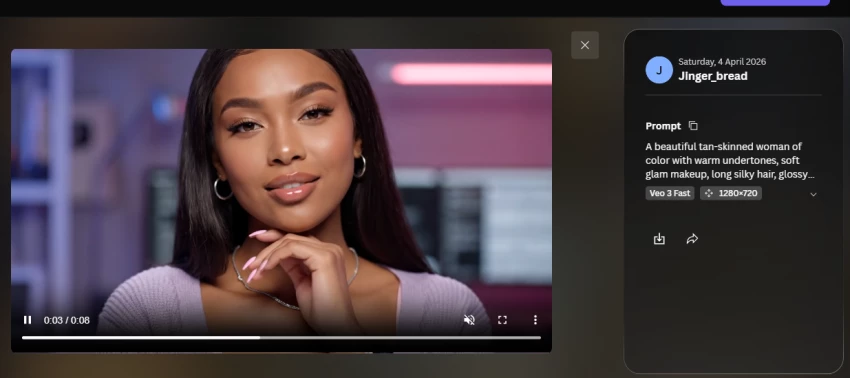
Midjourney feels like a smart, intense sketchbook. Leonardo feels more like a full workshop.
| Situation | Why Midjourney feels right |
| Goal is to explore styles and moods more than precise specs | It treats prompts like creative direction rather than strict blueprints. |
| Work involves concept art, editorial illustration, or fantasy worlds | Its default aesthetic naturally leans into cinematic and painterly looks. |
| Community and inspiration matter as much as output | The shared stream of work and prompts makes learning natural. |
| Volume needs are modest and quality matters more than quantity | Paying for fewer but more distinctive images feels acceptable. |
| Situation | Why Leonardo feels right |
| Goal is to ship product shots, marketing assets, or game art | Realism‑focused models and better text rendering suit production use. |
| Need exists for consistent characters, styles, or brand looks | Custom model training and ControlNet provide repeatability. |
| Work includes both images and motion pieces | Built‑in video generation means fewer tool switches. |
| There is a need for APIs, automation, or integration into apps | A full API supports pipelines and developer workflows. |
| Budget must stretch across a high number of generations | Token systems and rollovers give more output per dollar. |
This is often enough to see where a real project belongs.
Midjourney’s strongest moments often show up when prompts are open‑ended or artistic. A simple phrase like “a city at dawn in the rain” can come back as a frame that feels like it belongs in a film. Style prompts using art history, cinematography language, or specific visual moods generally produce images with a surprising level of coherence.
For pure creativity sessions, Midjourney has a way of turning vague ideas into visuals that push thinking forward. That makes it ideal for:
It also benefits heavily from the crowd around it. Seeing how other people achieve certain looks through prompts, parameters, and seeds is a form of social learning no static documentation can match.
Leonardo’s strengths show up when there is a clear brief. If the prompt is “packaging shot for a new drink can, white background, print‑ready resolution, label text legible,” the platform is more likely to hit that mark cleanly.
The ability to train custom models based on a character, product, or visual style is especially valuable. Once training is done, that model can be reused across dozens or hundreds of images, which solves one of the biggest headaches with AI images: keeping things consistent.
The built‑in canvas allows details to be fixed quickly without bouncing between tools. Areas can be masked, changed, extended, or cleaned up. Combined with motion tools that turn still images into clips, Leonardo becomes a bridge from idea to deliverable for:
Midjourney can certainly contribute inspiration here, but Leonardo is usually where the final, production‑ready frame is crafted.
Text inside images is still a weak spot for many AI models. Midjourney, even in advanced versions, tends to mangle letterforms and struggle with precise wording in logos, labels, and posters. For simple designs where text can be added later in a design tool, this is not a big issue. For finished assets that require readable text directly from the AI, it is a dealbreaker.
Leonardo handles text more reliably. It is not perfect, but in side‑by‑side tests, text accuracy, legibility, and layout come out noticeably better. That is one reason Leonardo is more often used for packaging mockups, social ads, banners, and interface‑adjacent graphics. Anything that needs readable letters benefits from that extra control.
Technical prompts that mention camera types, focal lengths, lighting setups, and material properties also tend to translate more faithfully in Leonardo. Midjourney interprets many of those requests in its own artistic way, which is sometimes what is wanted and sometimes not.
Community vs tools: what matters more to you?
Midjourney feels like a live gallery. Even without touching the tools, watching its firehose of images can reframe how someone thinks about composition, lighting, and style. That constant feed becomes part of the value.
Leonardo feels like a studio. The community is there, but the star of the show is the toolbox: models, canvas, training, video, and APIs. Inspiration is possible, but the focus is on getting projects finished.
Choose based on where energy is drawn: toward watching, experimenting, and sharing, or toward building systems and delivering assets.
Many studios, agencies, and serious creators do not force themselves to choose permanently. A pattern has emerged:
use Midjourney as the “idea engine” to explore visual directions, moods, and bold compositions
pick the best concepts and move them into Leonardo
retrain or refine the look using Leonardo models, then finalise details on the canvas
create motion pieces from the chosen images when needed
This keeps the emotional, surprising side of Midjourney and the controlled, repeatable side of Leonardo working together. It is less about which tool wins and more about where each tool sits in the process.
Instead of asking which platform is “best,” look at the next project in the pipeline.
If that project calls for concept art, visual experiments, stylised social posts, or illustrations where the main goal is to feel something when looking at the image, Midjourney aligns naturally.
If that project calls for product shots, campaign assets, game visuals, or anything that must be consistent, editable, and ready to hand to a client or upload to a store, Leonardo aligns more naturally.
The best choice is the one that makes the next real piece of work easier, not the one that looks best on a feature chart.
Be the first to post comment!

CivitAI made it incredibly easy to grab Stable Diffusion checkpoints and LoRAs,...
Suraj Malik2 days ago

Unlucid AI built its reputation around “uncensored AI for dreamers,” with free o...
Suraj Malik2 days ago
Artificial intelligence has learned how to write essays, generate images, and ev...
Suraj Malik4 weeks ago

Let’s be honest.Online learning has come a long way from static video lectures a...
Suraj Malik1 month ago
The NSFW AI companion market is no longer small or experimental. It has become s...
Suraj Malik1 month ago
Merlin AI is often installed casually,usually as a browser extension someone wan...
Suraj Malik1 month ago