I’m going to be blunt up front: Novel AI wasn’t what I expected.
Not in a bad way, just wildly different from the “AI writing tools” I’ve used before.
When I finally sat down and spent real time with it (not just the usual 10-minute test I give most tools), I realized something important:
Novel AI doesn’t behave like ChatGPT, Claude, Reedsy, Sudowrite, or DreamPress.
It behaves like an eccentric but incredibly gifted co-author.
It can be brilliant, stubborn, chaotic, graceful, frustrating, and shockingly human.
So this review isn’t a surface-level overview.
It’s everything I experienced, the good, the bad, the confusing, the addictive, after writing nearly 30,000 words inside Novel AI’s editor.
When I first logged in, I expected something friendly, sliders, simple buttons, big “Generate Story” text.
Instead, Novel AI hit me with an editor filled with:
Honestly?
I froze.
This wasn’t the “Casual AI writer” experience I got from DreamPress or Smodin.
This looked like someone dumped tools meant for actual novelists and said:
“You figure it out.”
And for the first half hour, that was exactly how it felt.
But something unexpected happened after I tuned a few settings and wrote my first proper prompt.
Novel AI didn’t give me generic filler or melodramatic clichés.
It gave me a scene, a real one, with pacing, rhythm, characterization, and emotional control.
That was the moment I knew I had to go deeper.
I ran Novel AI through every type of writing I could think of:
And my conclusion?
Novel AI writes like someone who actually reads books.
The prose isn’t flat. It isn’t corporate. It isn’t robotic.
It feels deliberate. It has pauses, tension, reflection, energy.
I wrote a prompt about a character sitting in a café after a breakup, a typical emotional test scene.
Most AI tools fill this with dramatic clichés.
Novel AI did something different.
It slowed down.
Focused on small sensory details.
Let emotions simmer instead of explode.
It felt… human.
If you don’t guide it properly?
It becomes poetic gibberish.
It can over-describe.
It can get flowery.
It can derail emotionally.
That’s why Novel AI is NOT a “plug and play” tool.
It’s a knife, powerful, precise, but dangerous if you don’t know how to handle it.
This was the part that made me realize why serious writers swear by Novel AI.
I put in:
“Aiden is a mechanic who hides his fear of abandonment behind dry humor.”
Novel AI kept that tone consistently for 8–10 generations.
Better than any other tool I’ve used.
I added:
“Tone: grounded, restrained, realistic human emotions, no melodrama.”
This instantly “corrected” the AI’s tendency to become overly poetic.
This is where the magic really happened.
I created:
Novel AI began referencing my lore naturally.
Not perfectly, but enough that I could maintain narrative integrity.
This feature alone puts Novel AI above 90% of creative writing tools.
I tested the main presets:
Balanced, emotional, best for character-focused scenes.
More dramatic, lush, fantasy-tilted prose.
Cleaner, tighter, more controlled narrative structure.
Switching presets felt like switching between different authors.
For example:
I didn’t expect to rely on presets this heavily.
But I did, in fact, presets became one of the reasons I enjoyed experimenting.
This is the part most reviews gloss over.
Novel AI expects you to experiment.
If you try to treat it like “ChatGPT for fiction,” you’ll hate it.
If you try to treat it like “DreamPress but fancier,” you’ll be confused.
Here’s the truth:
And because of that…
But if you’re someone who cares about craft?
If you enjoy shaping a character voice, pacing a narrative, or building a world?
Novel AI becomes a dream.
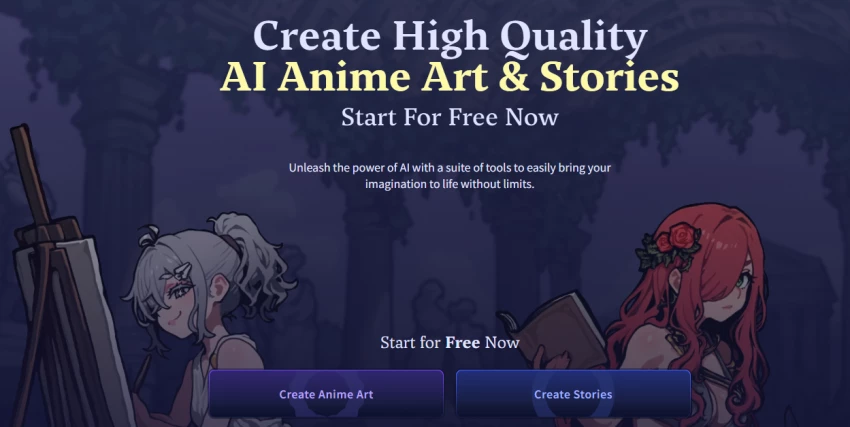
I tested image generation like everyone else, expecting mid quality.
But the anime-style art?
Holy.
It.
Delivers.
Highlights:
Detailed character art
Clean faces
strong lighting control
good prompt accuracy
But,
Still, paired with fiction writing, the image generator feels like an optional but fun bonus.

I tried the Opus plan ($25/month).
The writing experience felt worth it for a serious writer.
But for casual writers?
It feels expensive.
Compared to DreamPress ($5–$10), Novel AI is a commitment.
But the depth you get is also far more advanced.
If you’re planning to write a book, a long fanfic, or a full universe, Novel AI is absolutely worth it.
If you just want to have fun with short stories?
Probably not.
I noticed that if I wrote a few paragraphs myself, Novel AI began matching my tone.
It avoids cheap clichés when instructed.
It knows “less is more.”
But only if settings are tuned properly.
It feels alive in ways other tools don’t.
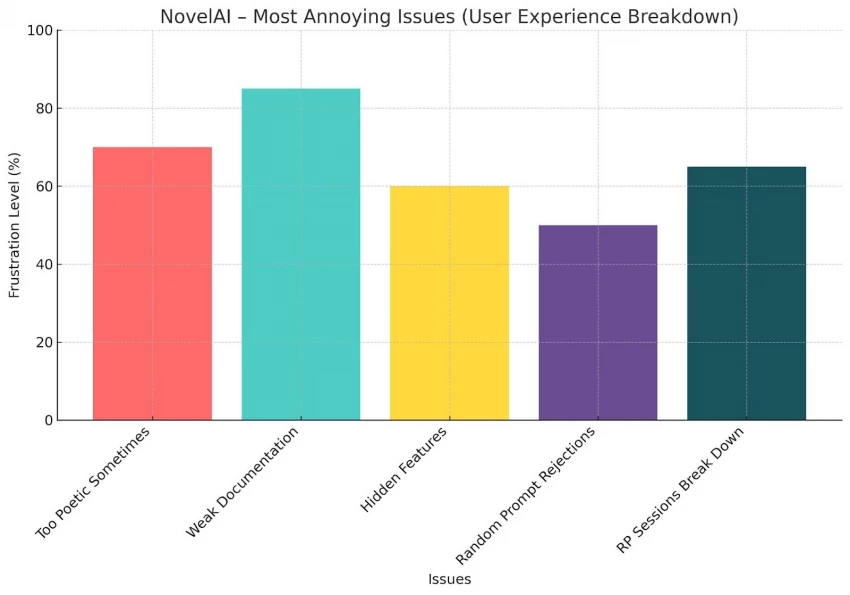
Sometimes I had to “dial it back” multiple times.
You have to learn by yourself or depend on Reddit guides.
Lorebook access isn’t obvious for new users.
Especially after long sessions.
Continuity survives longer than other tools, but not endlessly.
After a week of writing, editing, building characters, and testing edge cases…
Here’s the truth:
If you want:
Novel AI is absolutely unmatched.
But if you want:
You’ll get frustrated fast.
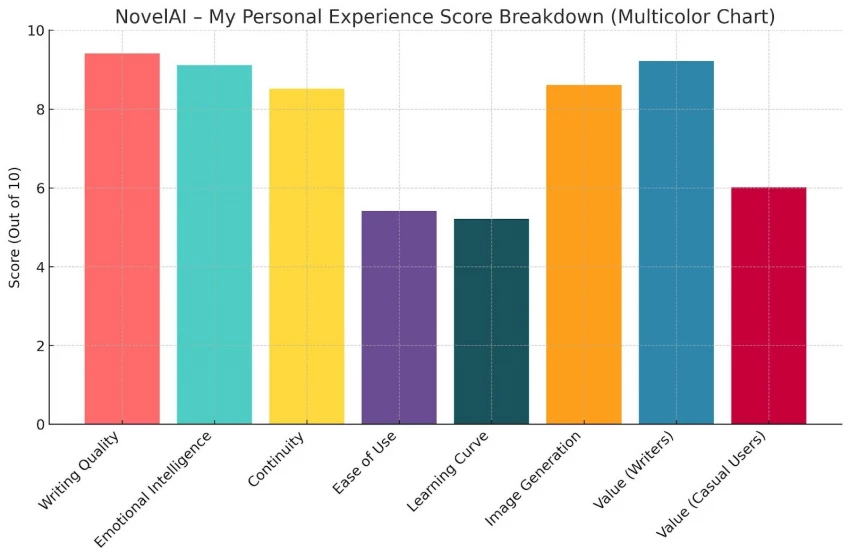
| Category | My Score |
| Writing quality | 9.4/10 |
| Emotional intelligence | 9.1/10 |
| Continuity (with memory) | 8.5/10 |
| Ease of use | 5.4/10 |
| Learning curve | 5.2/10 |
| Image generation | 8.6/10 |
| Value for serious writers | 9.2/10 |
| Value for casual users | 6.0/10 |
| Overall | ⭐ 8.6 / 10 |
Novel AI didn’t impress me out of the box.
It impressed me when I stopped treating it like a toy and started treating it like a creative partner.
It’s flawed, powerful, moody, brilliant, frustrating, addictive, exactly like a real writer.
And that’s why I ended up liking it more than most AI writing tools.
Be the first to post comment!
I’ll admit it, SpicyChat AI is one of those tools you don’t exactly open with “s...
Vivek Gupta4 days ago
For months, the global AI industry has lived in a state of suspended animation w...
Vivek Gupta1 week ago

In today’s fast-moving digital landscape, intelligent software that can act inde...
Mighva Verma3 weeks ago

In today’s business world, customer expectations have shifted dramatically. Peop...
Mighva Verma3 weeks ago

Top AI Transcription Tools Designed for TeamsRemote and hybrid teams are drownin...
Mighva Verma1 month ago
In today’s content-saturated world, merely producing more isn’t enough. Smart cr...
Mighva Verma1 month ago