Reviews
5 min read
PolyAI Review: Features, User Reviews, Use Cases and Alternatives
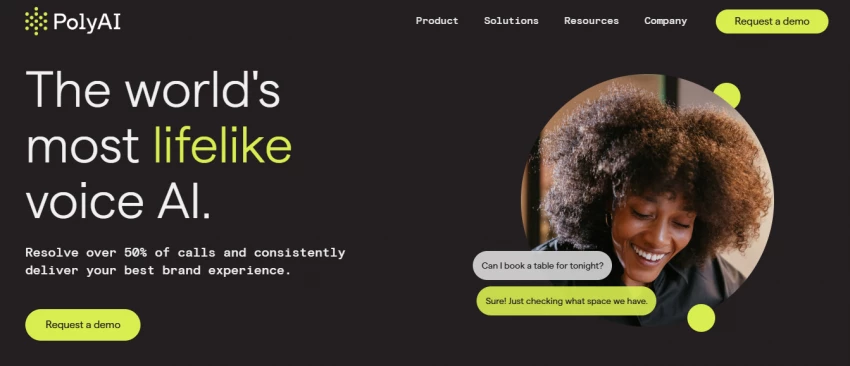
Poly AI is a sophisticated conversational AI platform designed to facilitate natural, human-like interactions in customer support, sales, and service automation. With a focus on contextual understanding and multilingual capabilities, Poly AI is tailored for businesses that require a robust AI assistant capable of handling complex, dynamic conversations.
● Core Voice & Language Capabilities : Natural, human‑like voice synthesis designed for phone calls, with voices that sound like real agents rather than text‑to‑speech and Multilingual support (dozens of languages and dialects) for global deployments in banking, healthcare, travel, and hospitality.
● Agentic AI & Agent Studio: There is a control center to build, manage, and monitor AI agents introduced as a major 2025 product milestone and agents can reason over context, plan multi‑step workflows (e.g., authenticate, look up account, reschedule), and execute actions to reach a business goal.
● Enterprise Integrations & Compliance: Native integrations with CRMs, contact‑center platforms, and telephony (e.g., existing IVRs, call routing) to slot into current stacks without major rip‑and‑replace. For Enterprise, it grade security and compliance, including support for SOC 2, HIPAA, and GDPR, aimed at regulated sectors.
● Analytics, Automation & Performance: For operations and performance, PolyAI offers session and call analytics dashboards that surface metrics like call volume, containment or resolution rates, and emerging hot issues, helping teams understand what customers are asking and where flows break down.
● Targeted Use Cases & CX Focus: 24/7 inbound support for reservations, FAQs, order status, authentication, and account changes, with natural escalation to humans when needed. It specifically designs for hospitality, financial services, healthcare, utilities, and retail, often delivered as fully managed projects.
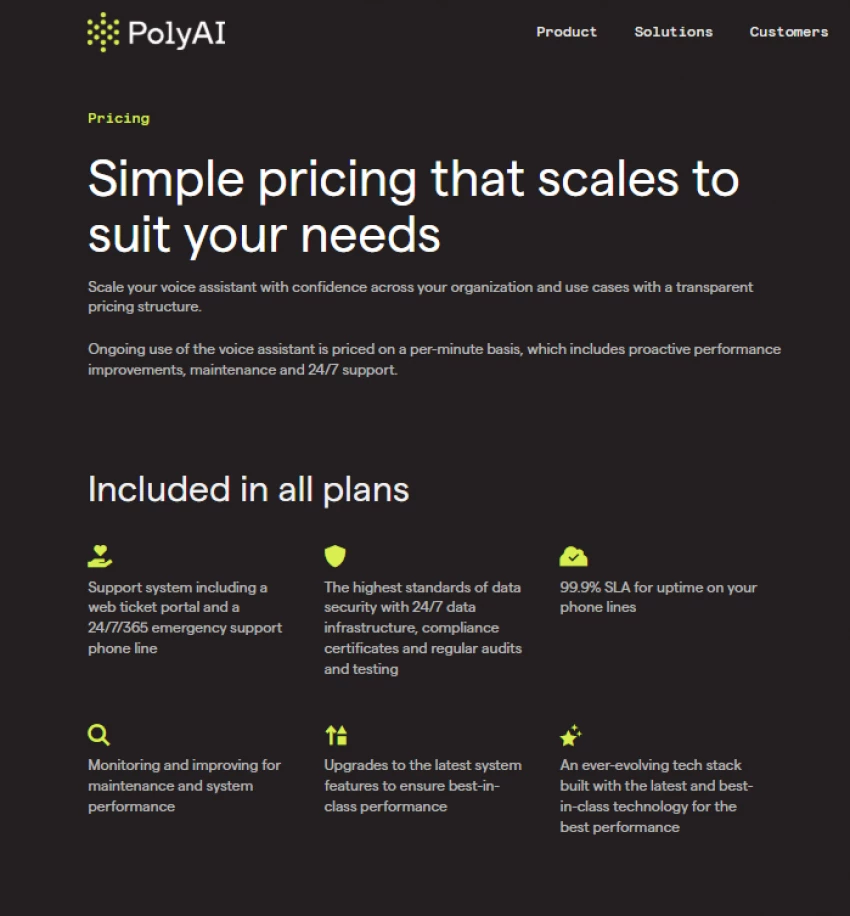
PolyAI does not publish a simple, fixed price list; pricing is custom and enterprise‑oriented, with usage‑based billing underneath.
| Platform | Avg Rating | Reviews (used) |
| G2 | ≈4.6–5.0/5 | ~11–12 |
| Capterra | ≈4.5–5.0/5 | Few (1–3 public) |
| Trustpilot | 3.7/5 | 1 |
| Analyst/industry blogs | Typically 6–9/10 equivalent, or “top-tier/leader” labels | ~6–8 |
| Reddit threads | N/A (text sentiment) | Several |
● Highly human‑like, natural, emotionally intelligent voice; many reviewers say callers often cannot tell it is a bot.
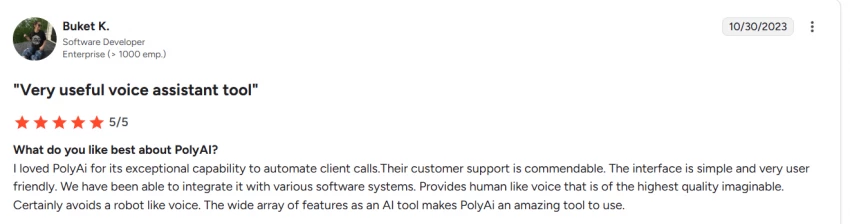
● Strong call containment and automation: 50–80% (sometimes 87–90%) of calls handled without agents, with big reductions in operating costs and wait times .
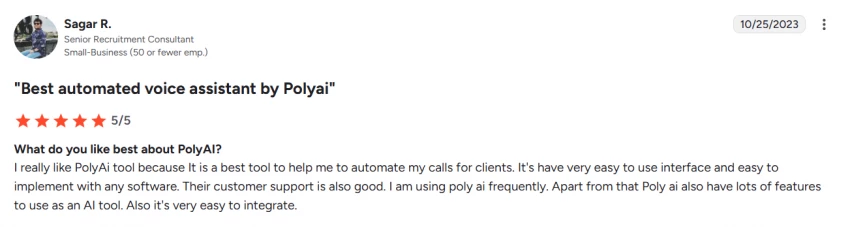
● Enterprise‑grade security and compliance (SOC 2, HIPAA, GDPR) plus deep integrations with CRMs/telephony systems, appealing to banks, healthcare, travel, hospitality.
● Documented ROI: Forrester‑commissioned and analyst reports cite ~391% ROI over three years, millions in incremental revenue, and major reductions in seasonal hiring.
● Support and implementation: Several G2/Capterra users describe the PolyAI team as knowledgeable, responsive, and able to launch in weeks with strong guidance.
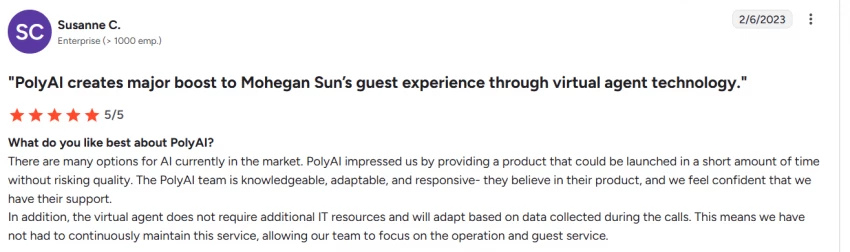
● Pricing opacity and overall cost: Frequently described as a “$150k+ enterprise” product with no public pricing and a premium, contract‑driven model.
● Analytics depth: User‑facing analytics described as basic, lacking deep sentiment and funnel analysis by some reviewers (despite marketing claims of rich analytics).

● Latency: Typical response times around 700–900 ms; labeled “good but not best‑in‑class” and a concern for high‑pressure or ultra‑fast interactions.

● Limited self‑service and “walled garden”: No LLM sandbox, limited dashboard control, most changes routed via account teams; agile teams can feel blocked.
● Not ideal for SMBs/hobbyists: Reddit and several blogs stress it is overkill or too expensive if you are not a large call‑center‑style operation. reddit
● Large or upper‑mid enterprises with high inbound call volume (tens of thousands+ per month) that want to automate Tier‑1 customer support, reservations, account inquiries, and similar flows over phone.
● Regulated industries (banking, healthcare, insurance) and brand‑sensitive hospitality/travel companies needing compliant, highly natural voice experiences with strong call containment and proven ROI.
● Teams that value a fully managed, white‑glove deployment and are comfortable working through an account team rather than directly tweaking models.
● Startups, SMBs, or solo builders seeking low‑cost, transparent, self‑serve voice AI with flexible experimentation and developer‑friendly sandboxes.
● Ultra‑low‑latency use cases where sub‑500 ms response is critical (e.g., real‑time trading, gaming voice assistants); other platforms may perform better on latency.
● Teams whose main priority is deep in‑house analytics and granular control over prompts, models, and routing rather than a managed “finished product.”
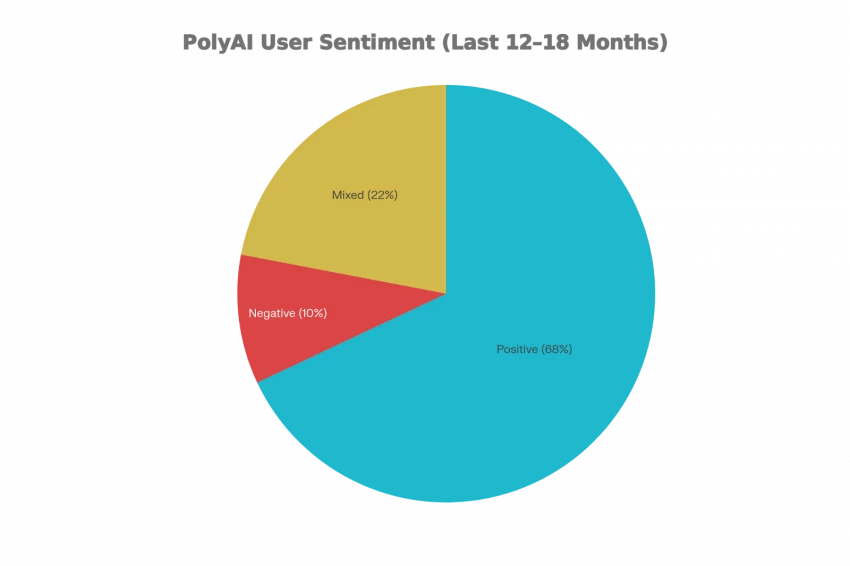
Here is a clean pie chart illustrating PolyAI’s approximate sentiment split (68% Positive, 22% Mixed, 10% Negative) from recent reviews and analyses.
| Features | Poly AI | Google Dialogflow | IBM Watson | LivePerson |
| Main Focus | Enterprise voice & text automation | General-purpose NLP & chatbot | Enterprise AI with advanced NLP | Conversational commerce & support |
| Voice Integration | Yes, strong voice support | Limited (via integrations) | Yes, robust voice capabilities | Yes, integrated for live chat |
| Multilingual Support | Yes, supports over 45 languages | Yes, supports over 20 languages | Yes, supports multiple languages | Yes, supports multiple languages |
| Analytics/Insights | Limited analytics & reporting | Detailed reporting & analytics | Advanced analytics & reporting | Rich analytics and reporting |
For large enterprises with high call volumes, strict compliance needs, and a clear business case for automating millions of conversations, PolyAI is a top-tier, high-ROI choice and justifiably positioned as a leader in enterprise voice AI. For SMBs, early-stage teams, or organizations that prioritize low cost, self-serve experimentation, and rapid iteration over white-glove implementation, PolyAI is likely too expensive, too closed, and too slow to adapt—making newer, more flexible voice platforms a better match.
Be the first to post comment!

There was a time when every company website proudly displayed glowing customer t...
Suraj Malik10 hours ago

Imagine choosing a business partner, a SaaS tool, or a digital agency without ch...
Suraj Malik11 hours ago

I didn’t land on Monkeytype because someone told me it was “the best typing site...
Sakshi Dhingra11 hours ago

Online gaming in India has changed rapidly. What once meant casual mobile games...
Sakshi Dhingra11 hours ago

In today’s data-driven marketing landscape, clarity is often promised but rarely...
Michael Hicklen13 hours ago

I didn’t start analyzing Daman Games because of hype. I started because I kept s...
Sakshi Dhingra1 day ago