
The push to automate customer service is no longer a trend. It is a financial necessity. With the conversational AI market projected to reach tens of billions of dollars in value within the next decade, businesses are aggressively searching for AI systems that not only answer questions but genuinely improve the customer experience. This is where PolyAI has built its reputation, claiming to deliver voice AI that sounds remarkably human.

There is one complication.
The “PolyAI” name actually covers two completely different products:
This review breaks down both products, analyzes user sentiment, and examines performance data to determine whether PolyAI is truly best in class or just an expensive promise.
| Category | Rating |
|---|---|
| Voice Quality and Realism | ★★★★★ (5/5) |
| Automation and Performance | ★★★★☆ (4.7/5) |
| Enterprise Integration and Security | ★★★★☆ (4.5/5) |
| Cost and ROI Justification | ★★☆☆☆ (2.5/5) |
| Category | Rating |
|---|---|
| Creative Freedom and Uncensored Chat | ★★★★★ (5/5) |
| Cost and Accessibility | ★★★★★ (5/5) |
| Reliability and Factual Accuracy | ★☆☆☆☆ (1.5/5) |

PolyAI’s flagship product is its enterprise voice AI. It is designed for large corporations that want to automate high volumes of calls with human-level quality.
PolyAI’s leading feature is its incredibly lifelike voice. Users consistently highlight how natural and expressive the system sounds compared to traditional robotic IVR systems. The platform blends advanced speech synthesis with strong natural language understanding to create smooth, believable conversations.
This matters because customers often avoid traditional phone support due to robotic voices and rigid menu trees. PolyAI addresses this problem by making the experience feel closer to speaking with a trained human agent.
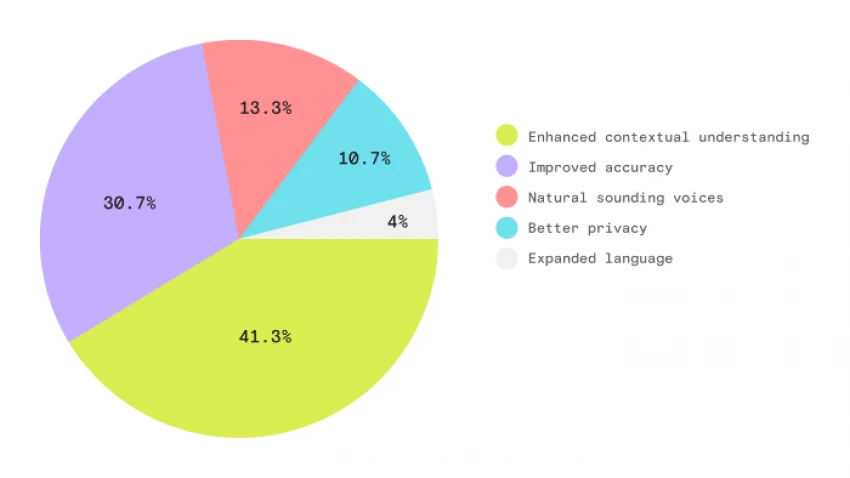
A realistic voice is useless if the AI cannot resolve real customer issues. PolyAI’s business value is driven by high automation rates, with some reported deployments handling up to 90 percent of transactional calls without human agents.
The impact is significant:
The platform also offers strong security standards such as SOC 2 Type II compliance and integrates smoothly with major CRMs and enterprise systems.
Feedback from professional review sites and enterprise users reveals consistent themes.
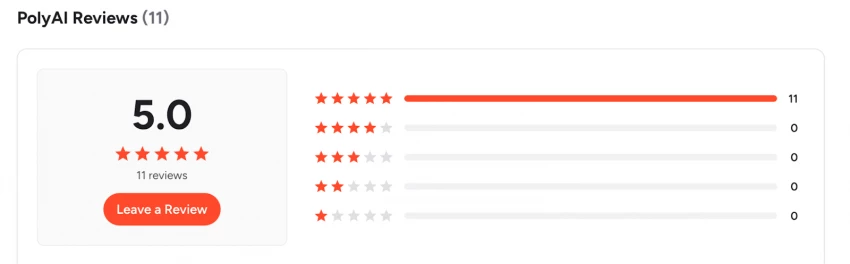
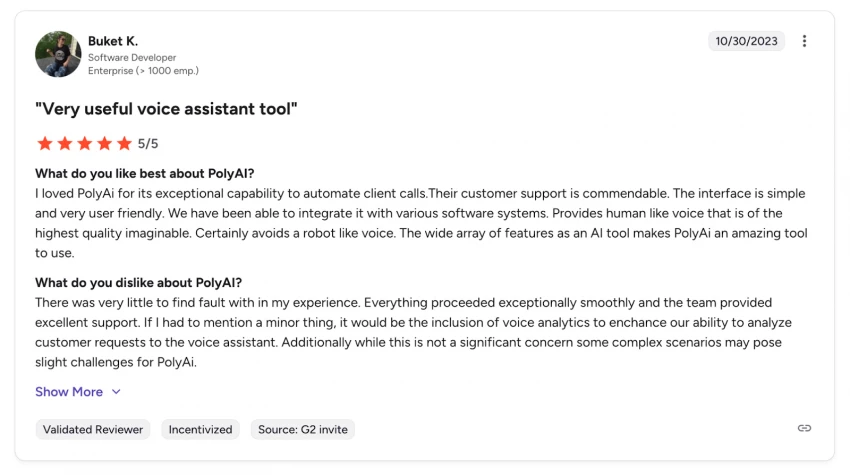
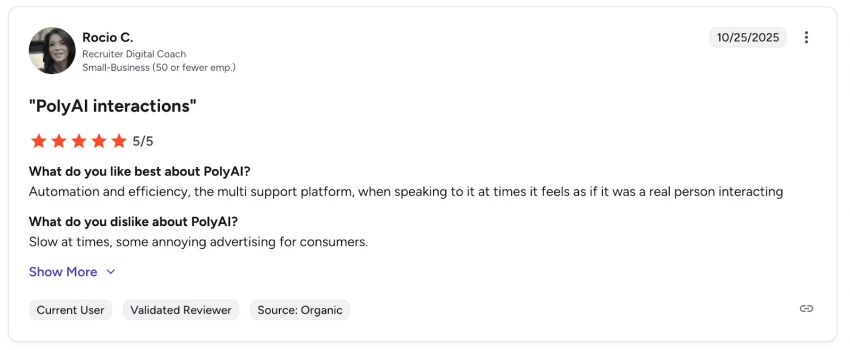
PolyAI delivers high performance but at a premium price. The solution is aimed at enterprises handling massive call volumes.
Costs commonly exceed six figures annually, and rollouts often take months. Companies need the budget, infrastructure, and patience for a long-term automation project. Small and mid-sized businesses will find it financially out of reach.

PolyBuzz is the opposite of the enterprise platform. It is free, fun, casual, and built for creative expression rather than business.
PolyBuzz markets itself as a highly free AI role-play environment. Unlike heavily filtered chatbots, it allows:
It is popular with users who feel constrained by mainstream AI chat restrictions.
Freedom comes at a cost.
PolyBuzz should not be used for research, factual questions, or anything requiring reliability. It is strictly an entertainment app.
PolyAI’s two products live in completely different worlds. Evaluating them together makes no sense unless you recognize this split.
PolyAI Enterprise is one of the strongest voice AI systems on the market. It offers:
The cost is high, but for companies handling millions of calls per year, the ROI is often substantial. It is recommended for organizations with heavy call volumes and high brand expectations.
PolyBuzz is a fun, creative tool, not a productivity or accuracy-focused system. It is ideal for:
Users should expect low factual reliability and frequent ads. It is not meant for serious tasks.
Be the first to post comment!

There was a time when every company website proudly displayed glowing customer t...
Suraj Malik1 week ago

Imagine choosing a business partner, a SaaS tool, or a digital agency without ch...
Suraj Malik1 week ago

I didn’t land on Monkeytype because someone told me it was “the best typing site...
Sakshi Dhingra1 week ago

Online gaming in India has changed rapidly. What once meant casual mobile games...
Sakshi Dhingra1 week ago

In today’s data-driven marketing landscape, clarity is often promised but rarely...
Michael Hicklen1 week ago

I didn’t start analyzing Daman Games because of hype. I started because I kept s...
Sakshi Dhingra1 week ago