When brands think about where to anchor their DNS (Domain Name System) backbone, they often find themselves comparing options that serve very different roles. On one side of the spectrum is Amazon’s Route 53, a cloud-native DNS service designed for high-performance, scalable routing and integration into complex infrastructure. On the other side is GoDaddy, a well-known domain registrar and hosting provider that also offers DNS services tied closely to domains, email, and website management. Although both can register domains and resolve DNS records, they represent different philosophies, use cases, and long-term strategies for web presence management.
To choose between them intelligently, it helps to unpack how each one functions in practice, how they handle performance, how they fit into modern operational workflows, and what a brand actually gains or sacrifices by choosing one over the other.
Understanding the Fundamental Positioning of Route 53 and GoDaddy
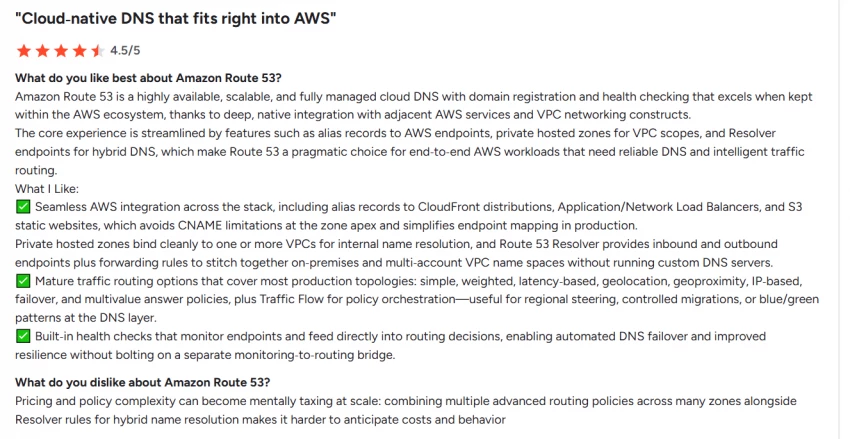
Amazon’s Route 53 is first and foremost a cloud infrastructure service. Built as part of the AWS ecosystem, it emphasizes availability, programmatic control, advanced traffic routing, broad scalability, and tight integration with other cloud services. Route 53 is designed for environments where domain resolution is just one part of a larger deployment, for example, when a distributed application spans multiple regions, load balancing and failover are critical, and automated infrastructure changes are routine.
GoDaddy, by contrast, is fundamentally a domain registrar and small business hosting brand. Its DNS services are bundled with domains and often with other offerings such as email or website builders. The management interface and workflows are targeted at users who want to set up a website with minimal technical learning. DNS in GoDaddy rarely becomes a separate focus for most users: those who register a domain often leave DNS configured in the place they bought it and do not delve into deeper record types or traffic management features.
This distinction, infrastructure-grade control versus high-convenience simplicity, shapes nearly every other difference between the two platforms.
Feature comparison
1) DNS basics (records, TTLs, zone management)
Both support the DNS fundamentals (A/AAAA/CNAME/TXT/MX, etc.) and standard zone editing.
● GoDaddy advantage: “Beginner-friendly” management, templates, bulk import/export, grouping, and an intuitive dashboard aimed at non-specialists. ()
● Route 53 advantage: Infrastructure-grade automation and tight integration with AWS services (useful if you deploy frequently and want DNS changes scripted).
● GoDaddy is generally “classic DNS hosting” (great for pointing names to things), but it’s not positioned as a full traffic engineering layer the way Route 53 is.
3) Health checks & automated failover
● Route 53: first-class health checks and DNS failover. You can monitor endpoints and automatically shift traffic away from unhealthy ones. ()
● GoDaddy Premium DNS: marketed around uptime and redundancy (secondary DNS + Anycast), but it’s not the same “health-check-driven application failover control plane” as Route 53. ()
4) DNSSEC (security)
● Route 53 supports DNSSEC signing/validation; Route 53 itself doesn’t charge to enable DNSSEC signing, though enabling signing can incur AWS KMS charges. ()
● GoDaddy supports DNSSEC; Premium DNS includes securing up to a set number of domains with DNSSEC (example: “secures up to 5 domains with DNSSEC” on the plan page). ()
5) Ecosystem integration
● Route 53 is best when your stack is AWS-heavy (CloudFront/ALB/API Gateway, etc.). Also, Route 53 pricing notes that some Alias queries mapped to certain AWS services don’t incur query charges, which can matter in high-traffic AWS architectures. ()
● GoDaddy is best when you want domains + email + website + hosting under one provider (less “cloud engineering,” more “small business operations”).
6) Scale and enterprise controls
● Route 53 is built for large-scale multi-environment DNS and complex architectures. Its pricing and limits are structured around hosted zones, records, queries, and optional features. ()
● GoDaddy Premium DNS emphasizes managing unlimited domains (zones), record limits per domain, and “no overage fees” in that product packaging.
Pricing model and cost dynamics
Route 53 pricing
● Route 53 DNS pricing is modular: you pay for hosted zones (for example, around 0.50 USD per hosted zone per month for the first 25 zones, and 0.10 USD per month for additional zones) plus DNS query volume tiers, with standard queries starting at roughly 0.40 USD per million.
● Health checks, traffic flow policies, and advanced resolver/firewall features are billed separately, and alias queries to many AWS resources are free, which can materially cut DNS bills for AWS‑centric workloads.
● This pay‑per‑use model tends to be cost‑efficient at scale or where query volume and features justify granular billing, but can feel complex for very small, low‑traffic hobby sites.
GoDaddy pricing
● GoDaddy’s core DNS is bundled “free” with domain registrations and hosting packages, so there is no separate DNS line item for typical small users.
● The catch is in domain pricing structure: first‑year promos often advertise .com domains under 10–15 USD, but renewal prices are higher; some 1‑year test cases show renewals above 50 USD for certain TLDs, plus upsells like privacy, email, and security add‑ons.
● For non‑technical customers who only maintain a few domains, the bundled model is simpler to understand, but over several years GoDaddy can become more expensive per domain compared with flatter registrar pricing.
Performance, reliability, and scalability
● Route 53 is built on AWS’s global anycast DNS infrastructure, and is generally regarded as highly available and low‑latency, especially when combined with AWS regions and edge services.
● User review platforms report that organizations moving from GoDaddy DNS to Route 53 saw improved availability and fewer outages, describing Route 53 as “rock solid” compared to earlier GoDaddy DNS incidents.
● GoDaddy DNS is adequate for low‑criticality sites and small business domains, and its own users rate availability highly in that context, but its platform is not designed as a specialized, feature‑rich enterprise DNS solution in the same way Route 53 is.
Usability and learning curve
● GoDaddy’s web interface is optimized for non‑technical users, with guided flows for searching, registering, and connecting domains, as well as connecting to builders and email in a few clicks.
● Route 53’s console and concepts (hosted zones, routing policies, health checks, integration with other AWS resources) demand more cloud familiarity and are better suited to engineers and DevOps teams.
● In user‑rating aggregates, both products are considered usable, but GoDaddy often scores higher for ease of use among small business users, while Route 53 scores higher among technical teams for flexibility and control.
Support, ecosystem, and add‑ons
● GoDaddy offers extensive sales and customer support for domain, hosting, email, and website builder products, with live chat and phone support tailored to small businesses and individuals.
● Route 53 support is part of AWS Support plans, which can be excellent for enterprises but may be overkill or expensive for very small projects that need simple hand‑holding.
● GoDaddy’s ecosystem includes shared hosting, managed WordPress, site builders, SSL, email marketing, and more, making it a one‑stop shop for non‑technical customers; Route 53’s “ecosystem” is the broader AWS platform of compute, storage, security, and networking services.
Ratings & reputation (what users say)
G2 ratings
● Amazon Route 53:4.5/5 on G2 (144 reviews shown on the pros/cons page).
● GoDaddy Domains:3.9/5 on G2 (946 reviews shown on the review page).
Simple websites, brochure sites, and owners who want an all‑in‑one vendor.
Which one should you choose?
● Choose Route 53 if you run production workloads on AWS or other cloud infrastructure, need high availability and advanced routing, expect traffic growth, or plan to automate DNS changes as part of your deployment pipeline.
● Choose GoDaddy if your priority is quick, non‑technical setup for a small number of domains, bundled with shared hosting, website builder, and email, and your DNS needs are basic.
● For many technical teams, a common pattern is using GoDaddy (or another registrar) only for domain registration, then delegating DNS to Route 53 or another specialized DNS provider to get the best of both worlds.
Side-by-side summary (who wins what)
● Advanced routing & traffic steering: Route 53
● Health checks + DNS failover: Route 53
● Beginner-friendly UI + bundles: GoDaddy
● Predictable plan pricing for managed DNS: GoDaddy Premium DNS
The smarter, future‑proof choice clearly leans toward Amazon Route 53 for anyone treating their website or product as a serious, scalable asset rather than a basic online presence. GoDaddy does a good job at lowering the entry barrier with attractive promos and a beginner‑friendly UI, but its DNS feature set, renewal pricing patterns, and limited automation make it more of a convenience layer than a long‑term technical foundation.
From a technical and business continuity perspective, Route 53 aligns far better with modern DevOps practices: granular routing policies, health checks, AWS‑native integrations, and a transparent pay‑for‑what‑you‑use model fit naturally into CI/CD pipelines and multi‑region architectures. In contrast, GoDaddy shines when your priority is “get a domain, get online, and don’t think about infrastructure,” but starts to show its limits as soon as uptime, latency, and change automation become non‑negotiable.
So, the practical recommendation for a growing brand, SaaS, or content‑heavy project is this: use a registrar like GoDaddy only if the deal is compelling, but delegate DNS to Route 53 (or a similar infrastructure‑grade provider) as soon as you care about resilience and control. That way, you preserve GoDaddy’s initial convenience if you want it, while anchoring your critical traffic on a DNS platform built for scale, observability, and long‑term stability.