Most comparisons between Semrush and Ahrefs throw long feature tables at readers and expect a decision. That approach ignores how tools are actually chosen in 2026. The real question is not “which has more features,” but “which fits the way work really looks from Monday to Friday.”
Semrush has grown into a broad marketing and visibility platform. Ahrefs has stayed focused on pure SEO areas such as keywords, backlinks, and technical health. Both are strong. The wrong choice is not the weaker tool. The wrong choice is the one that does not match the job.
Semrush behaves like a control room for digital visibility. Ahrefs behaves like a sharp SEO console that does fewer things but does them with focus.
| What matters most | Semrush | Ahrefs |
| Main purpose | All‑in‑one marketing and visibility platform that covers SEO, content, competitive data, and AI visibility | Focused SEO platform built around keywords, backlinks, audits, and rank tracking |
| Best suited for | Teams that handle several marketing channels and want one main hub | SEOs, link builders, and agencies focused mostly on organic search |
| Starting price feel | Starts higher, but everyday usage feels more predictable for frequent work | Has cheaper entry options, but lower plans rely more on credits and limits |
| Keyword research style | Great at turning one topic into a full content plan and cluster strategy | Great at deciding whether a keyword is really worth chasing based on realistic traffic potential |
| Backlink strengths | Strong for a broad, long‑term view of link growth and risk, with outreach tools around it | Still the default choice for many link‑focused SEOs who care about freshness and detail |
| Site audit style | Acts like a guide that ranks problems and helps decide what to fix first | Acts like a clean checklist that suits confident technical users |
| AI and new search | Connects classic SEO with AI search and prompt tracking inside one workflow | AI‑related features exist, but feel more like extras beside the core SEO tools |
| Ease of use | More powerful and more crowded; takes longer to feel natural | Cleaner, lighter, and easier to move around for daily SEO work |
Semrush in 2026 is presented as a visibility and digital marketing suite rather than just an SEO toolbox. It brings together keyword research, technical SEO, content planning, rank tracking, competitor analysis, paid search insights, local SEO, social monitoring, and a dedicated AI visibility layer.
That breadth makes Semrush a strong fit for teams that need one place to research, plan, support publishing, monitor performance, and understand how visible the brand is in both classic search and AI‑driven answers. It suits marketing or growth teams more than lone, narrow SEO roles.
Ahrefs in 2026 keeps a tighter focus. Its core still revolves around five main tools: Site Explorer, Keywords Explorer, Site Audit, Rank Tracker, and Content Explorer. Its strongest reputation remains tied to backlink analysis, keyword research, and competitor discovery from an SEO standpoint.
That focus makes Ahrefs feel more like an SEO workbench. It speaks most directly to specialists who want a clean environment, fewer non‑SEO features, and a daily workspace dedicated to search and links.
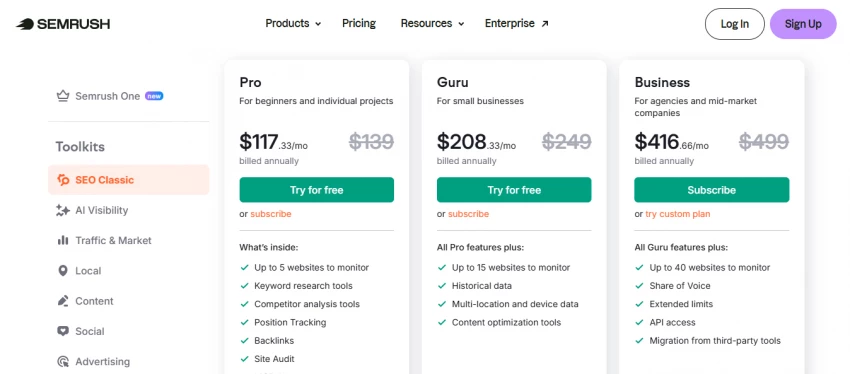
Semrush’s core plans sit at the higher end of the SEO market, with entry‑level pricing around the 139.95‑dollar mark for classic plans and higher pricing for Guru, Business, and newer bundled offerings that include AI visibility.
In everyday life, three things stand out:
For heavy users and cross‑functional teams, Semrush often feels expensive but predictable. For solo users or very small businesses, that same starting price may only make sense if it replaces several other tools.
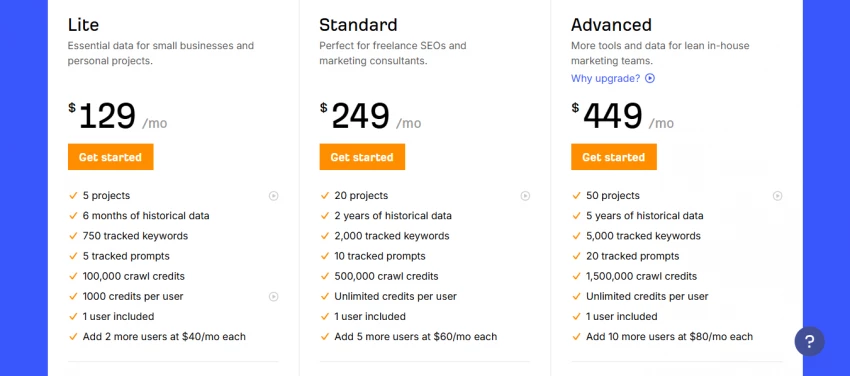
Ahrefs offers a cheaper Starter option, then Lite, Standard, Advanced, and Enterprise tiers above that. The starting numbers are lower than Semrush at first glance, especially for light use.
Two realities appear quickly in practice:
For users with modest usage, Ahrefs can feel efficient and affordable. For users who push the tool hard across many projects, there is more pressure to watch how much is being done on each plan.
Semrush feels more expensive on day one but more predictable under heavy use. Ahrefs feels cheaper at the door but demands more awareness of usage limits, especially on lower plans. The “cheapest” tool on paper may not be the easiest one to live with over a full year.

Semrush’s keyword tools are built for people who want to design content strategies, not just build a list of terms. They are particularly strong at:
For content marketers, editorial teams, and brands that care about topical authority, Semrush makes it easier to go from “one idea” to “a full content roadmap” around that idea. It behaves like a planning engine.
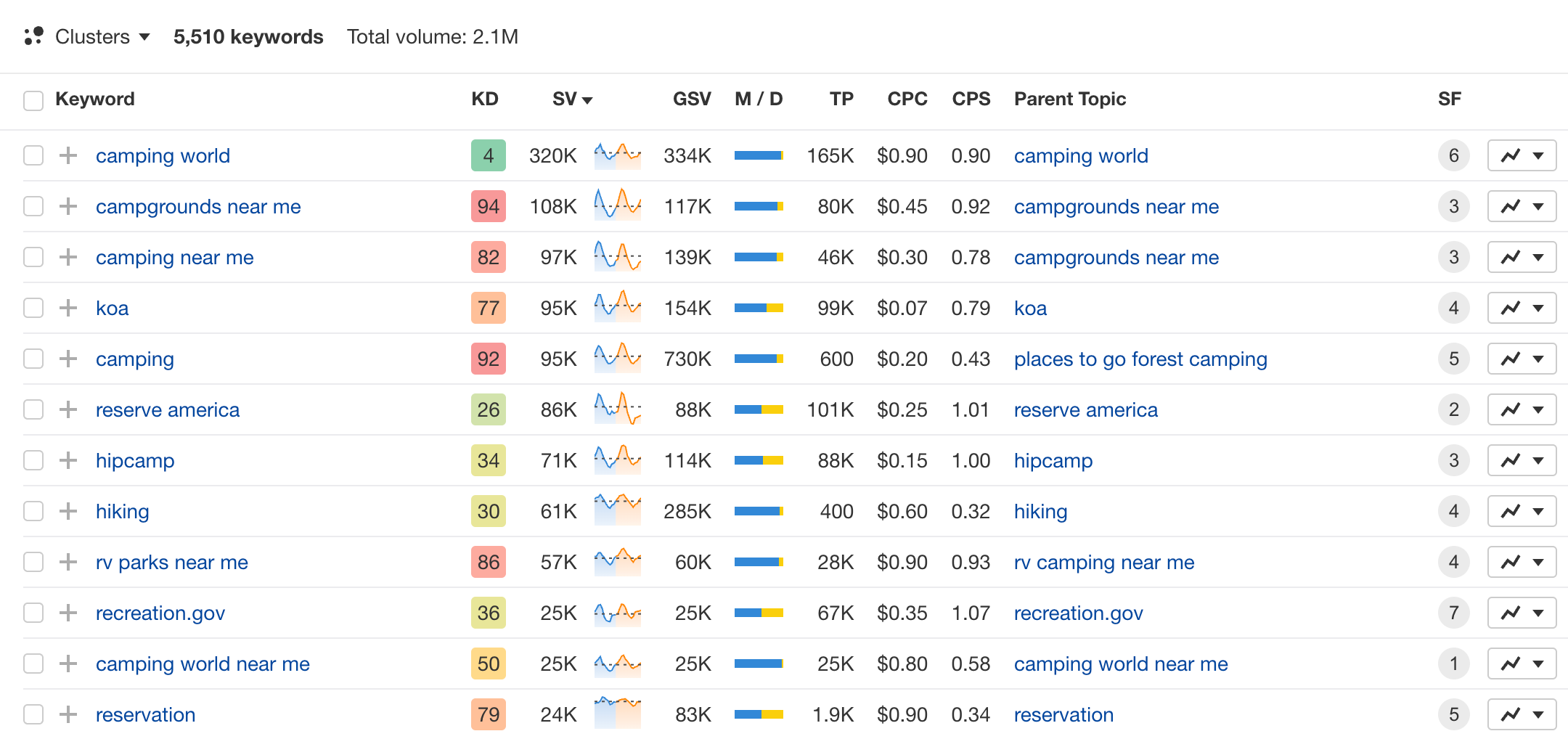
Ahrefs’ keyword tools are built for people who like to be strict about which topics deserve effort. The platform is known for metrics that focus on traffic potential and real‑world click behavior rather than just search volume on its own.
In practice, Ahrefs helps users:
For teams with limited capacity, this filtering is powerful. It supports a “fewer, better bets” approach, where time and content budget are spent only on targets that have a realistic chance of paying off.
Semrush is best when the goal is to build out a topic or niche with many pieces of content. Ahrefs is best when the goal is to avoid wasting time on poor opportunities. One is a strategy engine. The other is a reality filter.
Backlink data has always been one of the strongest topics in this comparison.
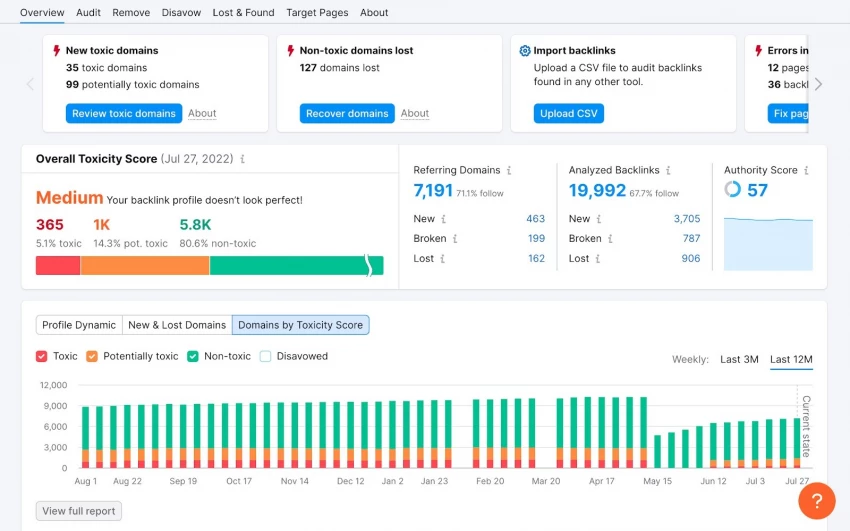
Semrush offers a very large backlink index, long historical depth, tools for spotting risky links, and outreach features that help teams manage link campaigns alongside other marketing activities. It is effective for seeing the big picture of how a site’s authority grows, where gaps exist, and where link cleanup is needed.
Ahrefs, however, still feels like home for many link‑driven SEOs. Its update pace, broken link discovery, “best by links” views, and detailed referring domain reports make it especially comfortable for link builders and agencies who live in those screens every day.
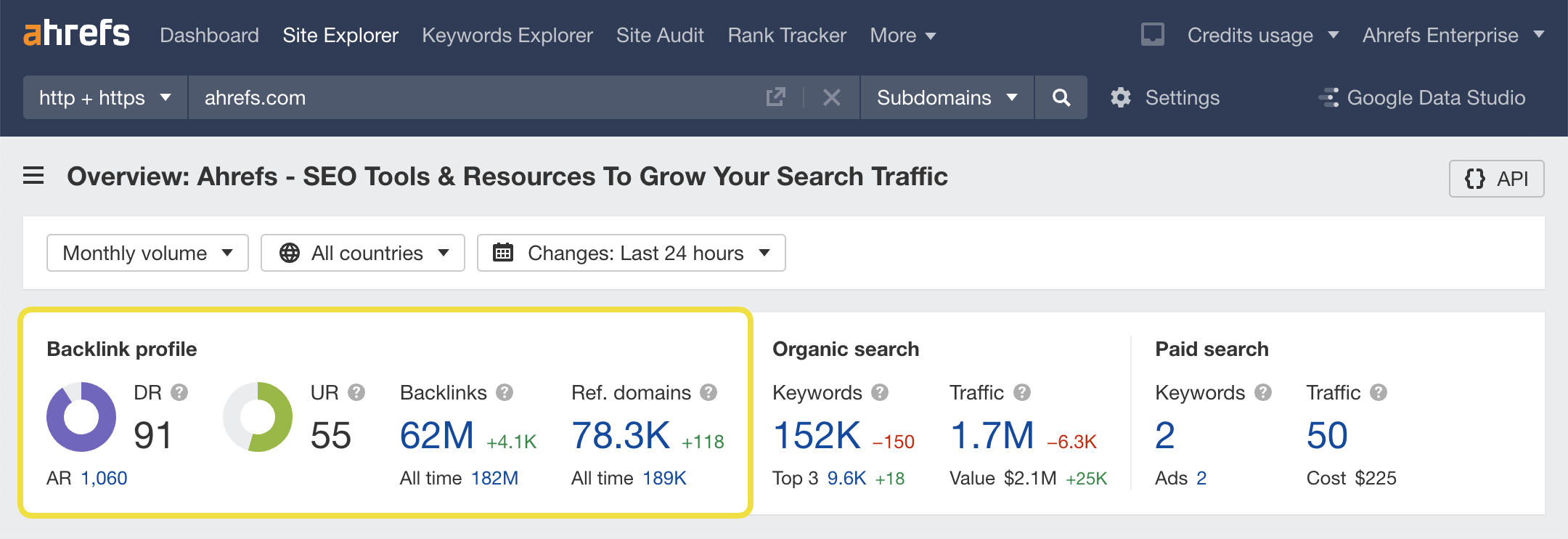
For someone who spends a lot of time hunting link opportunities, reverse‑engineering competitor link strategies, and monitoring link wins and losses, Ahrefs often feels sharper and more natural.
When backlinks are one important element among many, Semrush is strong enough and convenient inside its wider ecosystem. When backlinks are the central job, Ahrefs still feels like the more natural specialist tool.
Technical SEO can be intimidating, so the way a tool explains issues is as important as what it detects.
Semrush tends to behave like a project manager for technical SEO. Site audits highlight crawlability problems, speed issues, metadata problems, internal linking weaknesses, and more, then rank them by severity and likely impact. That ranking helps teams decide what to tackle first without needing deep technical experience.
Ahrefs produces solid technical reports as well, surfacing similar categories of issues. Its style is closer to a clean toolkit: the problems are listed clearly, but the platform expects the user to decide what matters most. For experienced SEOs, this is fine. For mixed teams, that can be less friendly.
Semrush is better when a clear “fix this first” roadmap is needed. Ahrefs is better when the person reading the audit is already comfortable interpreting technical SEO output.
Rank tracking is no longer just about desktop Google positions. AI‑driven answers, overviews, and conversational search now matter to brand visibility.
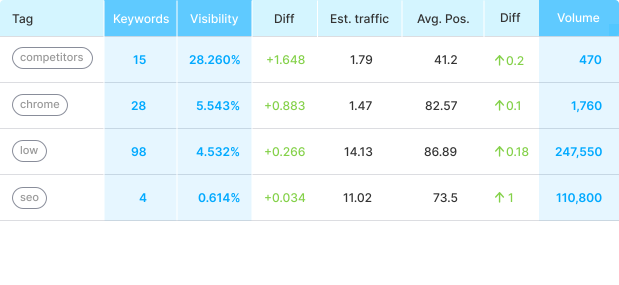
Semrush has leaned into this shift with an AI visibility layer that sits alongside classic rank tracking. It aims to show:
This helps teams tell a single story about visibility in the AI era instead of treating classic SEO and AI answers as separate worlds.
Ahrefs continues to offer strong rank tracking for classic search, with clear charts and share‑of‑voice metrics. AI‑related features exist, but they feel more like optional pieces around the core SEO product rather than the main storyline.

When leadership and clients now ask “how visible is this brand in AI answers as well as search results,” Semrush has the more complete answer. When success is still defined mainly by traditional rankings, Ahrefs remains perfectly capable.
Semrush supports content work from idea to performance. It helps find topics, structure outlines, check readability and optimisation while writing, audit older content, and track how pieces perform after publishing. For content‑heavy teams, this keeps everything in one environment.
Ahrefs focuses more on content intelligence. It helps find which pieces in a niche attract visits and links, which topics competitors own, and where gaps exist. Most teams then write and optimise content in separate tools.
Semrush feels like a big cockpit. It is powerful, but the number of buttons and panels can be overwhelming at first. Over time, teams learn the parts they actually need, but the first few sessions often feel dense.
Ahrefs feels like a cleaner console. Navigation is simpler, the main tools are fewer, and it is easier for someone who already understands SEO basics to find their way around quickly.
Semrush rewards teams that are ready to invest time learning a broad platform and want most work under one roof. Ahrefs rewards specialists who want a tight, focused environment dedicated to SEO tasks.
Semrush makes the most sense for:
In short, Semrush suits people who see SEO as one part of a bigger visibility picture and want their main tool to reflect that.
Ahrefs makes the most sense for:
In short, Ahrefs suits people who want a sharper SEO workbench and do not need one tool to cover every marketing channel.
Semrush is the better fit when the calendar is filled with content planning, performance reporting, local SEO, AI visibility checks, and cross‑channel decisions.
Ahrefs is the better fit when the calendar is filled with audits, link prospecting, competitor research, and tight keyword selection.
The smartest way to choose between them in 2026 is simple: match the tool to the week, not to the hype.
Be the first to post comment!

The first thing that stands out about Dippy AI is not the anime visuals or the N...
Suraj Malik4 days ago
I still remember the first time I installed Remix OS. It didn’t feel like I was...
Sakshi Dhingra1 week ago

Managing remote employees is very different from managing people in an office. W...
Sakshi Dhingra4 weeks ago

A school gradebook sounds like a simple thing until you watch what happens when...
Sakshi Dhingra1 month ago
The Growing Buzz Around EditPro in the AI Editing SpaceIn 2026, the name “EditPr...
Sakshi Dhingra1 month ago

When I first started deploying large language models, I assumed that choosing th...
Sakshi Dhingra1 month ago