When I first came across Skipit, I approached it with a bit of skepticism. The AI summarization space has exploded in the last two years, and almost every new tool claims to “save hours of time” by summarizing long videos or documents. In reality, many of these tools simply produce short, generic summaries that barely capture the actual meaning of the original content.
Skipit positions itself as an AI YouTube video summarizer that lets users ask questions about video content instead of watching the entire video. The idea is straightforward but potentially powerful. Instead of sitting through long lectures, podcasts, or tutorials, the system analyzes the video and generates summaries while also allowing the user to interact with the content through a conversational interface.
After spending time analyzing the platform, reading external reviews, and evaluating its feature set and pricing model, my conclusion is that Skipit is not trying to become a full AI workspace like ChatGPT or Claude. Instead, it is designed as a focused productivity tool aimed at people who consume large amounts of long-form video content.
The central idea behind Skipit is extremely simple: turn long YouTube videos into something searchable and interactive.
The official product page describes it as a tool that analyzes video content and extracts the key insights so users can access information without watching hours of footage. The tool also allows users to ask questions about a video once it has been processed.
This interaction layer is important. Traditional summarization tools usually generate one static summary and stop there. Skipit takes a slightly different approach by allowing follow-up questions. If a user wants to know what tools were mentioned in a tutorial or what the speaker’s main conclusion was, they can ask directly rather than searching through the video timeline.
Another interesting detail mentioned on the product page is that Skipit supports videos up to twelve hours long. That capacity is significant because many educational videos, conference recordings, and podcasts easily exceed one or two hours. A summarization tool that works only with short videos is far less useful for real research workflows.
From a conceptual standpoint, the product is trying to solve a very real problem: people today consume more video content than ever before, but they rarely have time to watch everything they want to learn from.
Skipit AI revolves around a very focused workflow: turning long YouTube videos into something interactive and searchable. At first glance the feature set may look simple, but when viewed through the lens of how people actually consume online video content, the capabilities become more meaningful.
The most obvious feature is video summarization itself. After inserting a YouTube link, the system analyzes the video and generates a condensed explanation of the main ideas. Instead of forcing users to scrub through timestamps or skim transcripts manually, Skipit attempts to extract the major points from the video in a format that can be read quickly. For educational videos, this often means highlighting the primary concepts or steps shown in a tutorial. For longer podcasts or interviews, the summaries tend to focus on major discussion themes rather than every minor detail.
What differentiates Skipit from basic summarization extensions is the conversational layer that sits on top of the summary. Once the video has been processed, users can ask questions directly about the content. In practice, this changes the way information is extracted from videos. Instead of passively reading a summary, users can request specific information. Someone watching a two-hour programming tutorial, for example, might ask which tools were used, what the main framework was, or which steps were emphasized as critical. The AI attempts to answer those questions based on the analyzed video content.
Another practical capability is the ability to process extremely long videos. According to the platform, Skipit can analyze videos up to twelve hours in length. That capacity matters more than it might initially seem. Many conference recordings, lectures, and online courses are uploaded in full length, and manually navigating such videos can be time consuming. By supporting very long content, the tool aims to make those recordings more accessible.
Skipit also stores previous conversations and processed videos. This effectively turns the tool into a lightweight archive of summarized content. If someone is researching a topic across several different videos, those stored chats can become a reference library of insights extracted from multiple sources.
There are also workflow features designed to make repeated use easier. The platform advertises unlimited messages and unlimited chats within the subscription plans, along with a prompt library and saved chat history. While these features are not revolutionary on their own, they support the core goal of allowing users to repeatedly analyze video content without worrying about limits.
Taken together, the feature set reveals something important about Skipit’s design philosophy. Rather than trying to compete with full AI assistants, the tool focuses on a single workflow and tries to execute that workflow efficiently.
One of the first things I noticed while reviewing Skipit is how intentionally simple the interface appears to be. Unlike many AI tools that present a complicated dashboard filled with features, Skipit seems to focus almost entirely on a single workflow.
The process is designed to begin by pasting a YouTube link into the system. The AI analyzes the video and generates a summary. Once that summary is available, users can start asking questions about the video through a chat interface.
According to the product page, the conversations and processed videos can be saved indefinitely. That detail might not seem particularly important at first, but in practice it changes how the tool can be used. Instead of treating each video summary as a temporary output, the saved conversations effectively create a searchable archive of insights extracted from different videos.
For someone conducting ongoing research on a topic, that archive feature could become quite valuable. Over time, it could function as a lightweight knowledge base derived from multiple video sources.
The simplicity of the interface also means the learning curve appears minimal. Many AI tools today overwhelm new users with dozens of configuration options. Skipit seems designed to avoid that problem by focusing on speed and accessibility.
The biggest question surrounding any AI summarization tool is accuracy. A summary is only useful if it captures the real meaning of the source material rather than producing a vague generalization.
Based on how Skipit describes its process and how similar AI summarization systems typically behave, the accuracy of summaries largely depends on the structure of the original video. When the content follows a clear narrative or step-by-step explanation, summaries tend to capture the key ideas fairly well. Tutorials and structured lectures usually translate effectively into summarized form because the main concepts are easy to identify.
However, videos that include long discussions, digressions, or highly technical explanations can be more difficult for summarization models. AI systems often prioritize extracting central themes rather than preserving every nuance of a complex argument. As a result, certain details or contextual explanations may be condensed too aggressively.
This limitation is not unique to Skipit. It reflects a broader challenge in AI summarization technology. Even advanced models occasionally flatten the depth of complex discussions because they are designed to identify patterns and key ideas rather than reproduce full reasoning chains.
For everyday productivity purposes, the level of accuracy Skipit aims for may still be sufficient. If the goal is to quickly understand what a video is about or decide whether it is worth watching fully, the summaries can provide a useful starting point.
However, users should treat AI summaries as a guide rather than a complete substitute for the original content. When the information is particularly important or technical, watching the relevant sections of the original video may still be necessary.
One of the more practical aspects of evaluating Skipit is understanding how quickly the system responds. Productivity tools are only valuable if they actually save time in real workflows.
The platform emphasizes speed heavily in its messaging, stating that questions about videos can be answered in seconds rather than minutes. This claim reflects the expectation that users want rapid insights rather than waiting through long processing times.
In general, AI summarization systems typically process video transcripts rather than raw video frames, which allows them to generate summaries relatively quickly once the transcript is available. If Skipit follows a similar approach, the speed advantage would come from analyzing text representations of the video rather than the entire visual stream.
In practical terms, this means the system can generate summaries relatively quickly even for long videos. Follow-up questions within the chat interface also appear designed to produce fast responses so that users can continue exploring the content without interruptions.
Speed becomes particularly important when analyzing multiple videos. Someone researching a topic may want to process several long videos in a short period of time. If the system responds quickly, the workflow becomes much more efficient compared with watching each video manually.
Of course, performance may vary depending on the complexity of the video and the underlying AI model used by the platform. But the emphasis on rapid interaction suggests that Skipit aims to prioritize responsiveness as part of the user experience.
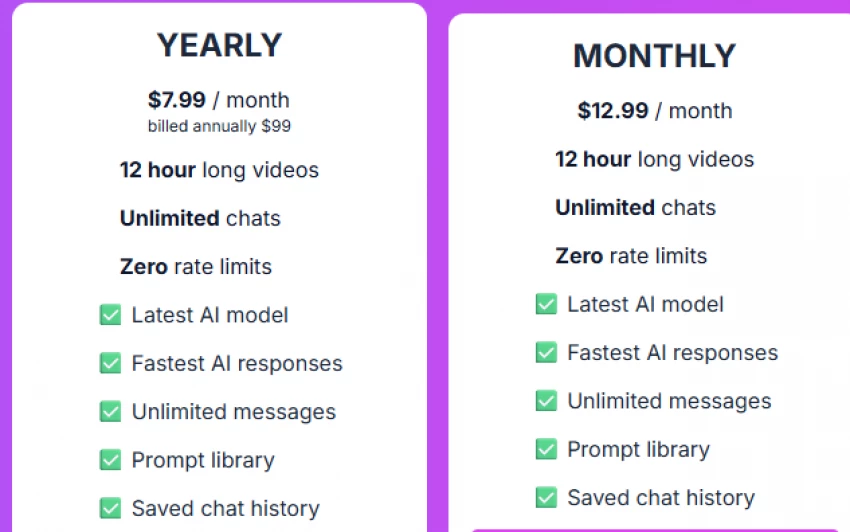
Skipit uses a subscription model with two main plans. The monthly plan is priced at $12.99 per month, while the annual plan costs $7.99 per month when billed annually at $99.
Both subscription tiers include the same main capabilities. Users can process videos up to twelve hours long, generate unlimited summaries, send unlimited chat messages, and access saved chat history. The system also advertises access to the latest AI model and faster response speeds.
From a pricing perspective, Skipit sits in an interesting middle ground. It is cheaper than some large AI subscriptions but more expensive than free browser extensions that offer basic summarization features.
Whether the pricing feels reasonable depends largely on how frequently someone uses the tool. If someone regularly analyzes long video content for learning or research, the time savings could justify the subscription cost. For casual users who only occasionally want a video summary, the value proposition may feel less compelling.
After analyzing the product positioning and feature set, I can see several realistic scenarios where Skipit might actually deliver value.
One of the most obvious use cases is education. Many online courses, lectures, and tutorials are delivered through long YouTube videos. Students who want to quickly review key concepts before exams could benefit from a tool that extracts the main points from those videos.
Another scenario involves professional learning. Many industry webinars and conference recordings are uploaded to YouTube. Professionals often want to extract insights from those recordings without committing hours to watching them fully.
Content creators might also find the tool useful for analyzing competitor videos. Instead of manually watching long content to identify trends or strategies, they could use Skipit to quickly surface the main themes.
These use cases demonstrate why the tool focuses heavily on time savings rather than trying to become a general AI assistant.
Although the concept is useful, Skipit also has clear limitations that should be acknowledged.
The most obvious limitation is the accuracy of AI-generated summaries. Even the best AI systems sometimes miss nuance when summarizing long discussions. If a video contains complex arguments or subtle explanations, the summary may oversimplify those ideas.
This means Skipit should not be treated as a replacement for watching important videos entirely. It works better as a filtering tool that helps users decide whether a video is worth watching in full.
Another limitation relates to scope. The official website focuses heavily on YouTube summarization, even though some directory sites describe the tool as supporting additional formats such as PDFs and web pages. If the product eventually expands to support more types of content, that would significantly increase its usefulness.
Finally, the pricing structure could become a barrier for users who already subscribe to multiple AI services. Many people today expect AI tools to bundle several capabilities into a single subscription rather than paying separately for each specialized utility.
| Pros | Cons |
| Summarizes YouTube videos up to 12 hours long. | AI summaries may miss detailed context. |
| Lets users ask questions about the video. | Mainly focused on YouTube content only. |
| Simple and easy-to-use interface. | Requires a paid subscription for full access. |
| Saves chats and video summaries. | Some AI tools offer similar features. |
| Unlimited chats and messages on paid plans. | Not useful if you rarely watch long videos. |
To understand Skipit’s position in the market, it helps to compare it with other tools that address similar problems.
One widely known alternative is Eightify, a browser extension designed specifically for summarizing YouTube videos. Eightify focuses on quick bullet-style summaries that highlight the key points of a video. While it is extremely fast, it generally lacks the deeper conversational interaction that Skipit offers through its chat interface.
Another competitor is Glasp, which combines summarization with note-taking and highlighting tools. Glasp is designed more as a knowledge management system rather than a pure summarization tool. Users can annotate videos and articles while building a shared knowledge library.
SummarizeBot is another platform that focuses on summarizing different types of content, including text documents, articles, and multimedia files. Compared with Skipit, SummarizeBot aims to support a wider range of content formats, though its interface can feel less streamlined.
What differentiates Skipit from these alternatives is its focus on conversation-based interaction with video content. Instead of just generating a static summary, it allows users to ask specific questions about the video.
This interaction layer gives Skipit a slightly different identity within the summarization tool ecosystem.
After analyzing the product, its pricing structure, and the surrounding ecosystem of summarization tools, my recommendation depends heavily on the type of user.
If someone frequently learns from long YouTube videos, Skipit could genuinely save time. The ability to summarize multi-hour videos and ask follow-up questions makes it more flexible than simple summarization extensions.
For students, researchers, and professionals who consume a lot of educational video content, the tool could become a useful part of their productivity workflow.
However, I would be more cautious recommending it to casual users. If someone only occasionally wants a video summary, they may not feel the need to pay for a dedicated subscription.
Another consideration is the rapidly evolving AI landscape. Large AI platforms are continuously adding new features, including video summarization capabilities. Over time, specialized tools like Skipit will need to continue improving in order to remain competitive.
After reviewing the product details, pricing model, and typical use cases, I would rate Skipit around 8 out of 10 as a specialized productivity tool.
Its biggest strengths are its simplicity, the conversational interaction with video content, and the ability to process extremely long videos. These features make it genuinely useful for people who rely heavily on video-based learning.
Its weaknesses are mostly related to scope and market competition. Because it focuses primarily on YouTube summarization, its usefulness depends heavily on how often someone consumes long video content.
In the end, Skipit feels like a tool that solves a specific problem very well rather than trying to become a universal AI assistant.
For the right type of user, that focus might actually be its greatest advantage.
Be the first to post comment!

I didn’t start exploring Dzine AI because I was chasing the latest AI trend. I d...
Sakshi Dhingra1 day ago

The positioning of Promptchan within the AI ecosystem is often misunderstood. Wh...
Sakshi Dhingra1 week ago
A Personal Moment That Made Me Care About Online Coupons AgainA few months ago,...
Parveen Verma1 week ago

Choosing the right software used to be straightforward. You compared features, c...
Suraj Malik2 weeks ago
When I first opened Final Round AI, I wasn’t looking for hype. I’ve seen too man...
Sakshi Dhingra2 weeks ago

There was a time when every company website proudly displayed glowing customer t...
Suraj Malik1 month ago