
Financial markets constantly tempt traders with predictions, forecasts, and confident opinions. Every day, headlines explain why something should go up or down. Yet, alongside this noisy world of explanations exists a much quieter philosophy, one that deliberately ignores news, opinions, and even economic narratives.
That philosophy is called trend following.
Over decades, trend following has survived bull markets, bear markets, crashes, and so-called “once-in-a-lifetime” events. It has been practiced by legendary traders, academic funds, and systematic investors across global markets. But longevity alone does not answer the most important questions modern traders ask:
What exactly is trend following?
Does it still work today?
What does “following trends” really mean in practice?
And what risks are often overlooked?
To answer these honestly, we need to move step by step, from foundations to modern realities.
Trend following is a rules-based trading approach that seeks to capture sustained price movements rather than predict market direction in advance. Instead of asking why prices move, it focuses only on whether they are moving, and in which direction.
According to Encyclopaedia Britannica, trend following strategies are built on a simple observation:
markets tend to move in persistent trends due to human behavior, institutional flows, and delayed reactions to information.
The strategy does not attempt to forecast tops, bottoms, or fair value. Instead, it reacts to price itself. When prices rise consistently, the system goes long. When prices fall consistently, the system goes short or exits.
This may sound almost too simple, but that simplicity is intentional.
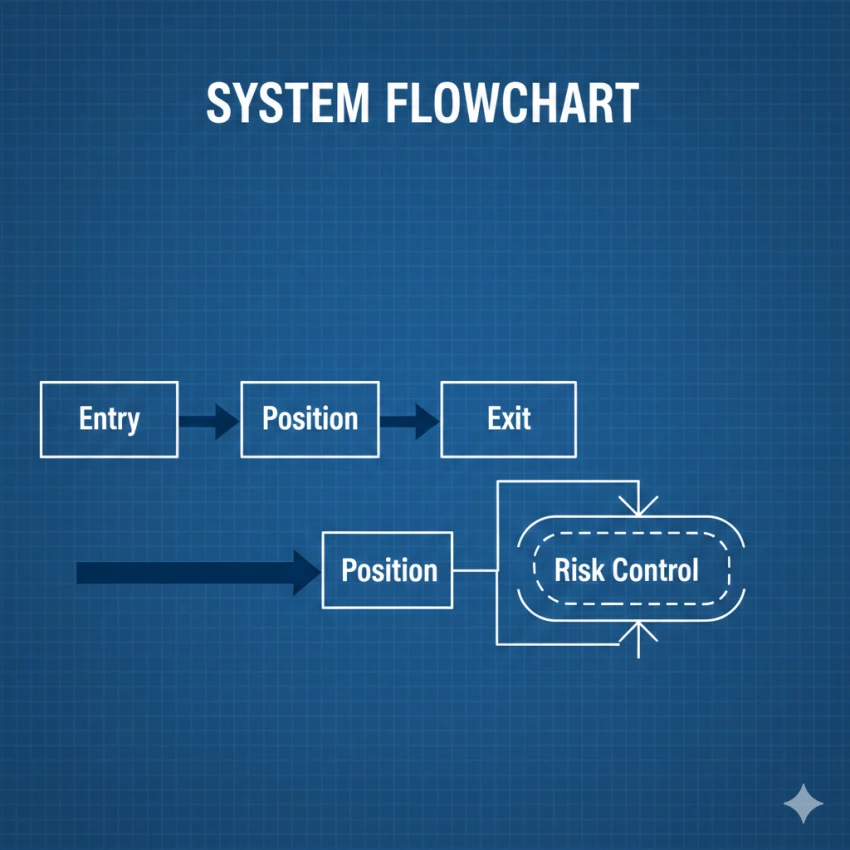
In real trading systems, trend following relies on three structural pillars:
Entry rules – objective conditions that signal when a trend has begun
Exit rules – predefined conditions that signal when a trend has ended
Position sizing and risk control – rules that limit how much is lost when trades fail
Most systems use price-based indicators such as moving averages, breakout levels, or volatility filters. Importantly, these tools are not used to predict reversals, but to confirm that a trend already exists.
This approach is designed to accept being late. Trend followers knowingly enter after a move has started and exit after it shows signs of ending. What they aim to capture is not perfection, but the middle of large moves.
This mindset sharply contrasts with prediction-based trading, and that contrast explains both its strengths and its frustrations.
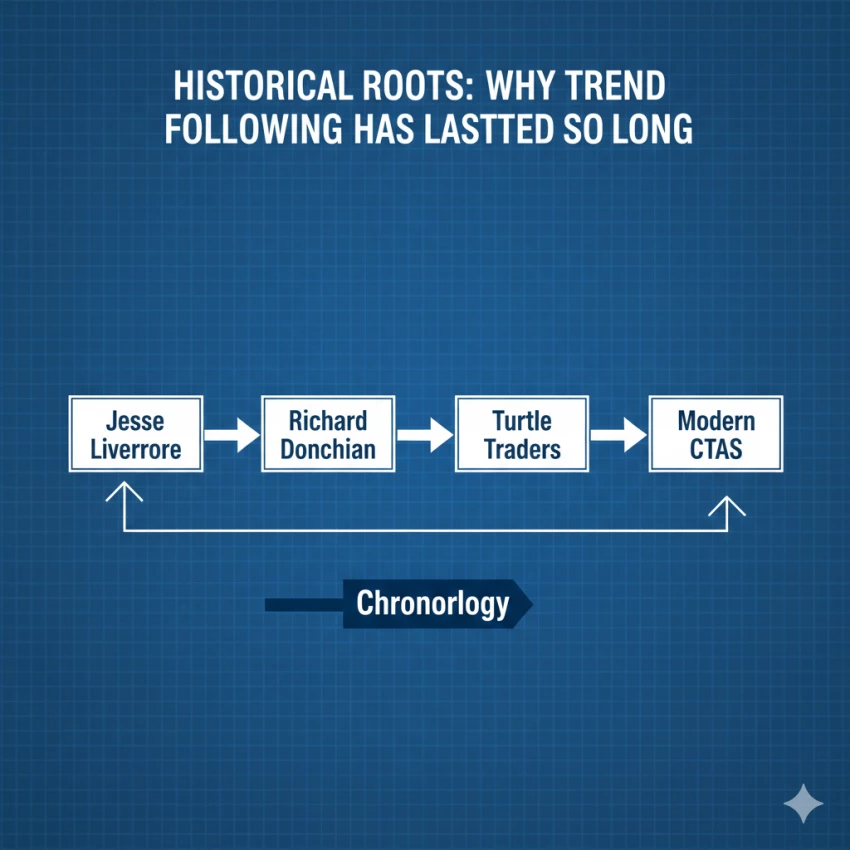
Trend following is not a modern invention. Its roots stretch back more than a century to traders like Jesse Livermore and Richard Donchian. Over time, it evolved into systematic strategies used by hedge funds and commodity trading advisors (CTAs).
One of the most famous modern experiments was the Turtle Traders, trained by Richard Dennis in the 1980s. The lesson was radical: trading skill could be taught using rules, not intuition.
These ideas were later popularized and documented extensively by Michael Covel, whose books, especially Trend Following, compiled decades of research, trader interviews, and performance evidence across markets and crises.
Covel’s work emphasizes a key point: trend following is not about intelligence or information advantage. It is about behavioral discipline in the face of uncertainty.
Many beginners misunderstand trend following as simply “buying what’s going up.” In reality, it is far more structured and psychologically demanding.
Following trends means:
It does not mean:
Trend followers expect to be wrong often. What they rely on is that a small number of large trends can outweigh many small losses.
This asymmetry, small losses, occasional large gains—is the defining feature of the strategy.
This is the most common, and most misunderstood, question.
Trend following does not work all the time. It never has. Periods of sideways, choppy markets can produce repeated small losses. These drawdowns test patience and discipline.
However, when evaluated over long time horizons and across diversified markets, trend following has historically demonstrated resilience. Research summarized on TrendFollowing.com and academic sources shows that trend-based strategies have performed during:
The reason is structural: trends emerge not from prediction, but from human and institutional behavior, which has not changed, even as technology has.
That said, trend following is not a shortcut. It requires long-term commitment, systematic execution, and emotional control.
Trends persist because markets are driven by people and institutions that:
Behavioral finance research, including work by Nobel laureates frequently discussed in Covel’s podcast, shows that fear, greed, herding, and loss aversion create delayed reactions. Those delays are what trend followers exploit, not superior analysis.
In this sense, trend following is less about markets and more about human behavior under uncertainty.
Despite its appeal, trend following carries real risks that are frequently understated.
First, drawdowns are unavoidable. Trend systems can go months or even years with flat or negative performance during range-bound markets.
Second, psychological stress is high. Most traders struggle with repeated small losses and the feeling of being “wrong” frequently.
Third, timing mismatch is common. Trend followers often underperform during strong mean-reversion phases, leading to abandonment at the worst possible time.
Fourth, improper execution ruins results. Deviating from rules, over-leveraging, or stopping systems mid-drawdown destroys the statistical edge.
Trend following is simple in logic, but difficult in execution.
Public reviews and discussions, including mixed feedback on platforms like Trustpilot, often reveal frustration from traders who:
These criticisms do not necessarily invalidate the strategy. Instead, they highlight a mismatch between expectation and reality.
Trend following rewards patience, not excitement.
Today, trend following is often used as:
Institutional investors value it because its return drivers differ from traditional buy-and-hold or discretionary strategies.
For individual traders, its value lies less in constant profits and more in survival and participation during extreme market moves.
Trend following is not a promise of easy money. It is a philosophy built on humility, accepting uncertainty, surrendering prediction, and letting markets reveal their direction over time.
For those who can tolerate discomfort, ambiguity, and delayed gratification, it remains one of the most enduring approaches in trading history.
For those seeking certainty, excitement, or constant validation, it is often the wrong path.
Understanding that difference is where real mastery begins.
1. What is a trend following strategy?
A trend following strategy is a rules-based trading approach that enters and exits positions based solely on price movement, aiming to capture sustained trends without predicting market direction.
2. Does trend following still work?
Yes, over long time horizons and across diversified markets, trend following has historically remained viable, but it does not work consistently every month or year and requires discipline through drawdowns.
3. What does following trends mean?
Following trends means reacting to price behavior rather than forecasting, accepting frequent small losses, and holding winning positions long enough for large trends to develop.
4. What are the risks of trend following?
The main risks include prolonged drawdowns, psychological pressure, underperformance in sideways markets, and failure due to poor execution or abandoning rules prematurely.
Be the first to post comment!