A Robot Behind the Counter, Extra Humans on the Floor, Starbucks Tries to Grow Traffic Again
by Vivek Gupta - 1 month ago - 6 min read
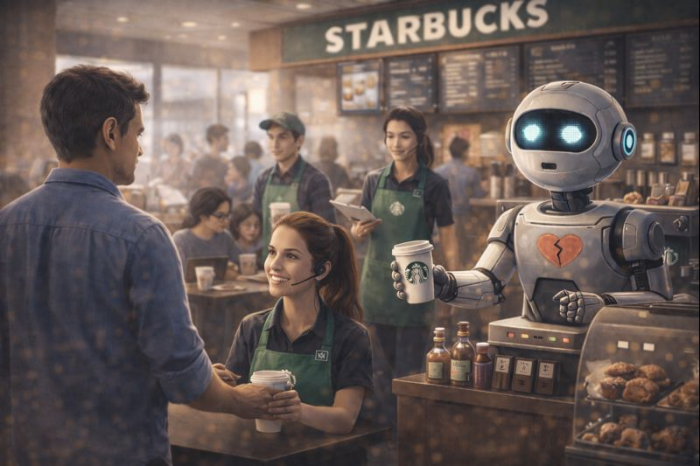
Starbucks wants to convince customers it can be fast again without feeling like a vending machine.
In late January 2026, the company tied its early U.S. traffic rebound to a very specific playbook: more automation in the workflow, more people in the store, and fewer moments where your latte feels like it is stuck in a bureaucratic process. In its Q1 fiscal 2026 update (quarter ended Dec. 28, 2025), Starbucks reported its first U.S. comparable transaction growth in eight quarters, alongside 4% U.S. comparable sales growth and 4% global comparable sales growth.
That combination is the point. Starbucks is not pitching robots as replacements for baristas. It is pitching them as the invisible staff member who does not call in sick, does not forget the recipe for a seasonal drink, and does not panic when four ordering channels collide at 8:40 a.m.
The turnaround signal Starbucks needed
The headline management is selling is simple: more people walked in, more often.
Starbucks said Q1 momentum was driven by more customers choosing Starbucks more frequently, which is exactly the metric the market had been waiting on after a long stretch of sluggish U.S. traffic.
A big reason the company is leaning so hard into this narrative is that Q1 also showed the trade-off: profitability got squeezed while Starbucks spent more on labor and absorbed cost pressures, even as revenue climbed to $9.9 billion, up year over year and ahead of estimates in many reports.
So the story Starbucks is telling investors is yes, margins bent, but traffic is moving again. And traffic is the hardest thing to recover once customers break routine.
The “robots” part is mostly software, and that is intentional
When people hear “robots at Starbucks,” they imagine a humanoid arm making cappuccinos like it is a sci-fi trailer. Starbucks is going with something less dramatic and more effective: AI tools that reduce friction for baristas and speed up order flow.
Green Dot Assist, an AI helper that lives on an iPad
Starbucks’ most visible AI push is Green Dot Assist, a generative AI assistant that baristas can use in real time from in-store iPads. It is designed to answer questions quickly, such as how to make a drink, how to handle a customization, or what to do when equipment acts up, without digging through manuals or internal pages.
Starbucks built it on Microsoft Azure using OpenAI technology and previously said it began as a pilot in a small set of stores.
The subtext here is practical. Starbucks would rather spend on tools that make employees faster and more confident than gamble on a fully automated barista experience that could make stores feel colder.
Smart Queue, the traffic cop behind the scenes
The other “robot” is not a robot at all. It is an order-sequencing brain.
Starbucks has been reworking how it handles orders arriving from drive-thru, mobile pickup, delivery, and in-café at the same time. When those streams collide, service slows, customers stare at their app like it personally betrayed them, and baristas get crushed. Starbucks has described its effort to tighten execution around speed and staffing as part of the broader “Back to Starbucks” operating reset.
Hardware is coming too, just later
Starbucks also used this moment to preview the next physical layer of automation.
Mastrena 3, a faster espresso workflow
Starbucks has said it plans to roll out the next generation of its espresso equipment, the Mastrena 3 system, on a later timeline. The pitch is straightforward: pull shots faster, reduce bottlenecks, and give baristas more time to focus on handoff and customer connection, not waiting on the machine.
The equipment is produced exclusively by Thermoplan, which is often part of the Starbucks espresso infrastructure story.
Digital menu boards and a new POS
Starbucks is also rolling out more digital infrastructure, including a next-generation point-of-sale system and expanded digital menu boards, both meant to reduce ordering friction and help stores flex messaging by time of day and demand. Starbucks has framed this as part of making service simpler and more consistent.
The twist, Starbucks is spending big on humans too
If this were a pure automation story, Starbucks would be cutting labor. It is doing the opposite.
The company has been explicit that staffing is part of the turnaround. In its own earnings and investor communications, Starbucks positioned labor investments as necessary to deliver the experience it wants customers to notice: faster service, better handoff, and a store that feels like a place again, not just a pickup lane.
That is the hybrid bet: use AI to smooth operations, then use the saved time to make the café experience feel more human.
Two quick signals Starbucks is leaning on:
• U.S. traffic improved in the quarter, snapping an eight-quarter drought
• Starbucks Rewards reached 35.5 million active members, a reminder that the mobile relationship still anchors the business
That is also where the humor sneaks in. Starbucks is effectively saying: we added AI so your drink does not take forever, and we added people so the store does not feel like an airport kiosk that sells iced oat milk.

Investor Day made the bigger ambition obvious, personalization at scale
At its January 29, 2026 Investor Day, Starbucks leaned into a future where ordering gets more predictive and less “scroll the menu like you are doomscrolling beverages.”
Coverage of the event highlighted Starbucks’ interest in conversational ordering tools that help customers land on a custom drink through prompts, and then route them to a store and checkout.
That matters because Starbucks now sells a huge portion of its drinks through customization, which is great for ticket size but brutal for speed. If Starbucks can make customization feel easier for customers and easier for baristas, it can grow without turning every morning rush into a miniature crisis.
Why this actually fits the title
Starbucks is betting on robots in the way modern retail actually works: not a single flashy machine, but a stack of systems that shave seconds off tasks and reduce mistakes.
And the early proof Starbucks is pointing to is narrow but meaningful. U.S. customer traffic finally moved up again, and management is arguing the tech-and-labor combo is why.
Whether it holds is the next test. Starbucks has already shown the market what it can do when it gets operational rhythm back. Now it is trying to do it with AI in the workflow, more humans in the café, and fewer mornings where your mobile order feels like it entered witness protection.