Aditya Agarwal’s AI Awakening: How a Veteran Engineer’s Words Sparked Anxiety Across Tech Markets
by Vivek Gupta - 1 month ago - 4 min read
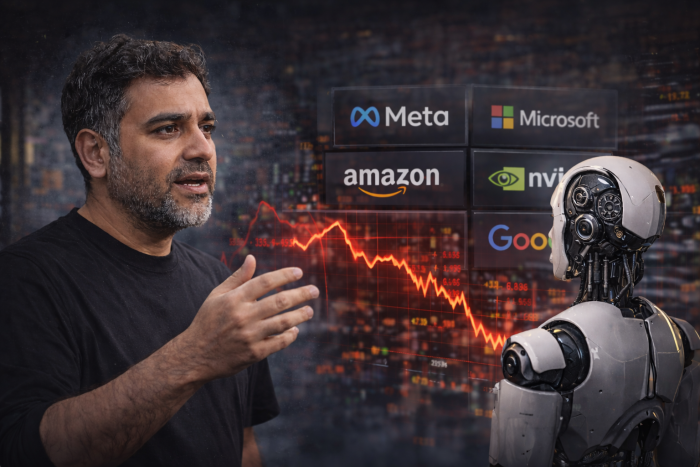
A candid remark by Aditya Agarwal, a former early engineer at Facebook and ex-CTO of Dropbox, has struck a nerve across the global tech industry, landing at a moment when investors and engineers alike are already uneasy about the speed of artificial intelligence adoption.
After spending a weekend coding with Claude, the AI assistant developed by Anthropic, Agarwal wrote on X that manual coding may soon be obsolete. “We will never ever write code by hand again,” he said, adding that continuing to do so “doesn’t make any sense.”
The comment, widely shared by technologists and business leaders, was not framed as triumphalist. Instead, Agarwal described mixed emotions. He said he felt “wonder” at what the tools can do, alongside “a profound sadness” as a skill that once defined his career has become “free and abundant.” He summed up his state of mind as “happy but disoriented.”
Why Agarwal’s words carry weight
Agarwal is not a casual observer of the tech cycle. He was an early engineer at Facebook during its formative years, later served as chief technology officer at Dropbox, and held senior roles at Flipkart. He is now a general partner at South Park Commons, a Silicon Valley fund and community that supports early-stage founders.
That background has made his comments resonate more deeply than a typical AI hot take. In his post, he noted that AI systems are now recreating entire categories of products he once helped build, including social platforms and collaborative tools. In one striking line, he observed that automated “agents” online are already hard to distinguish from humans in many contexts.
Indian and international outlets including Business Today, NDTV, and CNBCTV18 have highlighted the remarks as emblematic of a broader existential reckoning within the engineering profession.
Anthropic’s enterprise push adds fuel
The timing of Agarwal’s reflection is significant. His comments arrived just as Anthropic began rolling out a new suite of enterprise plug-ins for Claude, aimed at automating work across legal, sales, marketing, customer support, finance, and data analysis.
According to recent coverage, these tools can connect directly to internal systems such as email, calendars, knowledge bases, and project trackers. They are designed to draft documents, search internal data, plan workflows, and manage routine operational tasks with minimal human intervention.
The shift is notable because it moves AI beyond isolated assistance, such as writing snippets of code, toward coordinating entire workflows. For many observers, that marks a step change in how white-collar work could be organized.
Markets react to the speed of change
The convergence of Agarwal’s comments and Anthropic’s product launch has coincided with sharp market reactions, particularly in India’s IT services sector.
On February 4, major Indian IT stocks saw steep declines in a single session:
- Infosys fell more than 7 percent
- Tata Consultancy Services dropped nearly 7 percent
- HCL Tech, Wipro, and Tech Mahindra each slid between 3 and 4 percent
US-listed American depositary receipts of Indian IT firms also declined, while broader markets weakened, with the Nasdaq Composite and S&P 500 both closing lower.
Market commentary cited fears that enterprise AI tools could accelerate automation in areas traditionally billed by the hour, undercutting long-standing outsourcing and services models. The concern is not limited to India, but the country’s large IT services industry makes it particularly exposed to shifts in how software work is priced and delivered.
More than a technical debate
Beyond stock prices, Agarwal’s remarks have reignited debate about what it means to be an engineer in an AI-first era. Analysts and industry figures increasingly describe coding as moving away from line-by-line craftsmanship toward defining intent, reviewing AI-generated output, testing systems, and ensuring security and reliability.
That transition carries uneven implications. Entry-level roles centered on boilerplate coding and maintenance are seen as most vulnerable, while demand may grow for skills in AI oversight, system integration, and domain-specific problem solving.
A moment of reflection for the industry
What makes Agarwal’s statement stand out is not just its technical claim, but its emotional honesty. By openly admitting confusion and loss alongside excitement, he has articulated a feeling many professionals are quietly grappling with.
As AI tools rapidly expand from code generation into broader workplace automation, the question facing the industry is no longer whether productivity will increase, but how quickly roles, identities, and business models will have to adapt.
For now, Agarwal’s weekend experiment has become a symbol of a wider transition, one that is unsettling markets and forcing engineers to rethink what their work will look like in the years ahead.