Amazon and Google Pour Hundreds of Billions Into AI Infrastructure as the Compute Arms Race Escalates
by Suraj Malik - 1 month ago - 5 min read
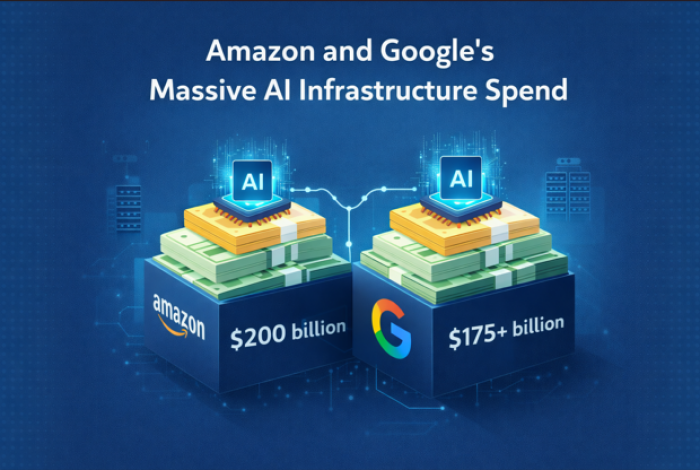
Amazon and Google are preparing for one of the most aggressive infrastructure spending cycles in tech history, committing staggering amounts of capital to AI data centers, custom chips, and cloud platforms in 2026. Together, the two companies are on track to invest nearly $400 billion in a single year, a scale that signals how central artificial intelligence has become to long-term competition among global tech giants.
The spending surge comes with a tradeoff. While these investments promise future control over AI computing and cloud margins, they are already unsettling investors who see profits being deferred far into the future.
A Spending Level the Industry Has Never Seen
Amazon has outlined plans to spend roughly $200 billion on capital expenditures in 2026, a sharp increase from its estimated $131.8 billion in 2025. Alphabet, Google’s parent company, is not far behind. After spending about $91.5 billion in 2025, Google expects its 2026 capex to land between $175 billion and $185 billion, nearly doubling year over year and far exceeding Wall Street forecasts.
Other major players are also escalating investment. Meta has guided capital spending between $115 billion and $135 billion for 2026. Microsoft has not issued a full-year forecast, but its quarterly run rate suggests annualized spending that could approach $150 billion if current levels continue. Oracle plans about $50 billion.
Taken together, the largest cloud and AI companies could collectively spend between $500 billion and $650 billion on AI-related infrastructure in 2026 alone.
What Amazon and Google Are Actually Buying
Much of this capital is flowing into massive data center expansions, networking equipment, and energy infrastructure. However, AI is the dominant driver behind the numbers.
Amazon is investing heavily in custom silicon such as Trainium and Inferentia chips, alongside robotics and its low-Earth-orbit satellite network. AI workloads are the single largest contributor to this expansion. Google is channeling capital into AI-optimized data centers, servers, and networking systems designed to support its Gemini models and Cloud AI services.
The goal is not simply to add capacity, but to reshape who controls the underlying economics of AI computing.
The Strategic Prize: Control Over Compute
At the heart of this spending spree is compute scarcity. Advanced AI accelerators have become the most constrained resource in the industry, and Nvidia’s dominance has given it extraordinary pricing power.
By building proprietary chips and vertically integrated systems, Amazon and Google aim to reduce dependence on Nvidia while improving long-term margins. Owning the infrastructure allows them to set internal pricing, prioritize their own AI services, and avoid being crowded out by competitors during periods of high demand.
Amazon’s Rainier supercomputer illustrates this approach. Built around roughly half a million Trainium2 chips, the system is expected to dramatically expand available compute for customers like Anthropic. Analysts estimate it could unlock billions of dollars in incremental AWS AI revenue as early as 2026.
Cloud and AI Platforms as the Real Business
Executives at both companies frame infrastructure spending as a necessary foundation for higher-margin services.
Google CEO Sundar Pichai has told investors that AI infrastructure investment is already driving growth across Cloud and advertising. Analysts expect AWS growth to re-accelerate in 2026, partly due to AI demand from enterprise customers and model developers.
The long-term thesis is that AI platforms will become core cloud workloads, similar to how databases and analytics defined earlier cloud eras. Training, inference, model hosting, and agent services are expected to generate recurring revenue that justifies today’s capital outlays.
Hardware and Software Working Together
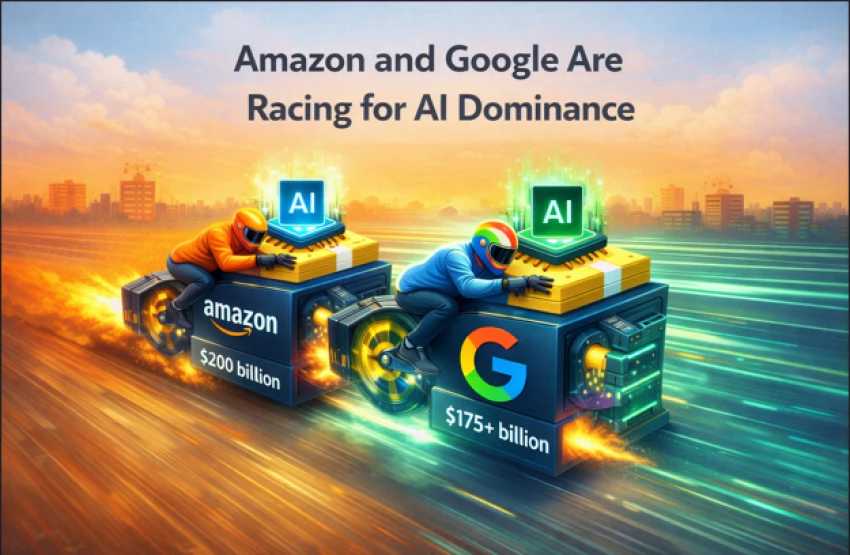
One advantage Amazon and Google share is tight integration between hardware and AI models. AWS with Trainium and Google with TPUs can co-design silicon and software at scale, improving performance per dollar and per watt.
Industry analysts note that this level of hardware-software coordination is difficult to match for rivals that rely primarily on third-party chips. Over time, this could strengthen AWS and Google Cloud’s competitive positions against Microsoft, Oracle, and others.
Why Markets Are Uncomfortable
Despite strong earnings, investor reaction to the 2026 spending plans has been cautious. Share prices for several hyperscalers declined following capex disclosures, with the largest drops hitting the companies with the most aggressive budgets.
The concern is timing. These investments are heavily front-loaded, while returns may take years to materialize. If AI demand grows more slowly than expected, or if pricing pressure increases, companies could be left with underutilized data centers and weaker returns on capital.
Some analysts describe the situation as a classic arms race. No company can afford to spend less than its peers, even if the short-term financial payoff is unclear.
What Must Go Right
For Amazon and Google’s strategy to succeed, several conditions need to hold.
Enterprise and AI lab demand must remain strong enough to keep new capacity fully utilized. Proprietary chips must deliver clear cost and performance advantages over Nvidia alternatives. AI platforms like Bedrock and Gemini must become default choices for developers, turning infrastructure into sticky, high-margin services. Regulatory and energy constraints must also allow these massive data centers to operate efficiently.
A Long Bet on the AI Infrastructure Layer
Amazon and Google are currently outspending nearly every competitor in the race to build AI infrastructure. The near-term cost is visible in capital budgets and investor unease. The long-term reward, if the strategy works, is far larger.
Control of the AI infrastructure layer means control over pricing, margins, and access in the next phase of computing. The gamble is not about winning headlines today, but about owning the foundation on which AI-driven businesses will be built for the next decade.
If demand holds and execution matches ambition, today’s spending surge may eventually look less like excess and more like inevitability.