ChatGPT Tests Ads for the First Time, Marking a Shift in How Free AI Is Funded
by Vivek Gupta - 2 months ago - 3 min read
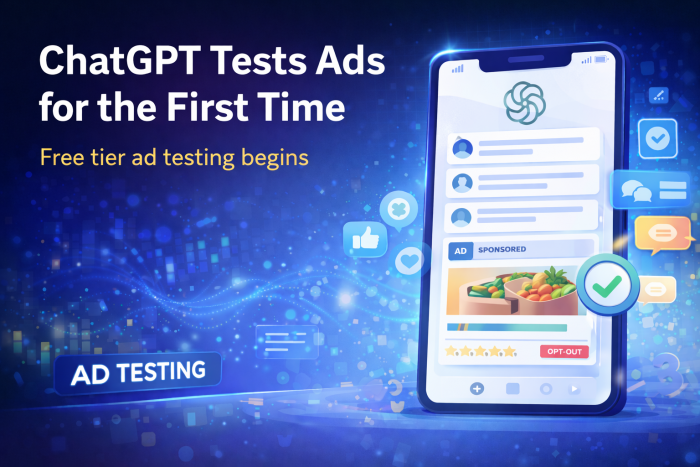
OpenAI has quietly crossed a line it spent years avoiding. Between February 8 and 10, 2026, the company began testing advertisements inside ChatGPT for the first time, introducing a carefully limited ad experience for logged-in adult users on the Free tier and the new Go subscription. Paid plans, including Plus, Pro, Business, Enterprise, and Education, remain ad-free.
The experiment is deliberately restrained. Ads appear only in a clearly labeled “Sponsored” section placed below ChatGPT’s responses, never inside or influencing the answers themselves. According to OpenAI, the goal is not aggressive monetization but learning how ads might coexist with a high-trust AI product without degrading the experience users rely on.
How the ads actually appear inside ChatGPT
At a practical level, the ads are contextual rather than intrusive. Someone asking for a recipe might see a meal-kit promotion beneath the response; a travel query could surface hotel or booking offers. OpenAI has emphasized several guardrails: no ads for users under 18, no ads related to health, mental health, or politics, and no sharing or selling of user data to advertisers. Performance metrics are reported only in aggregate, and advertisers cannot shape or steer ChatGPT’s outputs.
Why OpenAI is experimenting now
This move has been months in the making. In January, OpenAI confirmed plans to test ads alongside the launch of ChatGPT Go, an $8 per month option designed for users who want lower costs in exchange for ads. By late January, reports surfaced that OpenAI was quietly onboarding advertisers for a short, impressions-based trial with relatively modest commitments. Live testing began in early February, with OpenAI declining to comment beyond acknowledging the experiment.
The business context matters. OpenAI now operates at enormous scale, with reported annualized revenue around $20 billion and massive infrastructure spending commitments. Advertising offers a way to keep the free tier viable without forcing every user into a subscription.

Early reactions and unresolved concerns
Reactions have been mixed but measured. Some users welcome the trade-off if it preserves a capable free tier. Others worry that even well-labeled ads sit uncomfortably close to advice generated by a system people increasingly trust. Critics argue that conversational context is unusually powerful for persuasion, while supporters note that OpenAI’s separation of ads from responses is far stricter than most platforms.
Two things are already clear:
- Ads do not influence ChatGPT’s answers, and sensitive topics are explicitly excluded from ad targeting.
- This is a limited US-only test, with broader rollout dependent on user feedback and observed impact.
What this experiment could mean going forward
For now, OpenAI is moving cautiously, aware that trust is its most fragile asset. Whether ads become a permanent part of ChatGPT or remain a controlled experiment will depend less on advertiser interest and more on whether users feel the line between help and promotion has truly been respected.