How China Is Training Military Robots Using Lessons from Nature
by Vivek Gupta - 1 month ago - 5 min read
A hawk does not need a briefing packet to know which bird in a flock is struggling. It scans, spots the weak link, then commits. Now take that instinct, translate it into code, bolt it onto a drone swarm, and you have the basic idea behind a wave of animal-inspired military robotics research coming out of China.
In late January 2026, the National University of Defense Technology appeared on Chinese state media-linked reporting for a demonstration that grabbed attention for one simple reason, scale. A single operator was shown managing a swarm of more than 200 drones during an exercise framed around urban combat conditions, including scenarios where communications could be disrupted.
That is the kind of number that makes other militaries sit up straight, then quietly ask their engineers why their systems still panic when Wi-Fi gets moody.
The Hawk Moment, Why This Story Took Off
One strand of this broader push is what researchers have been doing at Beihang University, a major Chinese university often linked in reporting to defense-adjacent research. In a patent-backed research effort described in recent coverage, engineers studied how hawks pick targets and how prey birds dodge, then used those patterns to train competing drone behaviors in simulated aerial combat.
The headline-grabber from that work is a combat simulation result that sounds almost rude. In a five-versus-five scenario, the hawk-mode defensive drones reportedly eliminated the opposing group in 5.3 seconds, tied to a patent filed in April 2024.
If you are wondering why anyone cares about shaving seconds off a drone fight, it is because seconds are where human oversight goes to die. A person can supervise a lot of machines, right up until the machines start making decisions faster than the person can read the screen.
The Real Trick, Swarms That Keep Moving When Signals Get Jammed
The scarier part is not “many drones,” it is “many drones that still function when communication is degraded.” Reports around the 200-drone demo emphasize autonomy and coordination even after losing contact, which matters because electronic warfare is designed to do exactly that, break the link between operator and machine.
In plain language, the goal is to move from “pilot each drone” to “tell the swarm the outcome you want, then let the swarm figure out the route, spacing, and timing.” That kind of approach is often described as effect-based control in military discussions, were humans state objectives and machines handle execution.
It is also how you end up with a battlefield that feels less like chess and more like a nature documentary, except the narrator is an algorithm and the budget is unlimited.
Wolves on the Ground, Not Just Birds in the Air
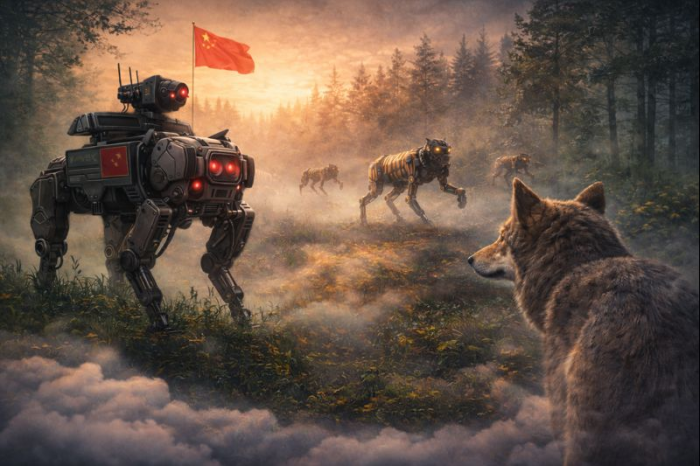
If hawks are the headline, wolves are the plot twist. China has also been showcasing quadruped “robot wolves,” designed to move with troops and potentially coordinate with aerial drones. Chinese state-linked reporting has described these systems as roughly 70 kilograms and adaptable to complex terrain, with payload flexibility that can include different mission modules.
Separate reporting has highlighted demonstrations and testing claims like stair climbing, obstacle handling, and weapon-carrying concepts, framing them as tools for reconnaissance, support, and coordinated operations.
A useful way to think about these robot wolves is not “replacement soldiers,” at least not yet. Think “the teammate you send first through the door,” the one that does not breathe, does not get tired, and does not ask for hazard pay.
Nature as a Weapons Lab, Why Biomimicry Appeals to Militaries
Biomimetic warfare is basically military R&D admitting something quietly obvious, evolution has been doing field testing for millions of years.
A hawk’s advantage is targeting selection, it picks the vulnerable, it reduces wasted effort. A wolf pack’s advantage is coordination without constant central control; it adapts in motion. At a drone-swarm level, those are exactly the problems engineers keep trying to solve, how do you choose targets, how do you coordinate, how do you keep operating when the environment is chaotic.
And nature has a nasty habit of producing solutions that are efficient, resilient, and brutally effective, which is not what you want to hear when the “predator” is a low-cost drone that can be produced at scale.
One Paragraph with Pointers, The “Okay, So What” Summary
Here is the practical takeaway in two quick points:
- Swarm control is moving toward scale, the 200-plus drone demo suggests a future where one operator can command a small army of machines in minutes.
- Animal-inspired tactics are being translated into AI behavior, research linked to Beihang University has described hawk-like targeting and prey-like evasion producing extremely fast simulation outcomes.
What This Means for Everyone Else
For militaries watching this trend, the lesson is not “copy the hawk.” The lesson is that autonomy is being trained around real-world constraints, like communications getting jammed, operators being overloaded, environments being messy, and targets being fleeting.
For policymakers, the uncomfortable question is where meaningful human control fits when engagements unfold in seconds. If a swarm can decide and act faster than a human can validate, then “human in the loop” can become “human watching the loop,” which is not the same thing.
For the rest of us, it is a reminder that the future of warfare may look less like giant platforms and more like lots of smaller systems cooperating, adapting, and learning, sometimes from the same animals you see outside your window.
Except your neighborhood hawk is probably not filing patents.
Bottom Line
China’s latest wave of biomimetic military robotics is not just about flashy demos; it is about turning predator logic into scalable autonomy. A 200-drone swarm under one operator is a headline, but the deeper story is the push toward systems that coordinate under pressure and keep functioning when the battlefield turns hostile to communications.
Hawks taught the drones how to pick the weak target, wolves taught robots how to move as a pack. The world now has to figure out what happens when those instincts get mass-produced.