ICE Detention Contractor Targets AI Data Center Boom With “Man Camps” for Workers
by Suraj Malik - 5 days ago - 4 min read
The rapid expansion of artificial intelligence infrastructure is creating new economic opportunities across the United States. But a recent report highlights how some companies tied to immigration detention are now positioning themselves to profit from the surge in AI data center construction.
According to reporting from TechCrunch, the company Target Hospitality is actively pursuing contracts to house thousands of temporary workers building large AI data centers. The company is best known for operating the Dilley Immigration Processing Center under contract with U.S. Immigration and Customs Enforcement.
As demand for computing power grows, massive AI data center projects are appearing in rural areas where local housing is limited. That environment has revived an older solution from the oil and gas industry: temporary worker housing settlements commonly referred to as “man camps.”
What “Man Camps” Are and Why AI Projects Need Them
Man camps are temporary housing communities designed to accommodate hundreds or even thousands of workers involved in large infrastructure projects. These camps were widely used during North America’s oil boom in remote areas such as the Bakken shale fields.
Now the same concept is being repurposed for AI infrastructure.
Building large data centers requires a sizable workforce for construction, electrical work, cooling infrastructure, and networking systems. Many projects are located in rural regions with access to cheap land and energy but limited residential capacity.
Temporary housing solves that logistical challenge.
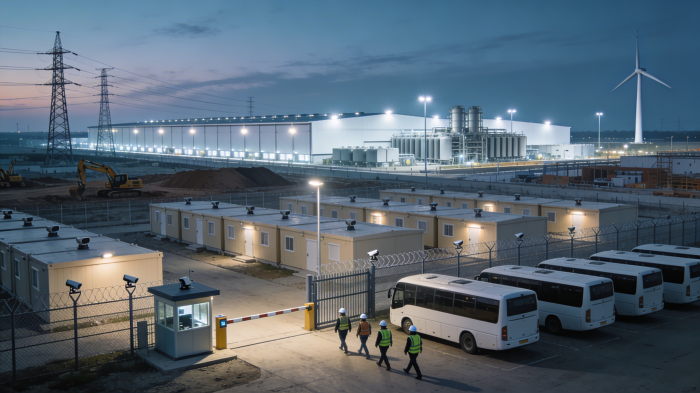
These camps often resemble small villages built specifically for workers. Facilities typically include dormitory-style buildings, dining halls, recreational areas, and laundry services.
A Major AI Data Center Project in Texas
One example highlighted in the report is located in Dickens County, Texas.
A former cryptocurrency mining facility in the region is being converted into a 1.6-gigawatt AI data center, a scale comparable to some of the largest computing facilities currently planned.
To support the construction workforce, Target Hospitality is developing a large worker housing camp near the site.
The project includes rows of gray dormitory-style housing units alongside amenities such as:
- A cafeteria
- A gym
- A laundromat
- Recreation and game rooms
The camp could ultimately accommodate more than 1,000 workers involved in building the facility.
Contracts Worth More Than $130 Million
The financial opportunity tied to these projects is significant.
Target Hospitality reportedly holds contracts worth about $132 million to construct and operate the Dickens County housing complex.
Executives at the company believe the market for workforce housing tied to AI infrastructure could expand rapidly.
According to the company’s chief commercial officer, the wave of AI data center construction represents “the largest, most actionable pipeline” the company has seen.
With tech companies investing billions into AI computing capacity, the number of large construction projects is expected to grow significantly over the next several years.
Ethical Questions Around the Company’s Role
While the business opportunity is clear, the situation has also raised ethical concerns.
Target Hospitality’s involvement in immigration detention has previously drawn scrutiny from advocates and legal groups. The company owns and operates the Dilley Immigration Processing Center, one of the largest family detention facilities in the United States.
Court filings related to the facility have alleged issues including:
- Worms and mold appearing in food
- Inadequate accommodations for children with allergies or special diets
- Other concerns about living conditions for detainees
- The company has disputed some of the allegations.
However, critics argue that the company’s expansion into AI infrastructure housing highlights an unusual overlap between two very different industries: immigration detention and cutting-edge technology development.
The AI Infrastructure Boom Is Creating New Industries
The rise of generative AI has dramatically increased demand for computing power. Training and operating modern AI models requires enormous data centers filled with specialized hardware.
Major technology companies are racing to build these facilities, often in regions where electricity costs are lower and land is plentiful.
Each project can involve thousands of construction workers over multiple years.
That demand is creating opportunities for industries that support large-scale infrastructure, including construction contractors, energy providers, and workforce housing companies.
Target Hospitality’s strategy reflects how companies connected to older sectors such as oil, mining, and government contracting are adapting to the AI economy.
A Sign of How AI Is Reshaping Local Economies
The emergence of worker camps around AI data centers demonstrates how the technology boom is affecting communities far beyond Silicon Valley.
Large computing campuses can bring construction jobs, infrastructure investment, and economic activity to rural regions that previously hosted industries like energy production or cryptocurrency mining.
At the same time, the involvement of companies associated with controversial industries can raise new debates about ethics and accountability in the AI supply chain.
As the global race to build AI infrastructure accelerates, questions about who profits from that expansion and how those projects affect local communities are likely to become increasingly prominent..