India Joins US-Led Pax Silica Alliance, Moves to the Centre of the Global AI and Chip Power Shift
by Suraj Malik - 1 month ago - 4 min read
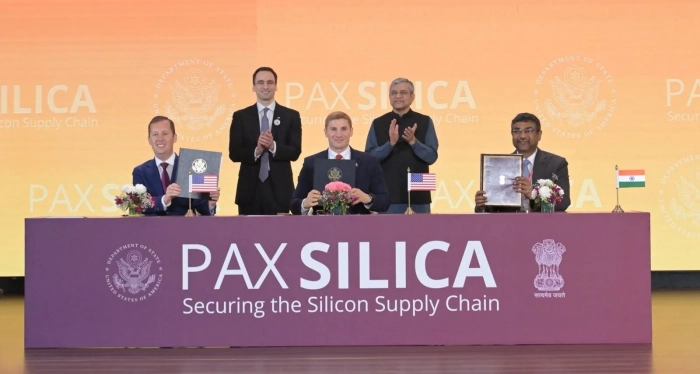
India has formally joined Pax Silica, a US-led coalition designed to secure semiconductor, AI and critical-minerals supply chains, marking a significant geopolitical and technological shift. The move places India closer to the core of an emerging Western-aligned tech network built for the AI era.
The announcement came on the sidelines of the India AI Impact Summit and signals Washington’s growing confidence in India as a long-term supply-chain partner.
What Pax Silica Actually Is
Pax Silica is a US-driven framework aimed at building a “trusted network” across the semiconductor and AI ecosystem. Instead of concentrating critical capabilities in a single geography, the initiative distributes key functions among allied nations.
The strategy focuses on coordinating countries that control major chokepoints in the tech stack, including:
- Dutch lithography leadership
- Japanese semiconductor chemicals
- Middle Eastern energy and capital
- Advanced packaging and manufacturing partners
The broader goal is to reduce strategic dependence on China and other countries described by US policymakers as “non-market actors.”
Why India Was Invited
India signed the Pax Silica Declaration after receiving an invitation in January 2026, reflecting a clear shift in how global powers view the country.
For years, India was seen primarily as a large digital market. Now it is increasingly viewed as a supply-chain resilience partner.
Analysts point to several factors behind the invitation:
- Four years of aggressive semiconductor policy
- Production subsidies and Semiconductor Mission incentives
- Ease-of-doing-business reforms
- Rapid growth in India’s electronics ecosystem
India also brings structural advantages that Pax Silica members value:
- One of the world’s largest pools of chip design engineers
- A fast-digitising domestic economy
- Long-term potential for ATMP, legacy fabs and mineral processing
- A large base of AI developers and services talent
Who Else Is in the Bloc
Pax Silica is expanding quickly.
Early signatories (December 2025)
- Japan
- Israel
- Australia
- Singapore
- South Korea
Later additions
- Greece
- Qatar
- United Arab Emirates
- United Kingdom
In addition, Canada, the European Union, the Netherlands, the OECD and Taiwan are participating as non-signatory members, aligning on policy and supply-chain coordination without full treaty commitments.
This structure gives Pax Silica both formal members and a broader policy orbit.
What India Stands to Gain
Membership is expected to unlock multiple near- and medium-term benefits.
Investment and infrastructure
- Increased US-and-ally investment into Indian AI compute and data centres
- Lower perceived risk for foreign investors in India’s semiconductor plans
- Stronger support for ATMP and legacy fab projects under the Semiconductor Mission
Critical minerals security
India also gains deeper integration into secured supply chains for:
- Lithium
- Cobalt
- Rare earth elements
This is particularly important for India’s ambitions in EVs, electronics manufacturing and energy transition technologies.
Near-term technical focus
Cooperation is likely to prioritise:
- Chip design
- Mature manufacturing nodes (28 nm and above)
- Advanced packaging
- Supply-chain security
Cutting-edge leading-edge fabs are not expected to be the immediate focus.
Strategic Trade-Offs India Must Manage
The membership is not without risks.
By joining Pax Silica, India is expected to move closer to Western export-control and investment-screening frameworks. That could create friction in several areas:
- Potential limits on supplying India-made tech to certain countries
- More scrutiny on cross-border tech flows
- Complications in managing ties with China and Russia
Perhaps most significantly, participation in a US-centric bloc could narrow India’s traditional multi-alignment strategy, where it has historically balanced relationships across geopolitical camps.
There may also be pressure to adopt US-aligned standards in AI and electronics rather than fully independent domestic frameworks.
Why This Moment Matters
India’s entry into Pax Silica signals a deeper structural shift in the global tech order.
Three trends are converging:
- AI is becoming infrastructure, not just software
- Semiconductor supply chains are being geopolitically reorganised
- Countries are being sorted into “trusted tech networks”
India is now positioning itself not just as a user of global technology, but as a core node in the supply chain of the AI age.
Bottom Line
India’s Pax Silica membership marks a strategic elevation in its global tech role. The move could unlock major investment, deepen semiconductor capabilities and strengthen AI infrastructure. But it also ties India more closely to a US-led technology bloc, introducing new geopolitical balancing challenges. How New Delhi manages the opportunities and constraints will shape its position in the AI economy for the next decade.