NASA’s Perseverance Rover Completes First Mars Drives Planned Entirely by Artificial Intelligence
by Suraj Malik - 1 month ago - 4 min read
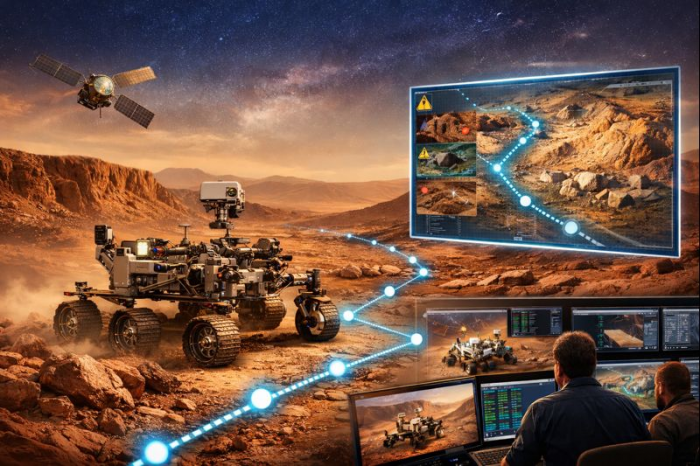
In December 2025, NASA quietly crossed a major operational milestone on Mars. For the first time since robotic exploration of the planet began in the late 1990s, a rover drove across the Martian surface using a route planned entirely by artificial intelligence, without human route planners selecting waypoints.
The achievement involved Perseverance, which executed two autonomous drives on December 8 and December 10, 2025. While the rover covered less than 250 meters on each drive, the significance lies not in the distance traveled but in how the route decisions were made. For 28 years, every Mars rover movement—from Spirit and Opportunity to Curiosity—relied on human engineers to plan each path in detail. That dependency has now been broken.
What exactly changed
During the two test runs, Perseverance followed navigation plans generated by AI systems trained to interpret Martian terrain using orbital imagery and elevation data. The rover traveled 689 feet (210 meters) on Sol 1,707 and 807 feet (246 meters) on Sol 1,709, both in the rocky terrain of Jezero Crater’s rim. The routes were more complex than typical conservative human-planned drives, yet remained well within the rover’s safety margins.
This marks the first time route planning—a mission-critical task—was handed over to AI rather than used only as a supporting tool. Until now, onboard autonomy was limited to obstacle avoidance after a human-designed route was already loaded.
How the AI planned a Mars drive
The planning system analyzed high-resolution images captured by Mars-orbiting spacecraft and combined them with three-dimensional elevation models of the terrain ahead. From this data, the AI identified hazards such as boulder fields, loose sand, exposed bedrock, and steep slopes, then generated a continuous driving path with defined waypoints for Perseverance to follow.
Before any command was transmitted to Mars, engineers at Jet Propulsion Laboratory ran the AI-generated plan through a detailed digital simulation—a virtual replica of Perseverance that models its hardware, software, power systems, and thermal behavior. The simulation checks more than 500,000 variables to ensure the rover can complete the drive without mechanical or software conflicts.
Only after the digital twin confirmed the plan was safe did NASA approve the commands for transmission.
Why autonomy matters on Mars
Mars operations are constrained by distance. Commands sent from Earth take between 4 and 24 minutes to reach the rover, making real-time control impossible. Every decision must be planned in advance, which historically limited how far rovers could safely travel in a single Martian day.
By allowing AI to plan routes rapidly, NASA removes one of the biggest operational bottlenecks. Route planning that once took hours of human effort can now be generated in minutes, enabling more frequent and potentially longer drives without increasing risk.
Key details from the December 2025 tests
- Two AI-planned drives completed successfully without human route input
- Total distance covered: 1,496 feet (456 meters)
- Terrain: rocky and uneven sections of Jezero Crater
- All commands validated through digital twin simulation before execution
What comes next
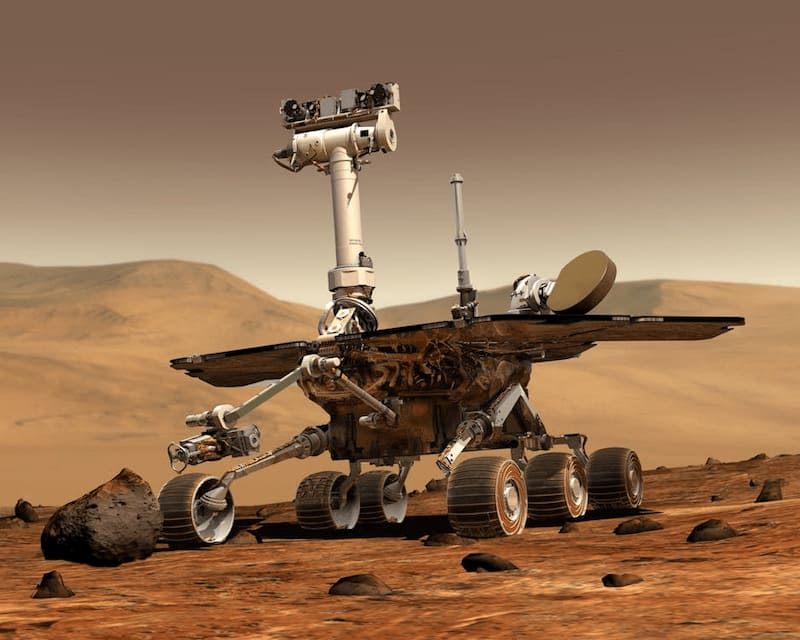
NASA engineers view the December drives as a proof of capability rather than a final deployment. The agency expects to gradually expand the use of AI planning, starting with longer daily drives and eventually enabling Perseverance to plan multiple sols of movement ahead.
Over time, the same approach could be applied to future Mars rovers, lunar vehicles supporting Artemis missions, and robotic explorers sent to more distant destinations where communication delays stretch to an hour or more. In those environments, autonomous planning is not just an efficiency gain—it becomes a necessity.
Why this milestone matters
The December 2025 drives represent a shift in operational authority rather than a simple software upgrade. For the first time, AI moved from assisting human planners to replacing them in a critical mission function, with humans acting as validators rather than designers.
If extended successfully, this model could reduce mission support costs, increase scientific coverage, and redefine how robotic exploration is conducted across the solar system. The distances driven were short, but the operational implications are long-lasting: Mars exploration has entered an era where artificial intelligence plans the journey, and humans approve the results.