OpenAI Launches Prism, an AI Tool Aimed at Speeding Up Scientific Writing
by Suraj Malik - 1 month ago - 5 min read
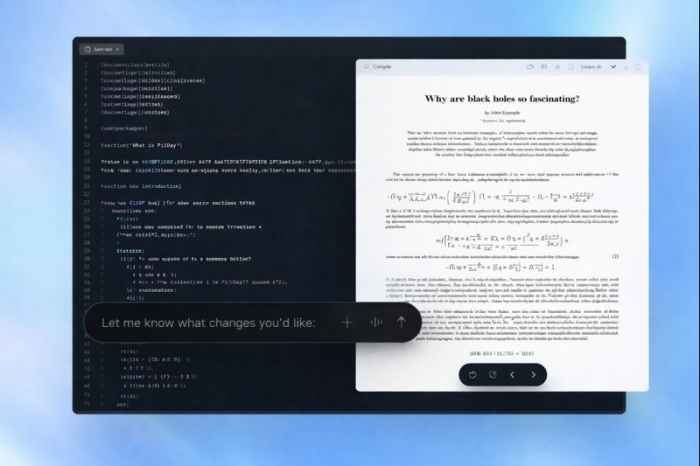
OpenAI on January 27, 2026, announced the launch of Prism, a free AI-powered workspace designed to help researchers write, revise, and collaborate on scientific papers. The new platform is built on GPT-5.2, OpenAI’s latest model optimized for mathematical and scientific reasoning.
Prism is OpenAI’s first product created specifically for scientific writing and academic research. It targets users who rely on LaTeX, the typesetting system widely used in disciplines such as physics, mathematics, computer science, engineering, and other technical fields. With this launch, OpenAI moves deeper into tools designed for professional research workflows, an area that has seen growing interest from major AI companies.

Integrated AI for Research Writing
Unlike general-purpose AI chat tools, Prism integrates GPT-5.2 directly into a LaTeX-native editor. This allows the AI to work within the manuscript itself, rather than as a separate interface. According to OpenAI, the model has access to the full structure of a research paper, including sections, equations, citations, figures, and references.
The company says this approach is intended to reduce workflow fragmentation for researchers, who often switch between LaTeX editors, reference managers, PDF readers, and external AI tools while preparing academic work.
Core Features
OpenAI outlined several key capabilities available in Prism:
- Embedded AI assistance: GPT-5.2 can help draft, revise, and refine scientific text directly within the document.
- Literature search and citations: Researchers can search academic databases such as arXiv from inside the workspace and receive AI-assisted citation suggestions and text updates based on related work.
- Equation and diagram support: Prism supports the creation and editing of mathematical equations and can convert handwritten formulas or whiteboard sketches into LaTeX code.
- Real-time collaboration: Multiple authors can work simultaneously on the same project, with edits, comments, and AI suggestions updating in real time.
- Cloud-based access: Users do not need to install LaTeX locally or manage compilation environments, as the platform runs entirely in the cloud.
OpenAI said these features are designed to reduce time spent on formatting, transcription, and reference management, allowing researchers to focus more on analysis and interpretation.
Built on Crixet
Prism is built on Crixet, a cloud-based LaTeX editor that OpenAI previously acquired. Before the acquisition, Crixet offered collaborative LaTeX editing along with a basic AI assistant. OpenAI has since rebuilt the platform with GPT-5.2 at its core, replacing earlier AI features with deeper document-level integration.
The transition has drawn mixed reactions from the LaTeX and research communities. Some users have welcomed the removal of subscription fees and the addition of advanced AI features. Others have raised concerns about data privacy and the growing role of AI in academic writing workflows, particularly for unpublished or sensitive research.
Role of GPT-5.2
GPT-5.2 was released by OpenAI in December 2025 and is described by the company as its most capable model to date for scientific and mathematical tasks. OpenAI says the model shows improved performance on graduate-level science benchmarks and advanced mathematics problems compared to earlier versions.
According to OpenAI, Prism is designed to use these capabilities to assist with reasoning-heavy writing tasks, while maintaining a clear division between AI assistance and human responsibility. The company emphasized that researchers remain responsible for verifying content, validating results, and making final authorship decisions.
Availability and Pricing
Prism is available immediately and free to anyone with a personal ChatGPT account. The platform supports unlimited projects and collaborators, a move that lowers barriers for researchers at smaller institutions or in under-resourced regions.
OpenAI said versions of Prism for Business, Enterprise, and Education customers will be introduced later. These versions are expected to include additional security, compliance, and administrative controls aimed at institutional use.
Competitive Landscape
With Prism, OpenAI enters a space long dominated by collaborative LaTeX platforms such as Overleaf. While Overleaf remains widely used in academia, Prism differentiates itself through deeper AI integration, unlimited collaboration without paid tiers, and multimodal input options such as voice and image-to-LaTeX conversion.
The launch comes amid increasing competition among AI companies targeting scientific and healthcare professionals. Earlier this month, OpenAI introduced ChatGPT Health, a product aimed at helping users understand medical information. Around the same time, rival firms have announced AI tools focused on clinical documentation, research support, and healthcare administration.

Broader Context
OpenAI executives have described 2026 as a key year for AI adoption in science, similar to how AI coding assistants became mainstream in software development during 2025. Prism reflects that strategy by embedding AI directly into the tools researchers already use, rather than offering assistance through separate interfaces.
While OpenAI positions Prism as a productivity aid rather than a replacement for human researchers, its introduction raises broader questions for academia around data governance, authorship norms, and the role of AI in knowledge creation.
For now, Prism represents a significant step in OpenAI’s effort to make AI a core part of scientific writing and collaboration, as competition intensifies to define how research work is produced in the coming years