PLI at a Crossroads: Why Smartphone Makers Want India’s Incentive Push to Continue
by Vivek Gupta - 1 month ago - 6 min read
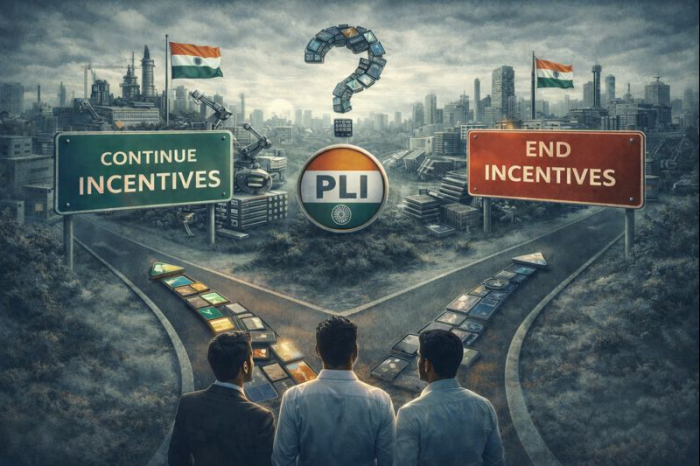
India’s smartphone manufacturing story over the past few years has been one of the most visible successes of the country’s industrial policy. Factories multiplied, exports surged, and global brands began treating India not just as a sales market but as a production hub. But with the current Production-Linked Incentive scheme for mobile phones set to end on March 31, 2026, industry leaders are now urging policymakers not to hit pause just when the momentum seems strongest.
Executives across the electronics ecosystem argue that ending incentives at a time when global component costs are rising could undo several years of progress. Their demand is not simply for more subsidies, but for continuity and smarter policy design. In conversations leading up to Budget 2026, manufacturers are calling for either an extension of the current scheme or a redesigned “PLI 2.0” that shifts focus from pure assembly toward deeper local value addition and component production.
A Scheme That Changed India’s Smartphone Map
The mobile PLI scheme, launched in 2020 with an allocation of roughly ₹40,995 crore, was designed to push companies to manufacture phones in India rather than import them. The results have been dramatic. Industry and government data indicate that between April 2020 and September 2025, India produced mobile phones worth more than ₹9 lakh crore, with exports crossing ₹5 lakh crore in the same period.
Investments under the scheme have crossed ₹13,000 crore, while incentives paid out so far total nearly ₹8,700 crore. Perhaps more importantly, electronics manufacturing, driven largely by mobile production, has generated over 12 lakh direct and indirect jobs. India now hosts around 300 mobile manufacturing units, compared with just a handful of major facilities about a decade ago.
Electronics has also become one of India’s fastest-growing export segments, with smartphones leading that charge. Brands such as Apple and Samsung increasingly ship India-made devices to markets including the United States and Europe. Industry leaders argue that abruptly ending incentives risks slowing this export momentum just as global supply chains are diversifying away from China.
Rising Costs Arrive at the Worst Possible Moment
The industry’s concern is not theoretical. Global component prices have climbed sharply over the past year, putting pressure on device makers worldwide. Memory components such as DRAM and NAND flash have seen price increases of roughly 40 to 50 percent, partly driven by demand from AI data centers. Semiconductor chip prices have also risen, while display panels, especially AMOLED screens, are becoming costlier.
Analysts estimate that overall smartphone production costs could rise by around 8 percent this year. For India, the impact is amplified because the country still imports many high-value components. As a result, global price increases directly squeeze local manufacturing margins, making exports less competitive.
Industry executives warn that if incentives vanish just as costs spike, manufacturers could rethink future expansion plans or shift production elsewhere. In short, India risks losing some of the cost advantage it worked hard to build.

Assembly Success, But Components Still Imported
While India has clearly succeeded in assembling phones at scale, the deeper ecosystem remains incomplete. Semiconductor chips alone accounted for a large share of electronics imports last year, with overall electronics imports still running into several lakh crore rupees annually.
This reveals a structural challenge. Much of the value in smartphones still lies in imported parts rather than domestic manufacturing. When global prices rise, Indian producers have little control over costs because local component supply is limited.
Recognizing this, the government introduced the Electronics Components Manufacturing Scheme, or ECMS, aimed at encouraging domestic production of items such as printed circuit boards, camera modules, and display components. The scheme carries an allocation of nearly ₹23,000 crore, and approvals for multiple large investment projects were recently announced.
However, officials acknowledge that building component ecosystems takes time. Industry estimates suggest it could take at least two years before ECMS-driven projects meaningfully reduce costs for phone makers. This timing mismatch is precisely why manufacturers want PLI incentives to overlap with component localization efforts rather than end abruptly.
Budget 2026: Decision Time for Policymakers
Signals from government officials suggest awareness of the dilemma. Policymakers recognize that the PLI scheme has delivered strong results, but they are also cautious about continuing subsidies indefinitely. Discussions appear to be leaning toward either extending incentives or redesigning them to push companies toward higher domestic value addition instead of simple assembly.
The upcoming budget is therefore critical. Companies are watching closely to see whether the government:
• Extends the current PLI structure for a few more years
• Launches a refined PLI 2.0 focused on components and value addition
• Or allows the scheme to sunset while relying on newer programs to carry the sector forward
The choice will shape the next phase of India’s electronics manufacturing story.
Exports Are Finally Taking Off
Export growth adds urgency to the debate. Industry estimates suggest smartphone exports from India could have reached around $30 billion in 2025, a remarkable jump in just a few years. Companies have started treating India as a global production base rather than merely a domestic assembly location.
Executives argue that policy continuity is crucial to locking in this position. If incentives end while competing nations continue offering manufacturing support, global companies could slow expansion or redirect investments elsewhere. The fear is not immediate factory closures, but a gradual loss of competitiveness over time.
What Manufacturers Want Going Forward
Industry conversations around Budget 2026 have crystallized into a few key demands. Companies are seeking clearer multi-year visibility on incentives so investment decisions can be made with confidence. They also want incentives to reward higher domestic content rather than simply higher sales volumes.
Other priorities include faster approvals under component localization schemes, smoother regulatory processes for new investments, and continued export support mechanisms. There is also growing interest in incentives for research and development so India can move beyond assembly toward design and engineering capabilities.
The Bigger Make-in-India Question
The debate ultimately reflects a broader transition underway in India’s manufacturing ambitions. The past five years proved that India can assemble smartphones at massive scale. The next challenge is to deepen the ecosystem so more value is created locally and less is imported.
Smartphone makers argue that PLI delivered strong returns relative to public spending, but the ecosystem is not yet mature enough to operate without support, especially when global cost pressures are rising. Ending incentives now, they say, risks treating a midpoint as a finish line.
For policymakers, the decision ahead is delicate. Continue incentives too long, and subsidies risk becoming permanent. End them too early, and manufacturing gains could stall.
As Budget 2026 approaches, the question facing India is simple but consequential: should the country treat the PLI scheme as a completed success story, or as the foundation of a still-unfinished manufacturing journey?