Poke Turns AI Agents Into a Text Message Experience
by Suraj Malik - 6 hours ago - 4 min read
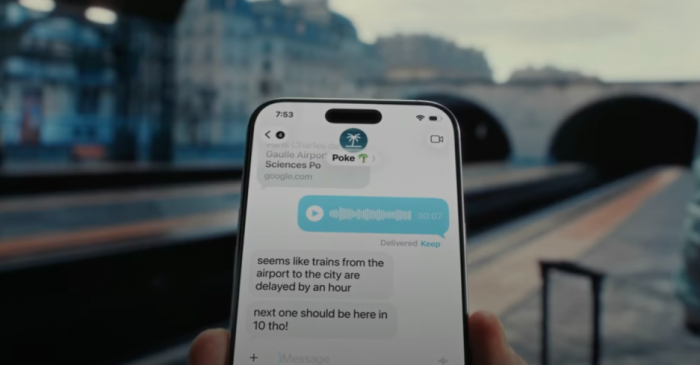
A new startup is simplifying automation at a time when AI agents are getting more complex
A new startup called Poke is betting that the future of AI won’t be built around dashboards, apps, or coding environments, but around something far simpler: text messages. According to a recent report, the company has launched an AI agent platform that allows users to automate real-world tasks by simply sending a message, positioning itself as a consumer-friendly alternative to increasingly technical AI systems.
What Poke Actually Does
Poke operates as a text-based AI agent that works across familiar messaging platforms like iMessage, SMS, Telegram, and in some regions, WhatsApp. Instead of requiring users to install apps or configure integrations, the system runs directly through conversations.
The core idea is straightforward: users describe what they want, and the AI executes it.
That includes tasks such as:
- Managing calendars and daily schedules
- Sending reminders (like weather alerts or medication prompts)
- Tracking fitness and health goals
- Monitoring emails and sending alerts
- Controlling smart home devices
- Editing photos or retrieving information
Unlike traditional chatbots that focus on answering questions, Poke is designed to take action, not just respond.
A Shift From Chatbots to “Doers”
The launch reflects a broader shift happening across the AI industry. Tools like ChatGPT or Claude are widely used for research and content generation, but newer “agentic AI” systems are being built to perform multi-step tasks autonomously.
Poke positions itself directly in this emerging category but removes the technical barriers.
Instead of:
- Installing tools
- Running commands in a terminal
- Managing APIs or dependencies
Users simply send a text.
This matters because many current agent-based systems, such as developer-focused frameworks, remain inaccessible to non-technical users and often raise security concerns due to deep system access.
The “Recipe” Layer: Automation Without Coding
One of Poke’s more notable features is its “recipes” system, which allows users to create automations in plain language.
For example:
- “Alert me if my boss emails after 6 PM”
- “Remind me every morning to check the weather and carry an umbrella”
These automations can be:
- Created in seconds using text
- Shared with other users
- Discovered through a growing recipe library
The company is even incentivizing users to build these automations by offering small payouts for successful referrals tied to shared recipes.
Funding, Growth, and Valuation
Poke is still a relatively small operation, with a team of around 10 people. But investor interest suggests strong belief in the model.
- Raised $15 million in an earlier seed round
- Recently added $10 million more funding
- Backed by firms like Spark Capital and General Catalyst
- Current valuation: ~$300 million (post-money)
This places Poke among a growing class of AI startups focused on consumer-first automation, rather than enterprise-heavy infrastructure.
Why This Matters Now
The timing of Poke’s launch is critical.
The AI industry is rapidly moving toward agent-based systems, where software doesn’t just generate output but completes tasks end-to-end. However, most of these systems remain:
- Developer-centric
- Complex to deploy
- Risky in terms of system-level access
Poke’s approach flips that model.
Instead of building more powerful tools for engineers, it builds simpler interfaces for everyone else, using the one interface nearly every user already understands: messaging.
This aligns with a broader trend where:
- Interfaces are becoming invisible
- Automation is embedded into everyday tools
- AI shifts from “assistant” to “operator”
The Bigger Picture: Democratizing AI Agents
Poke’s long-term bet is clear: AI adoption will be driven by simplicity, not capability alone.
While companies like OpenAI and Nvidia push advanced agent frameworks, Poke is targeting the gap between capability and usability. The assumption is that most users don’t want to learn new systems, they want outcomes with minimal friction.
If that thesis holds, text-based AI agents could become:
- A default layer for personal productivity
- A gateway to automation for non-technical users
- A competitor to both apps and traditional assistants
Final Take
Poke is not introducing a new type of AI. It is repackaging existing capabilities into a more accessible form.
That may sound incremental, but in the current AI cycle, interface innovation is becoming just as important as model innovation.
If successful, Poke could signal a shift where the next wave of AI adoption is not defined by better models, but by how effortlessly people can use them.