Sarvam AI Launches India-Focused Speech Model, Claiming Edge Over Global Rivals
by Vivek Gupta - 1 month ago - 5 min read
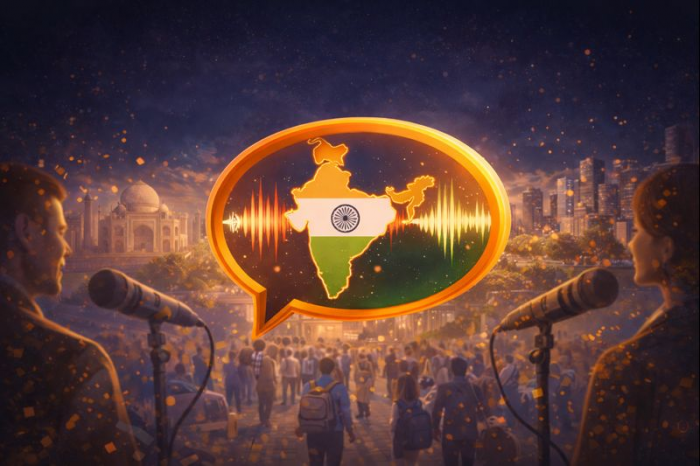
Indian AI startup Sarvam AI has unveiled Sarvam Audio, a speech recognition model built specifically for Indian languages and accents, positioning it as a homegrown alternative to offerings from OpenAI and Google.
Announced over February 2 and 3, Sarvam Audio is designed to handle the linguistic complexity of India’s everyday speech, including regional accents, dialect shifts, and the widespread habit of mixing English with local languages mid-sentence. The company claims the model outperforms GPT-4o Transcribe and Gemini 3 Flash on Indian-language benchmarks, though detailed comparative data has not yet been publicly released.
Built for How India Actually Speaks
Unlike global speech-to-text systems trained largely on Western datasets, Sarvam Audio focuses on real Indian speech patterns. The model supports 22 Indian languages listed under the Constitution’s Eighth Schedule, along with Indian English.
A standout feature is its handling of code-mixing, a common phenomenon where speakers blend languages such as Hindi and English within the same conversation. Sarvam says the model can maintain context even as languages switch, a task that general-purpose transcription systems often struggle with.
The system also includes built-in speaker diarization, allowing it to identify who spoke when in conversations involving up to eight speakers. This makes it suitable for meetings, call center recordings, podcasts, and multi-party interviews.
Trained on the Sounds of Everyday India
Sarvam Audio was trained on the IndicVoices dataset, developed in collaboration with IIT Madras. The dataset includes around 12,000 hours of speech collected from more than 16,000 speakers across 208 districts.
Crucially, much of this audio reflects real-world conditions rather than studio recordings. Training samples include background noise from tea shops, public offices, courtrooms, and homes. About three-quarters of the dataset consists of spontaneous speech rather than scripted reading, helping the model adapt to natural pauses, interruptions, and informal phrasing.
The underlying model, Sarvam 3B, has three billion parameters and is optimized for long-form audio such as lectures, meetings, and podcasts.
Enterprise Use Comes First
Sarvam Audio is being positioned primarily as a business-to-business product. The company says early demand is coming from sectors where Indian language support is critical but underserved by global AI tools.
Key target use cases include:
- Call centers and customer support operations
- Logistics and delivery coordination
- Banking, fintech, and compliance documentation
- E-commerce support chat and voice channels
- Government service helplines and workflows
The model is available via API for enterprise customers, with options for real-time transcription, short synchronous audio processing, and batch jobs for recordings up to an hour long.
Backed by the IndiaAI Mission
The launch is closely tied to India’s broader push for AI sovereignty. Sarvam AI was selected under the government’s IndiaAI Mission, receiving access to around 4,000 high-end GPUs for six months through partnerships with Yotta Data Services, Tata Communications, and E2E Networks.
The government program aims to reduce reliance on foreign AI infrastructure and models, particularly for sensitive domains such as language, governance, and public services. Sarvam is also part of a longer-term plan to build a 70-billion-parameter sovereign Indian large language model by 2027.
For policymakers, Sarvam Audio represents a practical step toward that goal, delivering a deployable product rather than a purely research-oriented system.
How It Stacks Up Against Global Models
Sarvam argues that global speech models excel at general transcription but fall short on Indian nuances. Systems like GPT-4o and Gemini are trained to work across many countries and languages, while Sarvam Audio is narrowly optimized for one market.
The company says this specialization gives it an accuracy advantage for Indian accents, informal speech, and multilingual conversations. However, it has not yet released detailed benchmark numbers or third-party evaluations to independently verify those claims.
Industry observers note that while specialization often improves performance, enterprise adoption will depend on real-world reliability at scale, pricing, and integration ease.
A Growing Product Line
Sarvam Audio is the latest addition to a fast-expanding product ecosystem. Since 2024, the company has rolled out a series of language-focused tools, including foundation models, translation services, speaker diarization tools, and AI-based video dubbing.
Together, these releases suggest Sarvam is aiming to build a full stack of language AI services tailored to Indian use cases rather than competing head-on with global models across every domain.
What Happens Next
The immediate question is whether Sarvam will publish detailed benchmarks comparing its system with international competitors. Enterprise customers are also expected to test the model in live environments such as call centers and logistics operations over the coming months.
If the performance claims hold up in production, Sarvam Audio could become a default choice for Indian enterprises needing accurate speech recognition across regional languages. If not, it risks being seen as another promising launch that struggled to match global standards.
For now, the release signals a clear shift in India’s AI landscape: from experimenting with language models to building commercial systems designed for local realities. Whether Sarvam Audio becomes a national standard or a niche solution will depend on what happens after the headlines fade and real conversations begin.