The TikTok Deal Is Done, So Why Does It Feel Like the Real Drama Just Started?
by Vivek Gupta - 1 month ago - 6 min read
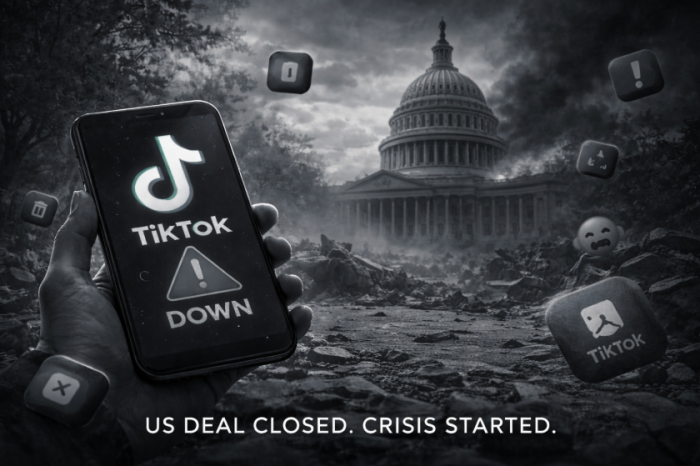
For years, the story around TikTok in the United States followed a familiar rhythm: political pressure, regulatory threats, last-minute negotiations, and then another temporary sigh of relief. That cycle finally appeared to end this month when the long-awaited US deal closed. Headlines framed it as the conclusion of a drawn-out saga, the moment when uncertainty gave way to stability.
Then, within days, the app stopped working properly.
What followed was not a quiet post-deal adjustment period but a cascade of outages, censorship allegations, investigations, and user flight. If the deal was meant to calm nerves, it instead exposed how fragile trust around the platform has become. The ink had barely dried before users started asking a much harder question: did solving the ownership problem just create a bigger credibility one?
A Victory That Lasted About 72 Hours
When the US deal closed on January 22, many users and creators believed the worst was finally behind them. Years of debate over data security, foreign influence, and regulatory risk seemed resolved. The platform had survived, again.
By January 25, that sense of relief evaporated.
A widespread infrastructure failure left millions of users unable to upload videos, refresh feeds, or see engagement on new posts. For some, the app loaded but felt frozen in time, recycling old content as if stuck in a loop. For others, it simply did not work at all.
Peak complaint volumes crossed tens of thousands in a matter of hours. While the company attributed the disruption to a power failure at a US data center, the explanation did little to calm frustration. Service came back only partially, and even days later reports continued to stack up.
It was a rough start for a platform that had just promised a more stable future.
What users experienced during the outage included:
- Videos uploading but receiving zero views
- Feeds repeating older content with no refresh
- Upload failures across both the main app and its editing tools
When a Technical Problem Becomes a Trust Problem
Outages happen. Users usually forgive them. What made this moment different was timing and context.
As service issues lingered, creators began reporting something more unsettling. Videos critical of political figures and law enforcement agencies appeared to publish normally but received zero views. Some were flagged as “ineligible for recommendation.” Others were placed under review without explanation.
Journalists and independent testers were able to replicate the issue. Polls showed that a large majority of users experienced either posting failures or unexplained suppression. Even private messages raised eyebrows when certain politically sensitive keywords failed to send at all.
The company described these incidents as technical side effects of the outage. Many users were unconvinced.
Within 24 hours, the narrative shifted from “temporary infrastructure failure” to “possible content control.” Once that suspicion took hold, trust eroded fast.
The Political Shadow Over a Social App
The deal that finalized TikTok’s US ownership was supposed to reduce political risk. Instead, it placed the platform under a new microscope.
Critics questioned whether the new structure would result in subtle pressure over what content thrives and what disappears quietly. Allegations centered on whether criticism of certain political figures and government agencies was being deprioritized.
Those concerns escalated when a state-level investigation was announced to determine whether content suppression violated local law. The inquiry did not accuse wrongdoing outright, but it signaled that regulators were taking user claims seriously.
For a platform built on algorithmic discovery, perception matters as much as policy. Once users suspect invisible hands shaping visibility, every glitch feels suspicious.
Key questions users began asking openly were:
- Is content moderation being influenced by new ownership priorities?
- Are technical failures masking intentional ranking changes?
Users Vote with Their Thumbs
As explanations lagged, behavior changed.
Uninstall rates jumped dramatically over the course of the week. Alternative short-form video apps saw sudden spikes in downloads, with one newcomer briefly climbing into the top ranks of app store charts.
Creators, in particular, reacted quickly. For people whose livelihoods depend on consistent reach, an app that posts videos into a void is not just annoying, it is dangerous. Some began cross-posting aggressively. Others paused publishing altogether.
It was not a mass exodus, but it was loud enough to matter.
In social platforms, momentum cuts both ways. Growth is powerful, but so is doubt.
The Irony of Regulatory Closure
There is a quiet irony at the heart of this moment.
The US deal was framed as a safeguard against foreign influence and opaque governance. It was meant to reassure users that oversight would be clearer, accountability stronger, and operations more transparent.
Instead, the first post-deal crisis left users feeling less certain than before.
The question many are now asking is not whether the platform is foreign or domestic, but whether it is predictable. Stability is not just about ownership, it is about consistency, reliability, and trust that rules will not shift without explanation.
In trying to close one chapter, the deal opened another that feels more personal.
Why This Moment Matters Beyond One App
What is happening here extends beyond TikTok itself.
Social platforms are no longer just entertainment. They shape political discourse, creative economies, and cultural narratives. When access falters or visibility feels manipulated, the impact ripples outward.
This episode highlights a growing tension across tech platforms. Governments want control. Companies want growth. Users want fairness. Algorithms sit in the middle, silent and powerful.
When systems fail at this scale, people stop assuming goodwill and start demanding clarity.
A Market That Has Lost Its Patience
Users in 2026 are less forgiving than they were five years ago. They have options. They understand how recommendation systems work, at least broadly. They recognize patterns.
The moment trust breaks, switching costs feel lower.
This is especially true for younger users and creators who grew up platform-agnostic. Loyalty is earned daily, not granted by default. If an app feels unstable or politically skewed, they move on without ceremony.
That reality may be the most important lesson from this week.
Can Confidence Be Rebuilt?
None of this means TikTok is finished. Far from it.
The platform still commands enormous attention, cultural relevance, and creative energy. Outages can be fixed. Investigations can clarify facts. Policies can be communicated better.
But rebuilding trust requires more than technical recovery.
It means explaining how moderation decisions are made, how outages affect ranking systems, and how political neutrality is maintained in practice, not just in statements. It means acknowledging uncertainty instead of hiding behind vague technical language.
Most importantly, it means remembering that users are not just data points. They are paying attention.
The Takeaway
The US deal was supposed to be the end of the story. Instead, it marked the beginning of a new chapter, one defined less by geopolitics and more by credibility.
In just a few days, TikTok moved from regulatory relief to reputational stress. Outages exposed fragility. Censorship claims exposed fear. User behavior exposed impatience.
Whether this moment becomes a footnote or a turning point depends on what happens next. But one thing is already clear.
Saving an app on paper is not the same as earning trust in practice.