What “AI Mirrors” Reveal When Sight Is No Longer the Only Way to See Yourself
by Vivek Gupta - 1 month ago - 7 min read
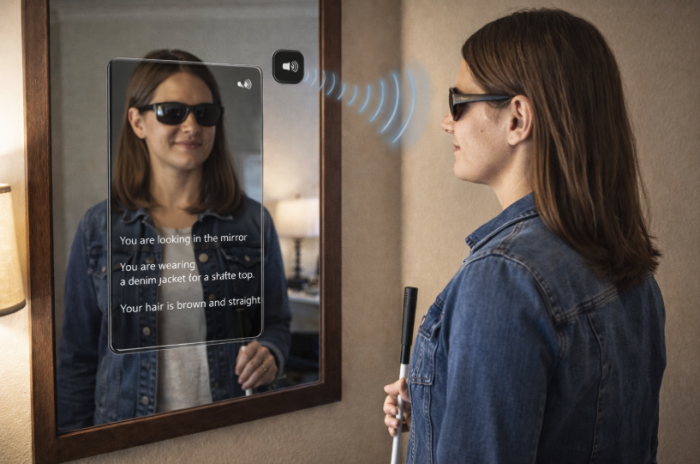
Imagine standing in front of a mirror and finally being able to see your own expression, posture, or the way your clothes fall, even if you have never done so before. For many blind and low vision people, this was once a distant fantasy. Today, a new class of tools loosely nicknamed “AI mirrors” is changing that. These technologies are offering visual feedback in ways that are reshaping self-perception, confidence, and independence.
This story is less about gadgets and more about lived experience. It is about people gaining access to visual information they never had before and the profound psychological shift that comes with it. In this article, we explore how this technology works, why it matters, and what it might mean for the future of accessibility and identity.
The Idea Behind “AI Mirrors”
At first glance, the phrase sounds like science fiction. But the term “AI mirror” doesn’t refer to a literal looking glass. Instead, it represents tools that use artificial intelligence to describe a person’s body, face, or appearance in real time. This isn’t simply identifying an object or reading text aloud. It is visual feedback about you, your own reflection translated into meaningful information.
For many blind people, this marks a significant shift. They are no longer reliant solely on others to explain visual details about themselves. Instead, AI powered tools provide direct, immediate feedback. The result can be a deeper sense of agency and self-awareness.
How “AI Mirrors” Work in Practice
The technologies behind these experiences vary, but they all share a common goal: turn visual data into human usable feedback. Let’s break this down without getting buried in technical jargon.
Smart Visual Awareness Tools
There are several tools today that bring aspects of visual information to life:
Glasses with real time analysis help users navigate the world by interpreting scenes and converting that into feedback they can sense through vibrations or audio. Unlike simple object detection, these systems understand context. For example, they can tell a user the difference between a walk-able surface and a visually similar obstacle like a shallow body of water.
Other wearable systems identify objects, read text aloud from menus or signs, and even recognize faces. They do this using advanced pattern recognition and voice interaction that feels natural and immediate.
Everyday Use Cases
Here’s where the “mirror” concept becomes meaningful:
- Self-perception: Tools can describe a person’s appearance, posture, or clothing. For some users, this is the first time they receive visual feedback about their own body.
- Reading and information access: Menus, labels, documents, screens and signs are no longer barriers to understanding. Users hear what text says when they need it.
- Navigation and safety: Real time interpretation of environments helps people walk more confidently, avoid obstacles and travel independently.
- Social interaction: Recognizing faces and expressions enhances connection. Video calling with live assistance adds a layer of support when needed.
- Professional pursuits: Even programming tools that describe 3D models in rich detail are enabling blind developers to work on complex designs on their own.
Together, these capabilities go beyond making life easier. They are reshaping experience.
A New Kind of Vision
One profound idea behind these technologies is not just seeing the world, but seeing yourself in it. Think about something most people take for granted: checking your reflection in a mirror before a meeting, or adjusting your outfit before leaving the house. For someone who has never had that information firsthand, an AI mirror offers something emotionally significant.
This is not about replacing human support. It is about broadening independence. Instead of asking a friend what they think your expression looks like, or guessing how your outfit appears, you get direct feedback. You can make decisions rooted in your own sense of self rather than piecing together secondhand descriptions.
Some users describe the experience as liberating. It gives them a sense of agency they never had before. The ability to know what others see when they look at you is not trivial. It is a human experience most people take for granted.
Technology That Feels Like a Companion
One example of these tools’ functions like a “self-driving car for pedestrians.” Instead of steering a vehicle, it helps a person navigate on foot. It interprets rough visual data and translates it into haptic feedback, tiny vibrations that guide movement safely. In a live test on a crowded show floor, someone blindfolded was able to use this haptic guidance to navigate successfully without visual cues.
Another tool, refined over years of development, reads text and describes objects and faces in real time. It can even interpret colours and brightness levels, giving users an unprecedented level of visual context about their surroundings.
What is especially interesting is how some mainstream devices originally designed for general use are now being adopted as assistive tools. This crossover shows that accessibility is not a niche concern, it is something that benefits everyone when tools are designed to be inclusive.
Innovation Around the World
Innovation is not limited to major corporate labs. In India, a teenager developed a smartphone powered system that recognizes objects, obstacles, text, and familiar faces. This tool uses voice and vibration alerts to help people understand their environment and is now being trailed in schools for the blind.
Another project makes 3-D modelling accessible by using text descriptions generated from images taken from multiple angles. Blind programmers have used this tool to create detailed models like robots and helicopters independently.
These kinds of contributions highlight an important point: accessibility innovation is happening everywhere, often driven by lived experience and necessity rather than detached design.
Psychological Impact: More Than Navigation
The real excitement is not just in the technical achievement, but in the psychological shift that accompanies it.
For decades, blind people have relied on language, memory, and touch to understand the world and themselves. Vision has been a secondhand sense in many areas of life. These AI tools change that. They create a bridge between visual data and personal interpretation that allows for firsthand experience in places once closed off.
This has effects beyond daily tasks:
- People feel a stronger sense of self as they gain visual context about their own bodies and expressions.
- Confidence grows because reliance on others for basic visual information diminishes.
- Social participation becomes richer when users can recognize faces and interpret cues that were previously inaccessible.
- Independence increases not just in physical navigation, but in how people present themselves socially and professionally.
In short, this technology is widening the emotional and experiential world of users.
What Accessibility Looks Like in 2026
It is important to note that these advancements are complements, not substitutes, for other mobility tools like canes, guide dogs, or braille. They are not perfect. There are limitations and ongoing challenges. But as part of an ecosystem of support, they are powerful.
The market for related devices like smart mirrors, tools that reflect visual information back to users in novel ways, is projected to grow significantly over the next decade. This reflects a broader trend: making visual feedback accessible is not a niche pursuit anymore. It is a mainstream concern that intersects with product design, consumer tech, and human experience.
Looking Ahead: A World with More Visual Access
As these technologies continue to improve and become more affordable, the question shifts from can we help people see to how do we ensure everyone can participate fully in life, not just functionally but meaningfully?
Imagine a future where:
- A person with low vision tries on clothing and hears a description of how it looks and fits.
- A blind student navigates a campus with real time scene interpretation.
- A software developer models 3-D objects independently and confidently.
- Someone identifies their own expression before a video call.
This future seems closer than we might have guessed even a few years ago.
A Mirror More Meaningful Than Glass
In the end, the phrase “AI mirror” captures something important: it is not just about reflecting an image. It is about reflecting identity, independence, and choice. For many blind people, these tools offer a new kind of vision, one built on information, context, and autonomy.
The revolution in assistive technology we are witnessing in 2026 is not just a technical milestone. It is a human story, one in which perception, dignity, and self-understanding gain new meaning. That is the true power of these tools.
And perhaps, that is what it means to truly see yourself.