When One Man Owns the Rockets, the Cars, and the Chat-bot: Is Musk About to Fuse His Empire into One Company?
by Vivek Gupta - 1 month ago - 6 min read
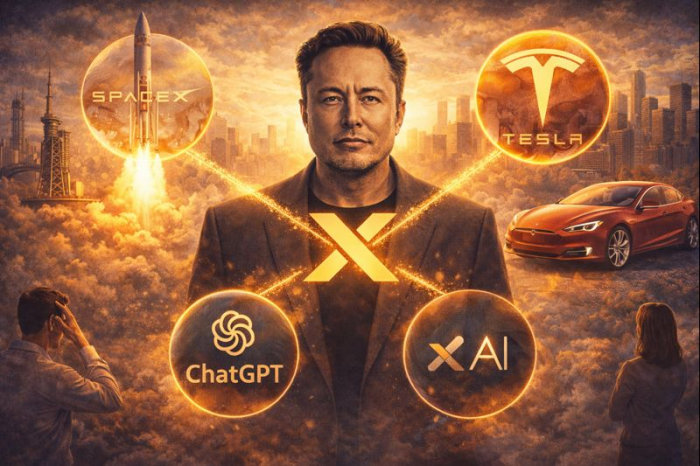
A decade ago, the idea of merging a rocket company, an electric car giant, and an AI lab would have sounded like a Silicon Valley fever dream. Today, it sounds like Thursday. Reports published January 29, 2026 say Elon Musk’s companies are discussing a merger plan that could pull SpaceX, Tesla, and xAI into a single corporate gravity well, bringing rockets, EVs, satellite internet, social media distribution via X, and Grok AI under one roof.
If you are thinking “that sounds too big to be real,” that reaction is part of the story. The talks are not confirmed as final, valuations and structures are still fluid, and none of the companies have made a formal public announcement. But the market still reacted like it heard thunder. Tesla shares jumped roughly 3 percent in after-hours trading after the reports hit, suggesting investors see potential upside in consolidation, or at least enjoy the drama.
And yes, this would be an unusually Musk-style consolidation: bold, complicated, and likely to make regulators reach for extra coffee.
Two merger paths, and one unspoken third
The reports point to two main merger structures being discussed. The first is the one people have speculated about for years: SpaceX plus Tesla. Bloomberg coverage referenced by Reuters suggests the two are considering a combination, an idea some Tesla investors have pushed for over time.
The second option appears to be getting more active attention: SpaceX plus xAI, potentially before SpaceX’s planned IPO later in 2026. Reuters reported SpaceX and xAI are in active talks, and the logic is easy to see. A SpaceX-xAI tie-up could bundle launch capability, Starlink’s satellite network, X as a distribution channel, and Grok as the AI product into one investor story.
Then there’s the unspoken third possibility: a future where all three become interconnected in practice, even if not merged in a single dramatic press release. Musk has already been knitting these companies together through investments and shared direction, which makes this feel less like a sudden plot twist and more like the final episode of a season that has been building all year.
The paper trail that made people look twice
One reason this story caught fire is that it is not based purely on vibes. Reuters noted corporate filings showing two new entities incorporated in Nevada on January 21, 2026: K2 Merger Sub Inc. and K2 Merger Sub 2 LLC. Those names are the corporate equivalent of seeing moving boxes outside your neighbor’s apartment. Technically, it does not prove the move is happening, but it strongly suggests someone is preparing.
Deal mechanics being discussed, according to reporting, include xAI shareholders receiving SpaceX stock in exchange for their xAI shares, with some executives potentially receiving cash instead of stock. Details remain under negotiation, but the structure hints at a pre-IPO cleanup where Musk’s businesses are arranged into a simpler story for public markets.
If you are an investor, you can already hear the pitch: “It’s not just a rocket company. It’s a space-and-AI infrastructure platform.” That kind of narrative does not just raise eyebrows. It raises valuations.
Why space-based AI suddenly sounds less ridiculous
The strategic vision behind a SpaceX-xAI combination is not just “bigger is better.” Reuters reporting and commentary surrounding the talks point toward Musk’s repeated idea that AI data centers could eventually be placed in space.
The pitch is simple to describe, even if wildly complex to execute: xAI builds the compute, SpaceX launches the infrastructure, Starlink provides global connectivity, and space offers abundant solar power and different cooling economics. The Verge’s coverage framed this as part of the motivation behind the merger discussions, with mid-2026 IPO timing in the background.
If this sounds like science fiction, remember that a lot of Musk’s “science fiction” has a habit of turning into “annoying reality” for competitors. Starlink itself went from unlikely idea to global internet backbone faster than most analysts predicted.

The money is so large it stops feeling like money
This story also lands because the numbers are absurd in the literal sense. Reuters reported SpaceX executed a secondary share sale at $421 per share, valuing the company around $800 billion. That is not just huge. That is “this is now a nation-state” huge.
At the same time, xAI has been priced by recent funding around $230 billion, according to Reuters reporting referenced elsewhere in this coverage. And Tesla disclosed it agreed to invest roughly $2 billion into xAI as part of that Series E financing, with the agreement dated January 16, 2026.
So the merger rumors are not happening in a vacuum. They are happening in a landscape where Musk’s companies already share financial arteries. A merger would not be a new relationship. It would be making an existing relationship official on Facebook.
The Pentagon angle that changes the tone
There is another layer that makes regulators and policy watchers sit up straighter: defense. Reuters reported xAI has a Pentagon contract worth up to $200 million connected to integrating Grok into military networks, tying AI capabilities to national security systems.
A SpaceX-xAI consolidation would therefore combine a major space contractor and satellite operator with an AI firm doing military integration work. That is not automatically disqualifying, but it does increase scrutiny. When space infrastructure, communications, and AI converge, governments tend to ask more questions, not fewer.
Why investors cheer and why others panic
Some investors like the idea because it simplifies a familiar worry: Musk manages a lot of companies at once, and people question whether that spreads attention thin. Reuters included reactions from market voices suggesting consolidation could reduce “too many separate companies” risk and create a tighter strategy.
On the other hand, consolidation can also amplify conflict-of-interest concerns, especially for Tesla shareholders who have already questioned Musk’s shifting priorities in AI. And then there is the practical challenge: integrating companies with radically different cultures is hard even when everyone is trying to be nice, which corporations famously are not.
If this merger happens, the opportunity is clear: a vertically integrated machine that can launch hardware, power it, connect it, and run AI on top of it. The risk is also clear: valuation complexity, regulatory gravity, and execution risk at a scale that turns “hard” into “legendary.”
What to watch next
The next signals will likely be boring, which is how you know they matter. Watch for regulatory filings, corporate disclosures, and changes tied to SpaceX’s IPO planning. Reuters has already pointed to the legal groundwork via the merger sub entities, so further paperwork could clarify which path is real: SpaceX plus Tesla, SpaceX plus xAI, or some hybrid outcome.
Until then, the headline version is simple: Musk may be trying to assemble a company that can move atoms and information, on Earth and in orbit, with AI as the glue. If that sounds like the plot of a futuristic business thriller, you are not wrong.
The only difference is that this one might file an S-1.