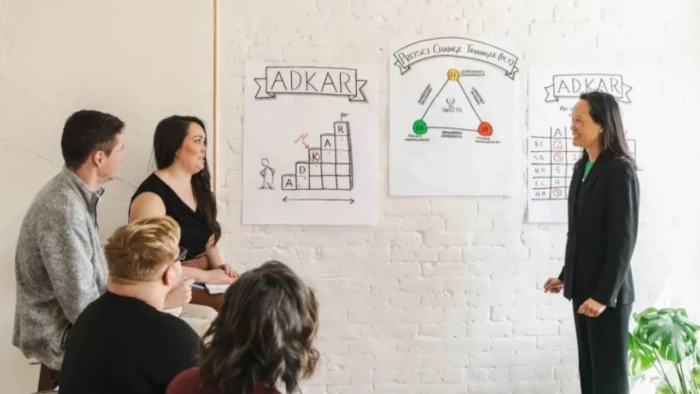
Change is constant in organizations. How to lead teams through new procedures, technology, or strategies is up to leaders. Change is handled differently by everybody. Kotter promotes a leader-driven approach, whereas the ADKAR Model focuses on individuals. This essay simplifies both models, compares them, and helps choose the best one.
Change is not automatic. Planning and assistance are needed. The ADKAR Model involves supporting everyone in the company, and small motivational boosts — much like the offers found at $50 free chip no deposit for NZ players — can help people stay engaged throughout the change process. At the top level, Kotter's model guides leaders, and understanding these distinctions helps in choosing the right approach.
Change is straightforward using the ADKAR Model. The procedure has five easy, cumulative steps. This paradigm helps individuals accept change from ignorance.
ADKAR was founded by Jeff Hiatt in 1994. He examined over 700 firms to see why certain modifications worked and others failed. His studies proved that change affects individuals predictably. Step-by-step support improves outcomes.
ADKAR's fundamental message is that people transform organizations. An announcement of a new system is useless if workers don't utilize it. ADKAR guides individuals through the trip.
For example, imagine a team switching to new software. Without awareness of why it is needed, people resist. ADKAR addresses this from the start. It turns passive workers into active participants. Change managers using ADKAR ask questions at each stage. Do people understand the need? Do they want to join in? This active involvement makes change last.
The model works well because it is easy to grasp. Anyone can follow the five steps without complex training. It applies to small shifts, like updating a form, or big ones, like restructuring a department.
When combined with the full Methodology, ADKAR scales up. The methodology adds phases for preparing, managing, and sustaining change. It includes tools like assessments to check progress. This combination handles large projects while keeping the focus on people.
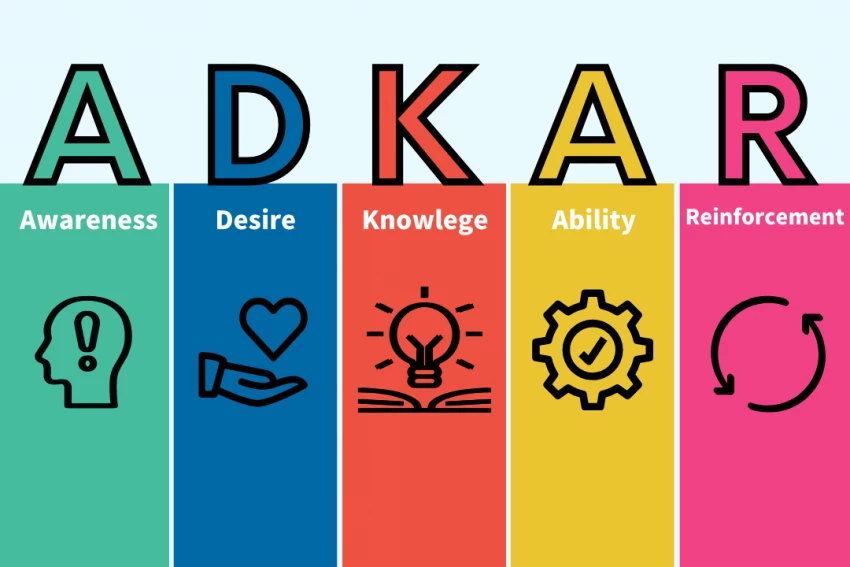
The ADKAR Model uses these sequential elements:
These steps form the only list of building blocks in this article. They create a roadmap that anyone can follow.
In "Leading Change." (1996), John Kotter presented his 8-Step Process. It gives leaders a step-by-step roadmap for major organizational changes.
The Kotter paradigm begins with enthusiasm and ends with incorporating new methods into culture. It helps leaders determine direction and get top support.
The process views change as a series of actions. Each step builds momentum. For instance, early wins keep people motivated. Kotter designed it for large-scale transformations, like mergers or market shifts.
Leaders form teams and communicate visions. They praise progress and eliminate obstacles. The model views change as continual. However, it remains high. It instructs leaders but not necessarily how to resolve issues.
Both models put people at the center of change. They recognize that success depends on human effort. ADKAR and Kotter aim for lasting results, not quick fixes.
Yet, they differ in focus and style. ADKAR zooms in on personal journeys. It supports employees at every level. Kotter looks at the whole organization from the leader's seat. It uses top-down instructions.
A common mix-up happens with ADKAR. Some think it is the same as the full Methodology. ADKAR handles individual change. The methodology adds structure for teams and companies. For fair comparisons in big changes, match the full approach against Kotter.
The table below shows a clear breakdown. It covers focus, steps, advantages, and more.
| Aspect | ADKAR Model | Methodology | Kotter 8-Step Process |
| Focus | Individual transitions | Individual and organizational levels | Organizational with top-down approach |
| Key Elements/Steps | Awareness, Desire, Knowledge, Ability, Reinforcement | ADKAR plus 3-Phase Process and Change Triangle | 8 steps from urgency to anchoring in culture |
| Advantages | Employee-centric, practical, easy to apply | Comprehensive, research-based, scalable | Emphasizes vision, coalition, momentum |
| Complexity | Simple for any change | Moderate, needs some training | Higher, requires strong leadership buy-in |
| Adaptability | Fits small to large projects | High for various scales | Best for large transformations |
| Resistance Handling | Direct at each personal stage | Proactive with tools | Through strategy and communication |
This table is the only comparison list in the article. It highlights why choices depend on the situation.
Kotter's approach has strengths, but it misses some key areas. It pushes for urgency without deep advice on handling pushback. Leaders might create excitement, but employees still feel lost.
The steps lack detail. A vision sounds good, but how do you build it? Skipping parts can cause confusion. Teams follow orders without feeling involved.
The top-down style limits input from the ground. Workers might feel forced, leading to frustration. Change feels like an event, not an ongoing process in fast-moving businesses.
Kotter ignores past changes. Companies carry baggage from old failures. It skips emotional reactions, like fear or doubt. Readiness checks are absent. Cultural fits get little attention. Overall, it focuses on structure over people. This can leave gaps in support.
ADKAR stands out for its flexibility and people-first view. It adapts to any method, from traditional plans to agile sprints. Milestones match project timelines, keeping everyone in sync.
In tough changes, ADKAR handles resistance head-on. It removes barriers at the personal level.
The decision comes down to needs. For people-focused shifts, ADKAR wins. It empowers individuals, leading to real transformation.
Kotter suits top-led, vision-heavy projects. It builds coalitions fast. Many blend elements. Use Kotter for strategy, ADKAR for execution.
In the end, successful change puts humans first. ADKAR does this best. It guides everyone from awareness to lasting habits. Organizations using ADKAR see teams thrive. They achieve goals and adapt more easily next time.
Change is hard, but the correct model helps. Consider size, culture, and people. Test small if unsure.
Be the first to post comment!
Introduction: Why Sales Automation Is No Longer OptionalToday’s B2B sales enviro...
Michael Hicklen1 month ago

Image search has quietly become one of the most powerful discovery, research, an...
Michael Hicklen1 month ago
Why Workflow Automation Matters in 2026Automation tools help businesses:● S...
Michael Hicklen1 month ago

1) Foundations :What software review platforms are-Software review platforms are...
Michael Hicklen1 month ago
1. What AI Automation in Daily Work Actually Means?1.1 AI automation in daily wo...
Michael Hicklen1 month ago

1. What Is a CRM?Definition-A CRM (Customer Relationship Management) system...
Michael Hicklen1 month ago