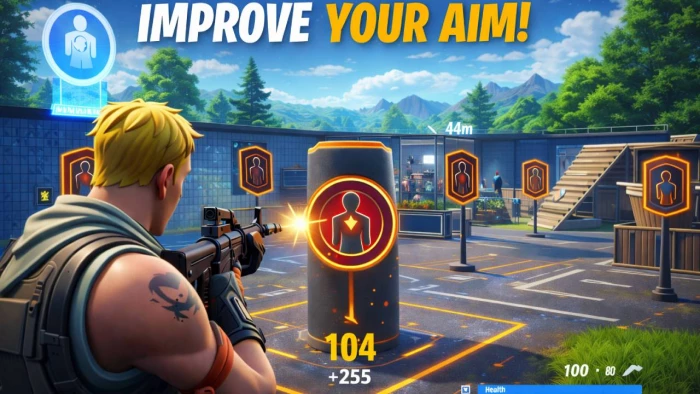
Let's be honest, Fortnite is one of the most mechanically demanding battle royale games out there. Between bloom, bullet drop, building, and fast-moving opponents at every angle, landing consistent shots is genuinely hard. If you've been grinding but still feel like your aim is holding you back, this guide is for you.
Before diving into fixes, it helps to understand why aiming in Fortnite feels harder than in other shooters like Valorant or Call of Duty. There are a few mechanics working against you:
● Bloom — Many weapons don't fire in a perfectly straight line. If you spray shots rapidly, your crosshair spread widens and accuracy drops. Pacing your shots tightly is far more effective than holding down the trigger.
● Movement accuracy penalty — Jumping or sprinting makes your crosshair bloom larger. Standing still or crouching tightens it considerably.
● Bullet drop — Snipers in Fortnite have real projectile travel time and gravity. At long range, you need to aim above your target and lead their movement to connect.
● Vertical combat — Building creates constant height changes, meaning you're often shooting at angles you wouldn't encounter in flat-map shooters.
Understanding these mechanics is the foundation of everything else.
One of the most common mistakes intermediate players make is constantly tweaking sensitivity. Changing settings every few matches prevents your hands from ever building muscle memory — and muscle memory is everything.
Here are the recommended baselines for 2026:
● Input Curve: Linear — it gives a direct, predictable response compared to Exponential, which smooths out your movements
● Look Sensitivity: 40–60% (Advanced Options)
● ADS Sensitivity: 15–17% — keeping ADS lower than Look gives you tighter control when scoped in
● Deadzone: 3–7% — keep it as low as possible without stick drift
● Aim Assist Strength: 100%
● Boost Ramp Time: 0.00s for the most consistent feel
● There's no universal sensitivity, but most competitive players trend toward lower DPI (400–800) with higher in-game sensitivity to compensate
● The key rule: once you find a sensitivity that feels controllable, stick with it for at least a week before evaluating it
Pro tip: Enable Advanced Options in Fortnite's settings. The simple 1–10 sliders are too imprecise for serious improvement — percentage-based inputs give you real control.
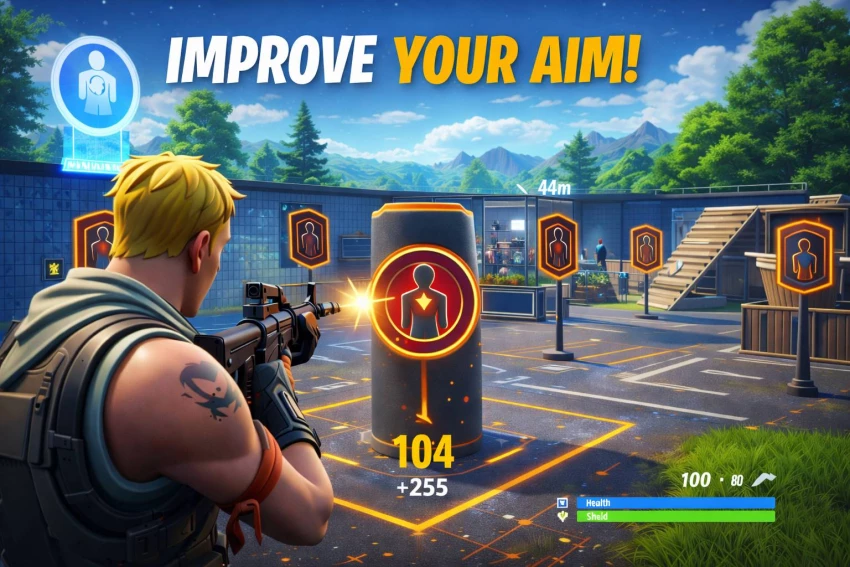
This is the single highest-impact habit you can build, and it costs zero time in an aim trainer. Most players aim at the ground while looting, rotating, or just running around — which means every time an enemy appears, they're making a massive crosshair adjustment before they can shoot.
Instead, train yourself to:
● Keep your crosshair at head height at all times — while moving, looting, and rotating
● Pre-aim common spots — doors, ramp edges, window openings, and edit holes
● Avoid aiming at the ground when running — the less distance your crosshair has to travel when an enemy appears, the more shots you land
This alone will make a noticeable difference in your first-shot accuracy within days.
Step 3: Understand Aim Assist (Controller Players)
Aim assist in Fortnite provides two key effects: a slowdown that reduces your sensitivity when your crosshair passes near an enemy, and a rotational pull that subtly tracks targets when you strafe. These mechanics are designed to close the gap between controller and mouse-and-keyboard precision.
A few things to know:
● Aim assist works best at 120fps or higher — more frequent input polling makes it more consistent and responsive
● It's disabled when Gyro Aiming is active — if your aim suddenly feels off, check that gyro hasn't been accidentally turned on
● Setting Aim Assist Strength to 100% is standard among competitive players and is not considered an unfair advantage — it simply meets the mechanical baseline
Step 4: Use Aim Trainers the Right Way
Aim trainers like 3D Aim Trainer and Kovaak's are powerful tools, but only if you use them correctly. The mistake most players make is hopping between random scenarios without a plan.
Fortnite specifically demands these skill types:
● Click timing and click speed — for burst firing and one-shotting
● Tracking — for following a moving target smoothly
● Strafe aiming — for hitting opponents who are side-stepping
● Vertical control — for hitting targets above and below you in builds
Pick one or two of these at a time and drill them consistently. Short, focused sessions beat long, unfocused ones every time.
No aim trainer fully replicates Fortnite's feel — the bloom, the build-fight chaos, the vertical movement. That's why in-game practice is irreplaceable.
Use Creative Mode to:
● Practice box fights — the most common close-range scenario in Fortnite
● Work on edit + shoot combos, which require you to aim immediately after performing an edit
● Run 1v1 maps against real players to simulate ranked pressure
Many competitive players balance around 3 hours of Creative practice with 1–2 hours of ranked daily. For intermediate players, even 45–60 minutes of focused Creative practice a few times a week will produce measurable results.
Improving mechanics takes time, and one thing that helps is having access to the right lobbies and brawler variety. Some players who want to experience high-level play on multiple accounts explore fortnite accounts for sale to test different progression levels, play styles, and ranked environments before committing resources to their main account. While that's a personal decision, the real foundation of improvement will always be deliberate practice — no account shortcut replaces repetition.
What will move the needle is applying the mechanics above consistently.
● Auto-aiming every shot — manual aim is almost always better unless the enemy is directly in your face
● Flicking too aggressively — most aim adjustments in Fortnite should be small and controlled, not sweeping flicks
● Spraying instead of burst firing — bloom punishes spray; pace your shots and let the first few be accurate
● Ignoring high ground — shooting downward is significantly easier than shooting upward at someone above you
● Changing settings constantly — consistency builds muscle memory, and muscle memory is how you aim without thinking
| Area | What to Do |
| Settings | Lock in sensitivity, enable Advanced Options, set ADS lower than Look |
| Crosshair Placement | Head height always, pre-aim doorways and peek spots |
| Aim Assist (controller) | 100% strength, Linear curve, low deadzones |
| Practice Routine | Aim trainer (tracking + click speed) + Creative box fights |
| In-Game Habits | Pace shots, stop spraying, fight for high ground |
Improving your aim in Fortnite isn't about grinding for hundreds of hours — it's about practicing the right things deliberately. Fix your settings, build the crosshair placement habit, understand how bloom works, and put in focused time in Creative. Do that consistently for two to three weeks, and you'll notice a real difference in how often your shots connect.
Be the first to post comment!
The Aviator is often described as a simple game: a plane takes off, a multiplier...
Sakshi Dhingra1 month ago

When a flashy app promises easy money, it’s tempting to give it a try. That’s ex...
Sakshi Dhingra6 months ago
If you’ve been hooked on Wordle or Connections, you’ve probably noticed the buzz...
Sakshi Dhingra6 months ago

The Rise of Third-Party MarketplacesWith the growing demand for in-game currency...
Sakshi Dhingra6 months ago

As a gamer who loves discovering new titles but doesn’t always want to spend a f...
Sakshi Dhingra6 months ago
When boredom strikes, there’s nothing more satisfying than slipping into a quick...
Vaishali7 months ago