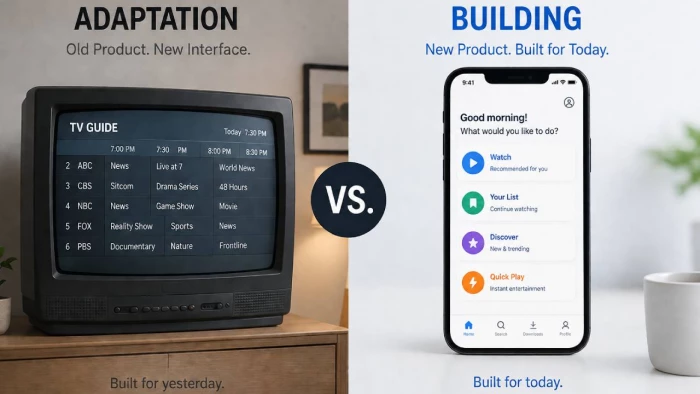
Television networks put their content on websites or dedicated platforms behind a paywall and call it streaming.
Banks built mobile apps on top of core banking infrastructure designed in the 1980s and consider themselves on the forefront of fintech.
And many traditional industries have taken their offline processes, added a polished interface, automated a few steps, and assumed the product had been digitised.
But here is the spoiler alert: none of those things are truly digital products.
They are physical products with a digital front door—and users can tell the difference within the first two minutes of using them.
The products that actually succeed on mobile were not adapted from something else. They were built around how people use screens: in short sessions, with immediate feedback, without requiring scheduled behavior or a physical location. That distinction sounds obvious, but it has taken most legacy industries nearly a decade to fully understand and act on it.
Netflix did not put a TV guide on the internet—it rebuilt content consumption around on-demand behavior and recommendation systems that traditional broadcasting could never replicate.
Revolut did not digitize a bank branch—it designed financial infrastructure from scratch around mobile-first assumptions that legacy banking apps are still struggling to match.
This pattern repeats across every category where a physical product with decades of user habits meets a generation raised on smartphones.
The adapted version feels clunky because it is clunky and the built version feels obvious because it was designed for the context it lives in.
This pattern hits almost every product that is digitising itself, and Gaming and lottery products are going through this right now. The pub keno screen running in every Australian RSL and sports bar is a product designed for a room: large screens, draws timed to the venue's rhythm, and prizes pooled across a physical retail network.
Putting that product on a website changes the delivery mechanism and nothing else. A lot of work needs to go behind it, but many platforms are just mindlessly putting out the clunky versions of their games and lotteries.
But some Platforms offering Australian online keno like KenoGO rebuilt the product for mobile from scratch. Independent draws every three minutes rather than being synced to a physical network. Their jackpots are reaching $40 million because the insurance model is not constrained by pooled retail revenue, and 4our distinct formats are designed for different mobile use cases rather than one game at different price points.
The mechanic is familiar but the product is not the pub game on a smaller screen.
Physical products are built around scheduled behavior.
People plan their engagement—watch something at a certain time, visit a location, or follow a routine tied to a calendar.
Mobile behavior works differently.
People use their phones in fragments—between meetings, while waiting in line, during short breaks, or in small idle moments throughout the day.
Products that require scheduled engagement are asking mobile users to behave in a way that no longer aligns with their reality.
The products winning on mobile today are those that fit into these gaps rather than demanding attention at fixed times:
Short-form video platforms
Casual apps with quick interaction cycles
Notification-driven news and content delivery
The common thread is simple:
They respect how people actually spend their time.
This is not limited to entertainment or finance. It applies to any category where a physical product is being translated into a digital experience.
The instinct to adapt is understandable. Existing products come with brand recognition, established users, and proven revenue models. Rebuilding from scratch introduces uncertainty.
But the gap between adapted and truly digital products is becoming increasingly visible.
Users who grew up in a mobile-first world have no attachment to legacy formats. They expect speed, flexibility, and simplicity—and they quickly abandon anything that doesn’t deliver it.
The real question every product team should ask in 2026 is:
Was this product designed for how people actually behave on the device they’re using?
Because that question is where most digital transformation efforts quietly fail—or succeed.
Be the first to post comment!

Why this comparison is differentMost comparisons between Semrush and Ahrefs thro...
Suraj Malik3 weeks ago

The first thing that stands out about Dippy AI is not the anime visuals or the N...
Suraj Malik3 weeks ago

I still remember the first time I installed Remix OS. It didn’t feel like I was...
Sakshi Dhingra1 month ago

Managing remote employees is very different from managing people in an office. W...
Sakshi Dhingra1 month ago

A school gradebook sounds like a simple thing until you watch what happens when...
Sakshi Dhingra1 month ago
The Growing Buzz Around EditPro in the AI Editing SpaceIn 2026, the name “EditPr...
Sakshi Dhingra1 month ago