In the past two years, I have taught, supervised, and assessed students in a university where artificial intelligence is not a distant concern; it is part of daily academic life. When generative AI tools became widely accessible in 2023, there was no immediate panic across campuses. Instead, conversations shifted toward a more practical question:
What are the most effective generative AI tools that help preserve academic integrity without transforming teaching into surveillance?
That question continues to shape procurement discussions within faculties and administrative teams. Among the tools frequently evaluated is Quetext, particularly by institutions already familiar with its plagiarism detection system. When its AI detection capability was introduced in 2023, many universities examined the framework and methodology described in Quetext’s AI detector documentation as part of broader academic integrity reviews.
I am writing this review not from a marketing perspective, but from direct academic experience. I had relied on Quetext’s plagiarism checker long before AI detection became part of the mainstream conversation, and I observed firsthand how institutions cautiously assessed and, in some cases, integrated its AI detection feature into their evolving integrity policies.
The discussion has never been about policing students. Rather, it centers on maintaining trust, clarity in assessment standards, and ensuring that both students and educators understand the boundaries between assisted writing and independent academic work.
Why Quetext Was Already Trusted Before AI Detection?
Long before we were worried about ChatGPT, Quetext had already built credibility where it matters most: plagiarism detection.
For the last five years, Quetext’s plagiarism checker has been one of the most widely used tools among:
● Universities and colleges
● Academic researchers
● Professional editors
● Publishers and journal reviewers
That trust wasn’t accidental.
Understanding the Methodology Behind Quetext’s Plagiarism Checker
From a faculty standpoint, three things stood out:
1. DeepSearch™ technology
Unlike surface-level matchers, Quetext didn’t just flag identical sentences. It caught:
a. Patchwork plagiarism
b. Lightly paraphrased passages
c. Structural similarities that other tools missed
2. Clarity of reports
Many plagiarism tools overwhelm users with red highlights and vague percentages. Quetext showed:
a. Exact source matches
b. Clear contextual explanations
c. Confidence-building transparency for both students and instructors
3. Low false positives
This matters more than most people realise. Over-flagging common phrases or technical language erodes trust quickly in academic settings.
Because of this, by the time AI-generated text entered classrooms, Quetext already had something most AI detectors lacked: institutional goodwill.
The AI Detector Launch (2023): Why Universities Paid Attention Immediately?
When Quetext launched its AI Detector in 2023, it wasn’t entering a vacuum. Dozens of AI detection tools appeared almost overnight, many promising “99% accuracy” with very little evidence.
Quetext took a different route.
Instead of marketing the AI Detector as a standalone miracle tool, it was positioned as:
● An extension of an already trusted plagiarism ecosystem
● A decision-support tool, not a verdict engine
● A system designed for educators, not content farms
For those of us already using Quetext’s plagiarism checker, adoption was natural rather than forced.
“We didn’t add a new tool. We added a new layer.”
That distinction matters.
How the Quetext AI Detector Actually Works in Practice?
Here’s the part most reviews skip: what using it weekly actually feels like.
What does the AI Detector do well?
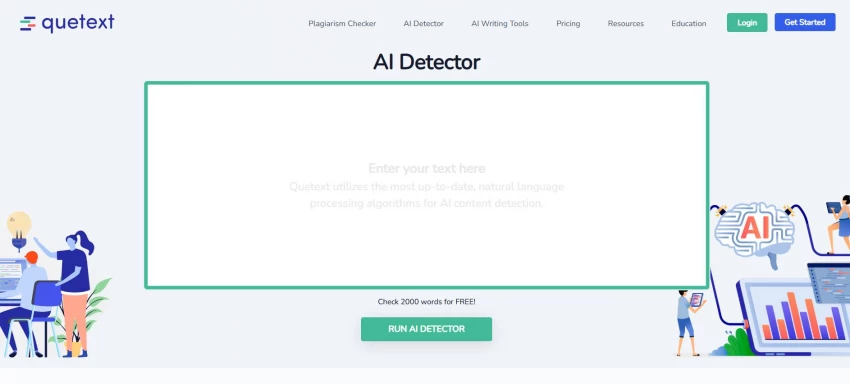
The Quetext AI Detector analyses:
● Sentence structure patterns
● Predictability and probability distributions
● Linguistic consistency across the document
● Alignment with known AI-generation behaviours
Instead of a binary “AI / Not AI” label, it provides:
● A confidence-based score
● Section-level indicators
● Contextual explanations
This approach aligns well with academic policy, where AI detection is used to trigger review, not punishment.
Why does this matter in universities?
Universities don’t need tools that shout “cheating.” They need tools that help answer:
● Does this submission warrant a conversation?
● Is this writing consistent with previous work?
● Is this AI-assisted, AI-generated, or simply well-written?
Quetext supports that nuance.
Why Universities Prefer Quetext Over AI-Only Detectors?
Many AI detectors launched with impressive demos, and then failed under real academic pressure.
Here’s where Quetext stands apart.
1. Integrated plagiarism + AI analysis
Most universities don’t want:
● Tool A for plagiarism
● Tool B for AI detection
● Tool C for citations
They want one system that understands how these signals interact.
Quetext offers:
● Plagiarism detection
● AI detection
● Citation support
● Paraphrasing analysis
All within one workflow.
2. Familiarity reduces resistance
Faculty adoption is often the biggest barrier.
Because Quetext’s plagiarism checker was already widely used, adding the AI Detector didn’t require:
● New training programmes
● Policy rewrites
● Faculty buy-in battles
That alone explains much of its institutional preference.
Accuracy, Reliability, and Academic Reality
No plagiarism or AI detection system is flawless, and suggesting otherwise would be academically dishonest. What sets Quetext apart, however, is its transparency, consistency, and restraint in how results are presented. Rather than positioning its tools as definitive judges, Quetext frames them as decision-support systems, which is precisely why they are trusted by universities, educators, and professional reviewers.
Both the Plagiarism Checker and the AI Detector prioritise clarity in scoring and methodology, helping users understand why a result appears rather than simply flagging content without explanation.
Strengths
● Low false-positive rates compared to many plagiarism and AI detection tools, reducing unnecessary academic disputes
● Clear differentiation between AI-heavy generation and AI-assisted writing, reflecting real-world academic workflows
● Consistent performance on long-form academic writing, including essays, research papers, and theses
● Established trust in the Plagiarism Checker, which has been among the most widely used tools in academia for over five years
● Seamless adoption of the AI Detector (launched in 2023) by institutions already relying on Quetext for originality checks
Limitations
● Short-form academic text (under ~250 words) can be more difficult to evaluate reliably for both plagiarism context and AI patterns
● Heavily edited or hybrid AI-generated content may fall below detection thresholds, especially when rewritten manually
● Non-English content detection continues to improve, but does not yet match the accuracy seen in English-language analysis
Crucially, Quetext does not claim infallibility, a stance that aligns with academic best practice. Universities value tools that support human judgment, not replace it, and Quetext’s balanced approach reflects a mature understanding of how plagiarism detection and AI analysis should function in real academic environments.
Metrics That Matter
Below is a consolidated view of how Quetext performs across the metrics universities care about:
Evaluation Metric
Academic Rating
AI Detection Reliability
★★★★☆ (4.6/5)
Plagiarism Detection Depth
★★★★★ (4.8/5)
False Positive Control
★★★★☆ (4.7/5)
Faculty Usability
★★★★☆ (4.6/5)
Student Transparency
★★★★☆ (4.6/5)
Institutional Trust
★★★★★ (4.8/5)
Overall Effectiveness
★★★★☆ (4.6+/5)
These scores don’t come from marketing claims; they reflect consistent feedback from educators, editors, and institutions using the tool at scale.
Why Writers and Authors Also Prefer Quetext?
Interestingly, Quetext’s AI Detector didn’t just gain traction in universities.
Writers and authors who were already using the plagiarism checker adopted it for different reasons:
● Pre-submission integrity checks
● Editorial transparency
● Publisher compliance
● Ethical AI-assisted writing
For professional writers, the appeal is simple:
It helps you prove originality, not just check for risk.
That dual use, education, and publishing, reinforces Quetext’s credibility across disciplines.
The Quiet Advantage - Support and Stability
While many AI startups have some type of advantage (typically not technical), Quetext excels in the following areas:
● A stable platform
● Reliable updates
● A well-respected support server and customer service
● Documentation that is clear and concise
For most academicians within the academic community, these attributes are far more important than the trendiest or highest feature-rated product.
A tool used by universities must:
● Be consistently functional.
● Have respect for the privacy of the user.
● Provide explainable outcomes.
● Provide a resource of human support for use when assistance is required.
Quetext provides all those basics, and that is why Quetext continues to be a product supported by an established institution year after year.
Final Thoughts
Quetext is not a product that has earned the trust of universities by rapidly developing and rolling out many products that are on the cutting edge (or trend) of AI. Rather, the company's strategy has been to build its business slowly, introduce products carefully, and respect the environment the company was creating products to serve.
Quetext's plagiarism checker has earned the institution's trust over a period of five years. The recent rollout of Quetext's AI Detector in 2023 has also continued to build upon that trust rather than replacing it.
For a university, Quetext is not a tool that is meant to catch students, but rather to create an environment in which:
● Academic integrity is preserved.
● Ethical use of Artificial Intelligence is supported.
● Fairness in assessment exists.
From my perspective as an educator who uses it regularly:
Quetext is not a perfect product. However, it is reliable, and that is why universities will continue to utilize Quetext as an agency to test for reliability.
Quetext will seem to be a less exciting product than others when compared against marketing hype alone. However, Quetext is at or near the top of the list when evaluating tools that have the most effectiveness and long-term stability. That is where universities want products to be located on the market.