
Legal disputes, especially those involving injuries, are rarely decided by a single document or statement. Responsibility must be established through structured proof, careful documentation, and legal standards that connect facts to liability.
Over time, the way accountability is evaluated has become more layered. Today’s claims require not only credible testimony but also organized records, timing consistency, and procedural discipline. Understanding how this framework works is essential for anyone navigating a serious legal matter.
Every personal injury claim rests on four essential legal pillars: duty of care, breach of that duty, causation, and measurable damages. These elements form the backbone of accountability in civil law.
A duty of care means that an individual or entity has a legal obligation to act with reasonable caution. Drivers must follow traffic laws. Property owners must maintain safe premises. Employers must provide reasonably safe working conditions. When that duty is violated, through negligence, inattention, or unsafe conduct, the next question becomes whether that breach directly caused harm.
It is not enough to show that an accident occurred. A claimant must demonstrate that another party failed to act reasonably and that this failure directly caused the injury in question. The link between action and injury, known as causation, is often where disputes arise. Defendants may argue that injuries were pre-existing, that external factors contributed, or that the harm would have occurred regardless of their conduct.
Even when liability seems obvious at first glance, complications can surface. Comparative fault rules may reduce compensation if the injured party is found partially responsible. Pre-existing medical conditions may raise questions about whether the accident worsened a condition or simply coincided with it. Minor inconsistencies in timelines or documentation may be used to challenge credibility.
Because of these complexities, modern courts and insurers expect claims to be supported by structured documentation rather than assumption. Medical records must align with the mechanism of injury. Accident reports must support the sequence of events. Financial damages must be clearly calculated and justified.
Ultimately, personal injury responsibility is not determined by sympathy or surface impressions. It is established through careful connection of legal elements, supported by organized and consistent proof.
Documentation is no longer just about collecting paperwork. It is about building a coherent and defensible timeline that connects every element of the claim.
Medical treatment should reflect consistent reporting of symptoms from the first visit forward. Diagnostic imaging, physician notes, and follow-up care should logically align with the mechanism of injury described in the accident. If a back injury is claimed, the medical narrative should explain how the impact plausibly caused that condition. Consistency builds credibility.
Accident reports should align with witness accounts. Repair estimates should correspond to the described force and direction of impact. Photographs taken at the scene should support the sequence of events. Even communication records with insurers should remain clear, measured, and consistent with prior statements.
Strong documentation creates a structured story supported by objective proof.
When records appear fragmented or contradictory, insurers often use those inconsistencies to reduce settlement value or challenge fault allocation. A delay in treatment may be framed as evidence that the injuries were minor. An omitted symptom in an early medical report may later be questioned. Small discrepancies can become focal points in negotiation.
This is why organization matters. Keeping detailed records, preserving copies of medical bills, saving correspondence, and maintaining a consistent account of events can significantly influence the strength of a claim.
Clear documentation strengthens credibility. Disorganized documentation weakens negotiation leverage.
One of the most underestimated aspects of personal injury claims is timing.
The period immediately following an accident often shapes how the entire case develops. Statements given too quickly without legal guidance can create unnecessary complications. Casual remarks to insurance adjusters may later be interpreted as admissions. Incomplete descriptions provided during early stress may be scrutinized months later.
Delayed medical treatment may also raise questions about injury severity or causation. Even when delays are understandable, insurers may argue that the gap weakens the connection between the accident and the injury.
Waiting too long to gather supporting records can limit available evidence. Witness memories fade. Physical damage may be repaired before documentation is complete. Surveillance footage may be overwritten. Repair shops may dispose of damaged parts that could have supported impact analysis.
The first 30 to 60 days following an accident are often decisive. This period is when medical documentation begins, evidence can still be preserved, and liability positioning takes shape. Strategic timing during this window helps ensure that records are consistent, rights are protected, and avoidable weaknesses are minimized.
In many cases, outcomes are influenced not only by what happened but also by how quickly and carefully the aftermath is managed.
Insurance carriers evaluate claims through structured internal processes. Adjusters review liability clarity, medical consistency, prior history, and documentation strength before determining settlement positions.
They often assess whether fault can be partially shifted, whether treatment appears excessive, or whether gaps in documentation reduce exposure. This evaluation is methodical.
Understanding how insurers approach claims allows legal teams to prepare strategically rather than react defensively.
As disputes grow more complex, particularly in serious vehicle collisions or cases involving significant injury, experienced legal representation becomes critical.
Attorneys do more than file paperwork. They analyze liability arguments, anticipate defense strategies, and ensure that evidence aligns with legal standards. They also manage communication with insurers to prevent statements from being misinterpreted or taken out of context.
In complex motor vehicle cases, especially where fault is disputed or damages are substantial, firms such as San Luis Obispo Car Accident Lawyers focus on building structured claims that combine medical evidence, accident analysis, and procedural discipline. Their role is to ensure that responsibility is clearly presented and supported by consistent documentation.
Legal perspective becomes especially important when comparative negligence arguments are introduced or when insurers attempt to minimize injury impact.
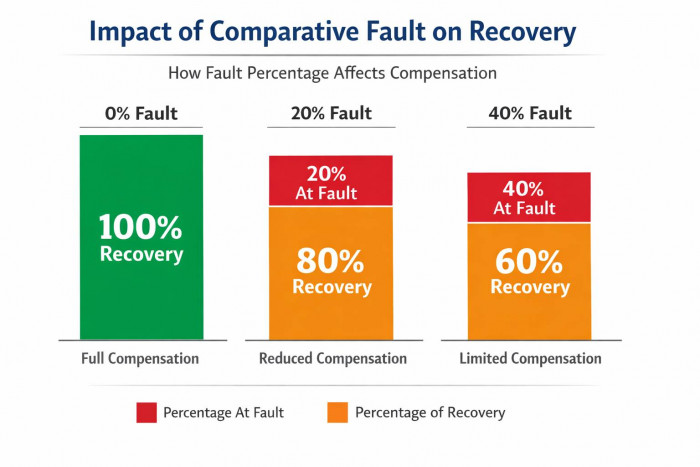
In many jurisdictions, compensation depends on fault percentage. Even a small shift in liability can significantly affect final recovery.
Because of this, strategic positioning matters. Attorneys must carefully evaluate accident reports, witness statements, and supporting documentation to prevent unnecessary fault allocation.
Precision in argument and documentation often determines whether liability remains clear or becomes diluted through contested interpretation.
As case documentation becomes more detailed and layered, analytical tools are increasingly used to support preparation and internal review.
Modern legal files often contain hundreds of pages of medical records, repair estimates, photographs, statements, correspondence, and technical reports. Managing this volume manually can increase the risk of overlooked inconsistencies or timeline gaps. AI-assisted platforms help organize large case files, sort documents chronologically, and flag discrepancies that may require clarification before negotiations begin.
For example, if medical treatment dates do not align precisely with reported symptoms, analytical tools may identify those inconsistencies early. If accident descriptions vary slightly across statements, software can highlight differences that attorneys may need to reconcile. This proactive review strengthens case structure before the opposing side has an opportunity to exploit weaknesses.
Reconstruction software can also simulate accident dynamics using available data inputs such as speed estimates, point of impact, and roadway configuration. By modeling alternate scenarios, legal teams can better understand how liability arguments may be presented and prepare accordingly.
Predictive models are sometimes used to estimate settlement ranges based on historical case outcomes, injury categories, and jurisdictional trends. While these estimates are not determinative, they provide reference points that can inform negotiation strategy.
Importantly, these tools do not replace legal reasoning or advocacy. Human judgment remains central to interpreting facts, applying legal standards, and advising clients. Analytical systems serve as support mechanisms, enhancing preparation by identifying gaps early and improving structural clarity.
When used responsibly, analytical support strengthens documentation, sharpens negotiation positioning, and helps ensure that cases are built on measurable consistency rather than assumptions.
At its core, personal injury law remains grounded in fairness and proof. What has evolved is the structure through which proof is organized and presented.
Responsibility is no longer argued casually. It is demonstrated through disciplined documentation, timely preservation, strategic positioning, and, when necessary, analytical support.
For individuals navigating legal claims, understanding this structured approach can make a meaningful difference. The strength of a case today depends not only on what occurred, but on how clearly and consistently it is documented and presented.
Be the first to post comment!

Introduction: Why Sales Automation Is No Longer OptionalToday’s B2B sales enviro...
Michael Hicklen2 months ago

Image search has quietly become one of the most powerful discovery, research, an...
Michael Hicklen2 months ago

Why Workflow Automation Matters in 2026Automation tools help businesses:● S...
Michael Hicklen2 months ago

1) Foundations :What software review platforms are-Software review platforms are...
Michael Hicklen2 months ago

1. What AI Automation in Daily Work Actually Means?1.1 AI automation in daily wo...
Michael Hicklen2 months ago

1. What Is a CRM?Definition-A CRM (Customer Relationship Management) system...
Michael Hicklen2 months ago