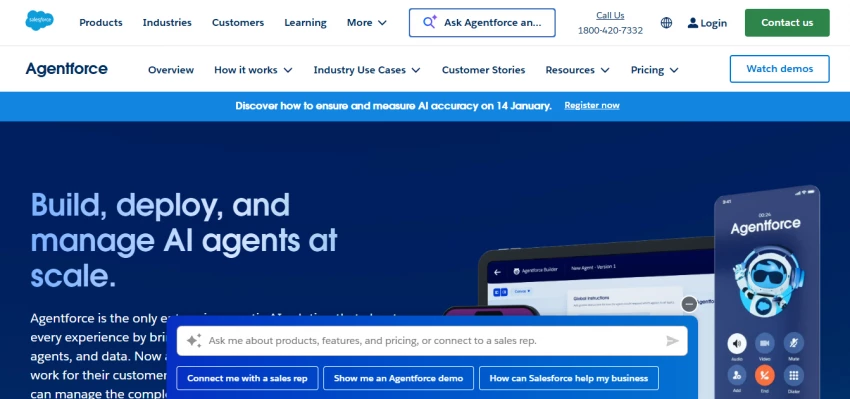
Agentforce is Salesforce’s AI agent platform that lets you create “digital workers” that live inside your Salesforce org and do real work for you. Instead of AI that just answers questions, these agents can understand a request, look up data, make a plan, and actually take actions like updating records, resolving a case, or qualifying a lead.
Think of it as a smart, always‑on teammate sitting on top of your CRM: it reads your Salesforce data, reasons through tasks, and executes steps following the rules you set.
What Agentforce Can Do
Answer customer queries, troubleshoot problems, and close simple tickets on its own.
Help sales reps by qualifying leads, summarising calls, suggesting next steps, and drafting emails.
Support internal teams (IT, HR, operations) by handling routine requests and workflows.
Work across channels like chat, web, voice calls, and internal tools, all connected to Salesforce.
How Agentforce Works?
Salesforce says an AI agent needs three things to get work done: data, reasoning, and actions. Agentforce simply bundles these in one place so you do not have to glue 10 different tools together.
The Simple Flow
User asks something
Example: “Why is my order delayed?” or “Show me stuck deals and email them.”
The agent understands and plans
The Atlas Reasoning Engine breaks the request into smaller steps: detect intent, fetch data, decide actions, and check if the result is good enough.
Agent takes action
It reads Salesforce data, calls flows/APIs, updates records, sends messages, or escalates to a human if needed.
Agent learns over time
You review what it did, adjust prompts/flows, and it gradually becomes more reliable for your use case.
Key Pieces You’ll Hear About
Piece / Term
Simple Meaning
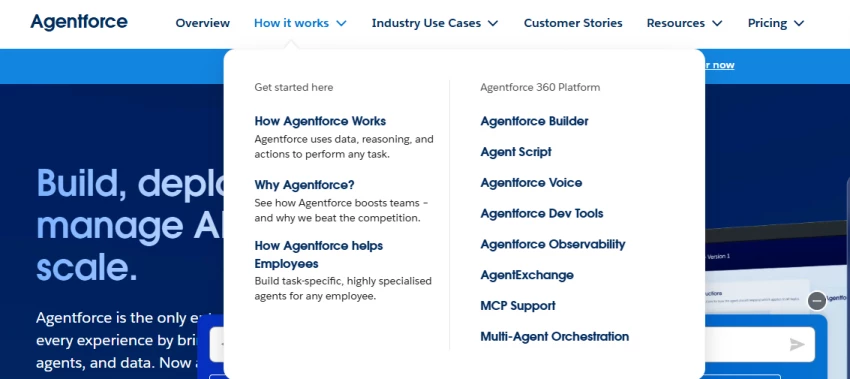
Agentforce Builder
Drag‑and‑drop + pro‑code workspace where you design and test each agent.
Atlas Reasoning
The “brain” that breaks problems into steps and chooses which tools to call.
Guardrails / Trust
Safety net: data access control, logging, content filters, audit trails.
Agentforce Voice
Adds phone/voice so agents can talk to customers directly.
Prebuilt templates
Ready‑made agents for support, sales, commerce, etc. you can tweak.
What Can You Use Agentforce For in 2026?
This is where things get interesting. By 2026, Agentforce will no longer just be a fancy chatbot; it will reach into many everyday Salesforce jobs.
1. Customer Support That Actually Solves Things
Handles common “Where is my order?”, password, billing, and simple tech issues 24/7.
Pulls order, case, and billing data, suggests solutions, updates the case, and only passes tricky ones to humans.
Can work across chat, email, and soon more AI channels for commerce like ChatGPT‑style shopping flows.
Why it matters: Faster replies, fewer tickets for your human team, and more consistent answers.
2. Smarter Sales & SDR Work
Watches your pipeline, flags stuck deals, and can nudge reps or send outreach automatically.
Reads past emails and call notes, then summarises accounts and suggests next best actions.
Qualifies leads by checking behaviour, firmographics, and engagement, then routes them to the right rep.
Why it matters: Less admin work for reps, better follow‑up, cleaner pipeline.
3. Commerce & Shopping Experiences
Acts as a shopping agent: helps with product discovery, FAQs, returns, and order changes on the web and new AI channels.
Optimises order routing to ship from the best location for cost and speed.
Helps merchandising teams by boosting or burying products automatically based on performance.
Why it matters: More personalised, “agentic” shopping and smoother order operations.
4. Internal IT, HR, and Operations
Answers internal questions like “How do I reset VPN?” or “What’s our leave policy?” using your internal knowledge.
Launches workflows: access requests, approvals, reminders, ticket updates, and data checks.
Why it matters: Fewer repetitive tickets for IT/HR and faster response for employees.
Agentforce Pricing
This is usually the most confusing part, so let’s keep it very direct. You pay in three main ways: base Salesforce, Agentforce add‑ons/editions, and usage.
1. You Still Need Salesforce First
Most Agentforce capabilities sit on top of Salesforce Enterprise/Unlimited or new “Agentforce 1” editions. If you are on very basic editions, you may need to upgrade before you even touch Agentforce.
2. Agentforce Licences & Editions
Independent breakdowns and pricing guides show roughly:
Agentforce add‑ons (Sales/Service/Field/Industries): Often quoted at around $125+ per user/month, depending on region, contract, and stack.
Agentforce 1 Editions (bundled AI editions): These bundle predictive, generative, and agentic AI with analytics; high‑end bundles are often referenced near $550 per user/month for top tiers.
Exact numbers vary a lot by deal and discount, so treat these as directional, not list price.
3. Usage / Flex Credits
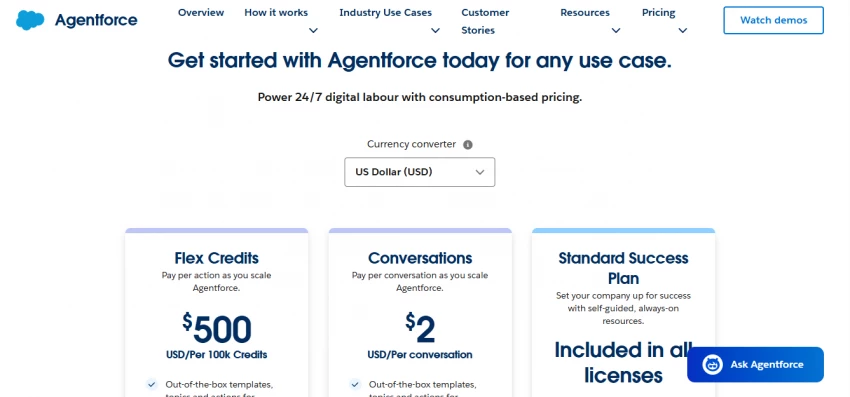
Salesforce introduced Flex Credits, where $500 buys 100,000 credits; a typical Agentforce action might consume around 20 credits.
Some guides translate this to roughly $0.10 per action or about $2 per conversation for certain setups, depending on how heavy the workflow is.
Simple takeaway: Agentforce is an enterprise‑level spend. It usually makes sense only if you are already invested in Salesforce and want AI to automate meaningful volumes of work, not just “play around.”
What Users Really Say
Let’s simplify the feedback from Reddit, G2, and deep‑dive blogs into honest positives and negatives, without copying anyone’s exact words.
What People Like
Real automation, not just chat: Users who have good implementations say Agentforce can genuinely replace a chunk of Tier‑1 support and routine sales tasks, not just summarise data.
Tight Salesforce fit: Admins appreciate that security, roles, data model, and flows all live in one place instead of juggling external AI tools.
Fast wins for small, clear use cases: Some admins report building narrow agents (for a specific type of case) in under two hours once they know the flow and data.
Good story for governance: Larger companies like the guardrails, logging, and auditability for compliance and risk teams.
What Frustrates People
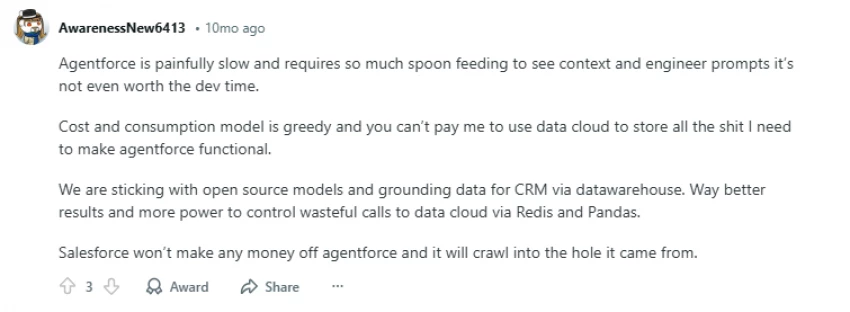
“Feels overhyped and pricey”: A chunk of Reddit and blog commentary describes Agentforce as expensive and not always delivering the hype level, especially if your use case is small.
Steep learning curve: Many admins say it is not “plug and play” – you need clean data, clear processes, and solid prompt/flow design to get consistent results.
ROI is unclear without pilots: Decision‑makers hesitate to sign big contracts because it is hard to model ROI until you run real‑world pilots.
LLM freshness and latency complaints: Some users feel the models used are not always the latest and that complex workflows can feel slow at times.
So… Is it the Worth?
Agentforce Is a Good Fit If…
You are already deep into Salesforce (Enterprise/Unlimited or Agentforce 1 editions).
You have clear, repeatable processes in support, sales, commerce, or internal ops that eat a lot of time today.
You can invest in setup: data cleanup, flows, prompts, and maybe a partner or in‑house architect.
In this scenario, Agentforce can genuinely act like an extra digital team, especially for service and internal workflows, and you are likely to see real productivity gains.
You Might Want To Wait If…
You are a smaller business on basic Salesforce editions or are still struggling with CRM adoption.
You mainly want content generation or simple FAQ bots and are okay with using separate, cheaper tools.
You do not yet have clean data or stable processes to automate.
In that case, start with lighter AI wins (like better email/call summarization or external copilots), fix your Salesforce basics, and revisit Agentforce later.