
Job hunting can start feeling like a full-time administrative job. A candidate may spend hours moving between LinkedIn, Naukri, Indeed, Glassdoor, company career pages, resume documents, and application trackers before completing even a handful of relevant applications.
Leeco AI wants to reduce that workload. It presents itself as an AI-powered career agent that searches for jobs, optimizes applications, supports referral outreach, and keeps candidates informed through WhatsApp.

The idea is appealing, especially for professionals who are actively applying to several roles every week. However, job-search automation also raises important questions about match quality, privacy, personalization, and whether sending more applications actually leads to better outcomes.
For this Leeco AI review, I examined the platform’s official product pages, Chrome extension listing, feature claims, privacy disclosures, available interface examples, and public user feedback. This is a research-based evaluation rather than a claim of extensive hands-on testing.
| Category | Details |
|---|---|
| Main purpose | AI-powered job searching and career preparation |
| Key features | Job discovery, auto-apply, resume optimization, referral outreach and application tracking |
| Additional tools | LeetCode guidance, mock interviews, YouTube assistance and DSA tracking |
| Main interface | Web platform and Chrome extension |
| Notifications | WhatsApp alerts and approval requests |
| Best suited for | Active job seekers, developers, students and technical candidates |
| Main concern | Accuracy, privacy and the quality of automated outreach |
| Overall rating | 7.5/10 |
The idea of putting job hunting “on autopilot”
Leeco describes itself as an AI agent that searches, optimizes, and networks for candidates around the clock. Instead of asking users to repeatedly refresh job boards, the system is designed to scan listings, compare them with a candidate’s preferences, and notify the person when a relevant opportunity appears.
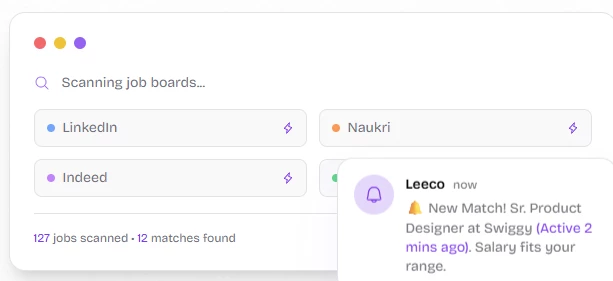
Users may specify details such as their preferred role, location, experience level, and salary expectations. Leeco then attempts to filter new vacancies and send suitable matches through WhatsApp.
This addresses a genuine frustration. New jobs can receive large numbers of applications soon after publication, and candidates who discover a listing late may feel that they have already missed the best opportunity to apply.
The important distinction is whether Leeco does more than the built-in alerts already offered by LinkedIn, Indeed, Naukri, and other job platforms. Its value depends on its ability to combine multiple sources, remove poor matches, verify that listings are active, and reduce the amount of manual checking required.
However, the effectiveness of this feature depends heavily on how accurately the system interprets user preferences and filters irrelevant listings. Many job platforms already offer alerts and recommendations, so the real advantage would depend on whether Leeco’s filtering is significantly better.
Continuous scanning of job platforms
One of the main features the platform promotes is real-time job monitoring. According to the product description on Leeco AI, the AI continuously scans major job marketplaces and verifies whether job listings are still active.
The system then compares those listings with a user’s profile and sends alerts when it finds a match. Notifications are typically delivered through WhatsApp so that users can respond quickly.
Conceptually this makes sense. Many hiring managers review applications in the first few hours after posting a job. Being among the earliest applicants can sometimes increase the chances of being noticed.
But this feature also raises questions. Job boards already provide automated alerts for new listings. The real value of Leeco would depend on whether it aggregates data from multiple platforms more effectively than those built-in tools.
Without extensive user data, it is difficult to determine whether the system actually improves discovery compared with traditional alerts.
How the platform attempts to improve resume performance
Another major feature promoted by the platform is resume optimization. Companies often rely on applicant tracking systems to screen resumes before recruiters review them. These systems analyze keywords, formatting, and relevance to determine which candidates proceed to the next stage.
Leeco claims to analyze resumes and adjust them for specific job roles. The explanation on Leeco AI suggests the system studies resumes from candidates who previously secured interviews and then applies similar patterns to the user’s document.
In the example presented by the platform, a standard resume is shown with an ATS compatibility score around 47 percent. After AI optimization, the example score increases to approximately 95 percent.
While such improvements are theoretically possible, ATS scoring systems vary widely between companies. Because of this variation, no universal optimization can guarantee better results for every application.
Still, the concept of automated resume tailoring is not unreasonable. Many candidates struggle to customize resumes for different roles, and an AI assistant could potentially help streamline that process.
One of the platform’s most unusual features
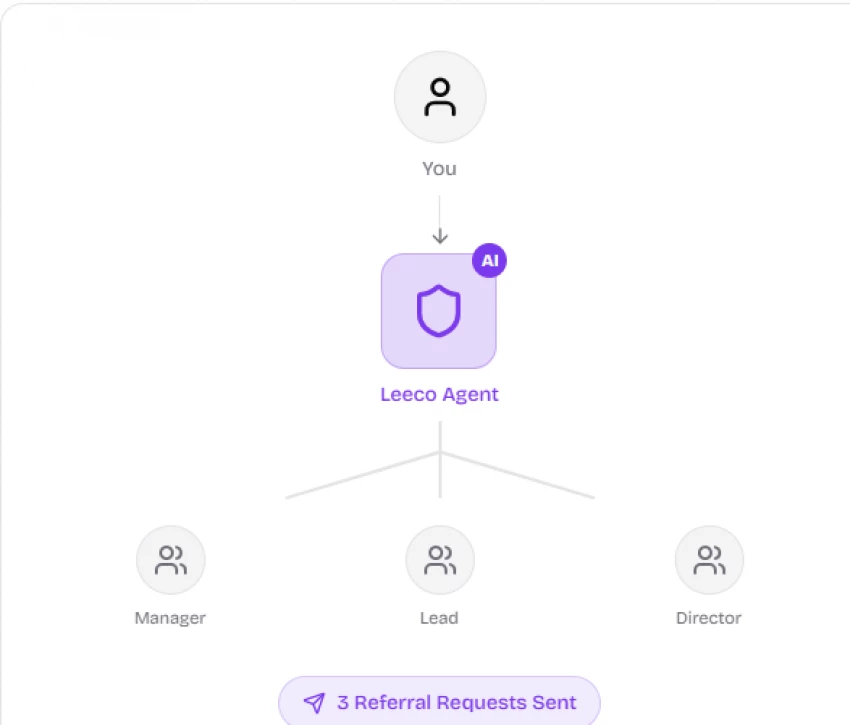
The feature that caught my attention most during my research was the referral automation system.
Hiring data consistently shows that internal referrals dramatically increase the likelihood of receiving an interview. Candidates who apply through referrals often bypass the massive queue of online applicants.
Leeco claims to identify employees working at companies where the user is applying and automatically send referral requests to them. The platform describes this process on Leeco AI as a way of turning a standard application into a recommendation request.
The system suggests that referrals can increase success rates by as much as seventy percent compared with cold applications.
This concept is interesting but also somewhat controversial. Networking typically works best when interactions feel authentic and personalized. If referral requests become automated messages sent to multiple employees, there is a risk that professionals may ignore them.
The success of this feature would likely depend on how personalized and context-aware those messages are.
A centralized way to track applications
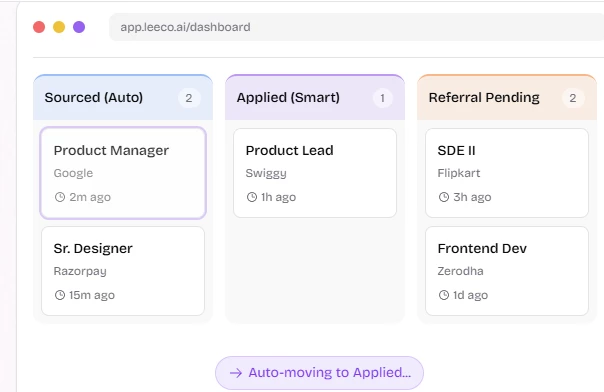
Another feature the platform highlights is a centralized dashboard where users can track their job search progress.
Anyone who has applied to dozens of jobs knows how easy it is to lose track of which companies responded or which applications are still pending. According to the platform interface shown on Leeco AI, the dashboard organizes opportunities into categories such as sourced roles, submitted applications, referral requests, and scheduled interviews.
This type of organization could be useful, particularly for candidates applying to many roles simultaneously.
However, similar functionality already exists in several job search management tools. The question is whether integrating that dashboard with automated job scanning and resume optimization provides a meaningful advantage.
What early users are discussing
Because the platform is relatively new, most available insights come from community discussions and early feedback.
In one discussion thread on Reddit, users expressed curiosity about the platform’s automation capabilities. Some users liked the idea of reducing repetitive job search tasks, while others were skeptical about whether automated applications and referral outreach would be effective.
Platforms like AgentsPointee and comparison pages such as G2’s alternatives section place Leeco among a growing category of AI tools focused on career assistance and interview preparation.
This broader trend suggests that companies are increasingly exploring ways to automate parts of the hiring process from the candidate’s perspective.
| Pros | Cons |
|---|---|
| Automates job searches across multiple platforms | Job matching accuracy may vary |
| Helps optimize resumes for ATS screening | ATS improvements are not guaranteed |
| Organizes applications in a single dashboard | Still a relatively new platform |
| Attempts referral and networking outreach | Automated outreach may feel impersonal |
Leeco appears best suited to active job seekers who apply frequently and are comfortable using automation as an assistant.
It may be particularly useful for software developers and technical candidates because its features extend into LeetCode practice, DSA learning, webpage explanations, and mock interviews.
Students and early-career candidates may also appreciate the structured support, although they should carefully review AI-generated resume changes and networking messages.
Leeco may be less suitable for senior leadership, highly specialized, creative, academic, or relationship-driven positions. These roles often require deeply customized applications, industry-specific networking, portfolios, research statements, or direct recruiter communication.
| Capability | Standard job alerts | Leeco AI |
| New-job notifications | Available | Available through automated scanning and WhatsApp |
| Multiple-platform aggregation | Usually limited | Promoted as a central feature |
| Resume tailoring | Usually unavailable | Included |
| Automatic applications | Limited | Included through the extension |
| Referral outreach | Not normally included | Promoted as an automated feature |
| Interview preparation | Separate tools required | Included for technical candidates |
| Application tracking | Basic or manual | Centralized dashboard |
| Human review required | Yes | Still recommended |
Strengths and limitations I noticed
After reviewing Leeco’s concept, documentation, and early user discussions, my overall impression is that the platform is trying to solve a genuine problem in the modern job-search process.
For many candidates, the most exhausting part of finding a job is not interview preparation. It is the repetitive work involved in searching for openings, filtering irrelevant listings, updating resumes, completing applications, and tracking responses.
Leeco’s main strength is its attempt to automate these time-consuming tasks. If the platform can continuously monitor multiple job boards, identify suitable roles, and reduce the need to repeatedly edit application materials, it could save active job seekers a considerable amount of time.
| Area | Potential Strength | Possible Limitation |
|---|---|---|
| Job discovery | Monitors multiple platforms and finds openings faster | Job matches may not always be accurate |
| Resume optimization | Adjusts resumes for specific roles and ATS systems | Changes may feel generic or include unsuitable keywords |
| Application automation | Reduces repetitive form filling | More applications do not always lead to more interviews |
| Referral outreach | Helps users find and contact relevant employees | Automated messages may feel impersonal or spam-like |
| Application tracking | Keeps job-search activity organized in one place | Its value depends on accurate and automatic updates |
Another positive aspect is that Leeco combines several parts of the job search within one workflow. Job discovery, resume optimization, referral outreach, and application tracking are usually handled through separate platforms. Leeco aims to bring them together through a single AI agent and dashboard.
This approach could be especially useful for candidates applying to several jobs at the same time. Instead of constantly switching between job boards, resume documents, networking platforms, and spreadsheets, users may be able to manage more of the process from one place.
However, there are still important limitations.
Hiring processes vary significantly between companies, industries, job levels, and countries. A resume or application strategy that works for one employer may not work for another. Automation may help users apply to more jobs, but submitting more applications does not automatically improve the chances of receiving interviews.
The quality and relevance of each application still matter. Applications that feel generic or lack role-specific context may be less effective, even if they are submitted quickly.
Leeco’s referral automation feature also raises practical concerns. Employee referrals can improve a candidate’s visibility, but genuine referrals are usually built through trust, professional relationships, or meaningful conversations.
If the platform sends automated messages to many employees, those requests may feel impersonal. Some recipients may ignore them or view them as spam. The effectiveness of this feature will depend heavily on how well Leeco personalizes each message and whether the outreach feels authentic.
There is also the possibility that employers will respond to the growing use of AI job agents by introducing stronger screening systems. Recruiters are already aware that candidates use AI to generate resumes, cover letters, and application answers.
If automated applications become common, companies may create new methods to detect mass submissions, repeated wording, or low-effort applications. This could make automation faster for candidates while also creating additional filters during recruitment.
Overall, Leeco currently feels more like an emerging career-automation platform than a fully proven hiring solution. Its concept is relevant, forward-looking, and based on real problems experienced by job seekers.
Based on available information, platform transparency, feature design, and the realism of its claims, my overall evaluation of the platform is:
Overall Rating: 7 / 10
The concept is innovative and addresses real frustrations in job searching. However, the effectiveness of automated referrals, AI resume optimization, and real-time job scanning will ultimately depend on real user outcomes rather than product demonstrations.
For now, Leeco appears to be an interesting experiment in AI-assisted career management rather than a guaranteed shortcut to landing a job.
After exploring Leeco AI and understanding how it works, I see it as an interesting attempt to reduce the repetitive workload involved in job hunting. Features like automated job scanning, resume optimization, and application tracking could make the process more organized and less time-consuming for candidates. However, securing a job still depends heavily on human interaction, networking, and interview performance. For now, Leeco AI seems best viewed as a supportive tool that can streamline parts of the job search rather than a complete solution that can fully automate it.
What is the use of Leeco AI?
Leeco AI is an automated job search agent that scans job platforms, finds relevant openings, and helps optimize resumes for applications. It also organizes applications and can assist with networking or referral outreach.
Why did LeEco fail in India?
The original LeEco smartphone company struggled due to heavy debt and aggressive expansion into multiple industries. Financial problems and operational challenges eventually forced the company to scale back its presence in India.
Who is the founder of Leeco AI?
Leeco AI appears to be a newer AI startup created by developers focused on automating the job search process. Public information about the founding team is still limited.
How can you use Leeco AI for free?
Users can typically sign up and set their job preferences to start receiving job matches and alerts. Some advanced automation features may require paid plans depending on the platform’s pricing model.
Share your thoughts about this article.
Be the first to post a comment!

AutoDraft AI looks appealing on the surface. It promises consistent cartoon char...
Muskan Kansay3 months ago
Are you tired of spending hours creating invoices for your clients? I was,...
Sakshi Dhingra3 months ago
How I approached this review: I researched Wegic AI through its public site, pri...
Sakshi Dhingra3 months ago
A 56% Wake-Up Call for Every StudentTL;DR — Perplexity wins for fact-finding, ci...
Sakshi Dhingra4 months ago

There's a moment every editor knows. You're three hours into a 78,000-word manus...
Sakshi Dhingra4 months ago

This Didn’t Feel Like a Tool. It Felt Like a System Trying to Build for Me.Most...
Sakshi Dhingra4 months ago