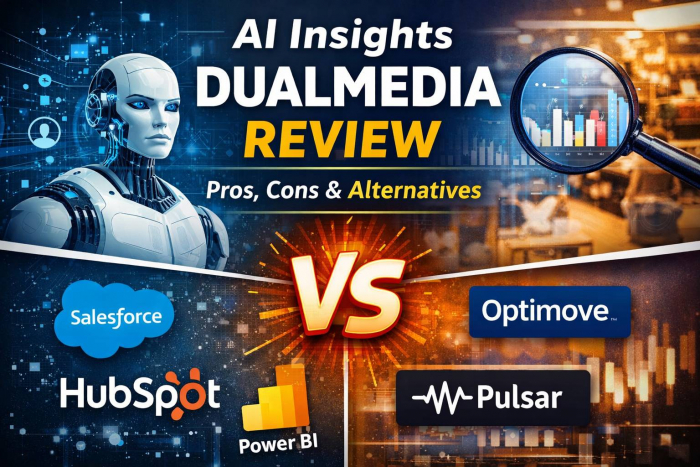
In today’s data-driven marketing landscape, clarity is often promised but rarely delivered. Many marketing platforms claim to offer deep customer insights, yet overwhelm users with fragmented dashboards and disconnected metrics. AI Insights DualMedia positions itself differently; it aims to truly listen to customer behavior across both digital and physical environments and convert that behavior into meaningful insights.
AI Insights DualMedia is built around a central promise: unifying online and offline customer behavior into a single behavioral model. It collects and processes data from sources such as:
● Website interactions and clicks
● Email engagement and response rates
● In-store visits and physical touchpoints
● Event participation
● Purchase and transaction history
Using machine learning, real-time data streaming, and predictive analytics, DualMedia attempts to identify patterns related to customer intent, timing, and sentiment. The platform claims it can predict conversions, identify churn risks, and recommend which channels deserve immediate attention.
Another core feature is omnichannel consistency, ensuring that messaging remains aligned across social media, paid search, email campaigns, and even offline interactions.
On paper, this is one of the hardest problems in marketing. Human behavior rarely follows clean, linear paths.
AI Insights DualMedia brings together customer interactions from digital channels (websites, emails, ads) and physical environments (stores, events, in-person interactions). By merging these signals into a single behavioral framework, the platform aims to eliminate the disconnect between online analytics and real-world activity.
Instead of relying on linear funnels, DualMedia groups users into behavior clusters. This allows marketers to understand how customers naturally move between touchpoints researching online, engaging offline, delaying decisions, and returning later to convert.
The platform processes incoming data in real time, enabling marketers to adjust campaigns while engagement is still happening. This feature is especially relevant for time-sensitive campaigns, retail promotions, and live or event-driven marketing.
Using machine learning, DualMedia assigns predictive scores that estimate purchase intent, churn risk, and engagement likelihood. These models are designed to help teams act early rather than responding after performance declines.
DualMedia evaluates how messaging performs across channels and flags inconsistencies between paid ads, email campaigns, social media, and offline communication. This helps brands maintain a consistent customer experience across all touchpoints.
The platform redistributes conversion credit across multiple interactions rather than assigning it to a single channel. This feature is intended to surface hidden influences such as in-store visits, delayed consideration, or non-digital triggers.
To reduce dashboard overload, DualMedia converts complex datasets into summarized insights and recommendations. These insights focus on behavioral trends, timing signals, and channel influence rather than raw metrics alone.
DualMedia is designed to sit on top of existing CRMs, analytics tools, and marketing platforms. For data-mature organizations, it functions as an intelligence layer rather than a full system replacement.
Some aspects of DualMedia align well with how customers actually behave today. Instead of tracking users through isolated channels, the platform focuses on behavior clusters, which is a more realistic way to interpret buyer journeys.
| Strength | Why It Matters |
| Cross-channel pattern recognition | Reveals triggers missed by single-channel analytics |
| Real-time optimization | Enables faster campaign adjustments |
| Predictive scoring | Helps identify churn or purchase intent early |
| Omnichannel alignment | Reduces inconsistent customer messaging |
This approach reflects real-world buying behavior. A customer may encounter a brand in-store, research it online later, and complete the purchase days afterward. Systems that treat each touchpoint separately often fail to capture this flow.
Despite its strengths, DualMedia faces practical limitations once deployed in real environments. Its effectiveness depends heavily on clean and consistent offline data, something many organizations struggle to maintain.
Common challenges include incomplete purchase histories, inconsistent event tracking, and limited emotional context. These gaps can lead to overly confident—but inaccurate AI interpretations.
● Overestimating digital ads when offline signals are missing
● Misreading sentiment due to limited data samples
● Assigning credit to the wrong channel
● Predicting churn based on correlation rather than causation
In short, DualMedia can tell a compelling story, but the accuracy of that story depends entirely on the data provided.
Real-world feedback paints a balanced picture. Most users report improved visibility and better coordination across teams but also note that the platform demands discipline and strong data governance.
| User Feedback | Practical Meaning |
| Better cross-channel visibility | Clearer understanding of online + offline interaction |
| Improved campaign efficiency | Reduced manual optimization |
| High data maintenance effort | Continuous quality control required |
| Emotional insights feel abstract | Sentiment predictions are harder to validate |
DualMedia tends to work best for organizations already committed to structured processes rather than teams seeking a quick fix.
One of the biggest barriers to DualMedia’s success is organizational resistance, not technology.
For the platform to function as intended, teams across social, retail, paid media, and analytics must collaborate and accept shared attribution. This often clashes with internal politics.
DualMedia may credit an in-store conversation or print campaign for a sale previously attributed to digital ads. If teams are not prepared to accept shifting influence, insights lose their impact.
The limitation is rarely the algorithm; it is the human response to uncomfortable data.
AI Insights DualMedia represents a meaningful evolution beyond traditional attribution tools. It attempts to move past surface-level metrics and focus on behavioral flow across environments.
However, it is not a universal decoder of human intent. It acts more as an interpreter. When data quality is high, insights feel valuable and actionable. When data is fragmented, insights become directional rather than definitive.
For many teams, DualMedia may not be the only or best option. Below is a practical comparison with leading alternatives.
| Platform | Best For | Key Strength | Limitation |
| AI Insights DualMedia | Omnichannel behavior modeling | Online + offline integration | High data quality requirements |
| Salesforce Marketing Cloud Intelligence (Datorama) | Enterprise analytics | Deep cross-channel reporting | Expensive, complex setup |
| HubSpot Marketing Hub | SMB to mid-market teams | All-in-one CRM + automation | Less advanced offline insights |
| Optimove | Retention & lifecycle marketing | Predictive personalization | Limited creative flexibility |
| Power BI | Custom analytics | Highly flexible dashboards | Requires technical expertise |
| Pulsar | Audience & sentiment analysis | Social listening & trends | Not conversion-focused |
It may not be ideal for:
● Small businesses with limited data
● Teams seeking plug-and-play solutions
● Organizations with siloed departments
● Marketers unwilling to challenge existing attribution beliefs
DualMedia’s biggest strength lies in its ability to combine online and offline customer data into a single behavioral view. Unlike traditional tools that treat channels separately, DualMedia attempts to understand how customers move naturally between physical stores, digital platforms, and delayed decision points.
This helps marketers see the full journey, not just isolated touchpoints.
The platform supports real-time data streaming, allowing campaigns to adjust while customer behavior is still unfolding. This is particularly useful for time-sensitive promotions, live events, or retail-driven campaigns where delayed insights often result in missed opportunities.
DualMedia uses machine learning to predict future behavior, such as purchase likelihood or potential churn. When backed by strong data, these predictive scores allow teams to act proactively instead of reacting after performance drops.
By aligning messaging across paid ads, social media, email, and offline touchpoints, DualMedia helps reduce inconsistent brand communication. This consistency improves user experience and can increase trust, especially for brands operating across multiple platforms.
Instead of focusing solely on vanity metrics (clicks, impressions), DualMedia emphasizes behavior patterns and intent signals. This encourages more strategic decisions based on how customers actually behave rather than how platforms report success.
For enterprises or mid-size companies with structured data pipelines, DualMedia can act as a powerful insight layer on top of existing analytics tools, helping extract deeper meaning from complex datasets.
DualMedia’s insights are only as accurate as the data fed into the system. Many organizations struggle with incomplete offline data, delayed reporting, or inconsistent event tracking. When data quality is poor, the platform may produce confident but misleading conclusions.
The setup process is not plug-and-play. Integrating multiple data sources, validating offline signals, and maintaining data accuracy requires ongoing effort. Smaller teams or businesses without technical resources may find this overwhelming.
While DualMedia claims to interpret emotional signals and sentiment, these insights often feel abstract to marketers. Without direct qualitative validation, teams may struggle to trust or act on sentiment-based predictions.
DualMedia frequently challenges traditional attribution models by redistributing credit across channels. While this is analytically valuable, it can cause organizational friction, especially in companies where teams compete for performance ownership.
For small businesses or startups with limited touchpoints and data volume, DualMedia may be excessive. Simpler tools like HubSpot or Google Analytics often provide better cost-to-value ratios at earlier growth stages.
Despite its AI-driven approach, DualMedia cannot fully decode human intent. Its insights should be treated as guidance rather than truth, especially when customer journeys are fragmented or emotionally driven.
Is AI Insights DualMedia suitable for small businesses?
Not typically. It performs best in organizations with established data pipelines and multiple customer touchpoints.
Does DualMedia replace traditional analytics tools?
No. It works best as a complementary layer alongside tools like CRMs and web analytics platforms.
How accurate are DualMedia’s AI predictions?
Accuracy depends on data quality. With strong data, predictions can be highly useful; with weak data, insights should be treated as directional.
AI Insights DualMedia is not a shortcut to marketing clarity but it is a thoughtful step in the right direction. Compared to traditional analytics platforms, it does a better job of reflecting how people actually move between online and offline spaces.
Its value depends on organizational readiness. Teams that prioritize data quality, embrace collaboration, and treat AI insights as guidance rather than absolute truth are most likely to benefit.
DualMedia pushes marketing forward but making those insights meaningful still depends on the marketers behind the platform.
Be the first to post comment!

I didn’t start analyzing Daman Games because of hype. I started because I kept s...
Sakshi Dhingra1 day ago

I don’t judge remote-desktop software by feature lists alone. I judge it by how...
Sakshi Dhingra1 day ago

What Dopple AI IsDopple AI is an AI‑powered character chat platform where you in...
Michael Hicklen5 days ago

Introduction: What Is Insnoop.com? Insnoop.com is a third-party web to...
Michael Hicklen5 days ago
Inworld AI has been one of the more interesting tools experimented with recently...
Michael Hicklen1 week ago
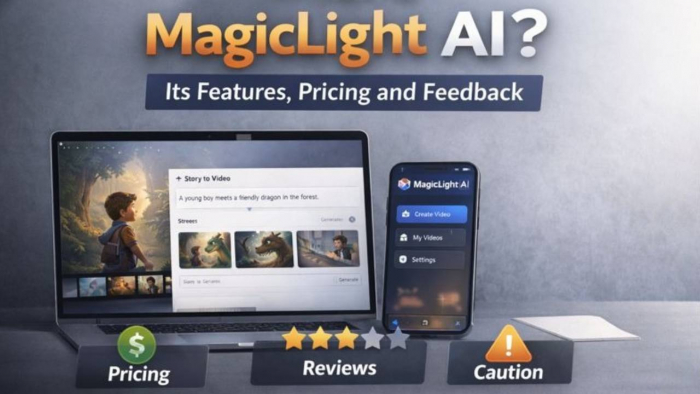
1. What MagicLight AI Is?MagicLight AI is an AI-driven text-to-video and animati...
Cheshta Upmanyu1 week ago