Here is the uncomfortable truth about modern work: the average knowledge worker now juggles more tools than ever, yet still loses hours each week to email triage, meeting follow-ups, status updates, and copy-paste work between apps. AI was supposed to fix this. In 2026, for the first time, the data suggests it finally is, but only for the people and teams who use it deliberately.
The past twelve months changed the category. AI productivity tools stopped being chatbots you visit and became agents that live inside your inbox, your spreadsheets, your codebase, and your meetings. ChatGPT moved into Excel and Google Sheets. Notion turned its workspace into an orchestration hub for AI agents. GitHub let developers run Copilot, Claude, and Codex side by side on the same pull request. Dictation tools like Wispr Flow reached every major operating system. This article breaks down every major update, what the adoption data actually shows, and how to build a stack that produces measurable gains rather than expensive noise.
Quick answer: AI productivity tools in 2026 are defined by agentic workflows, persistent memory, and deep office integration. The biggest updates include GPT-5.5 with memory sources in ChatGPT, Notion 3.5 and 3.6 with Custom Agents and Workers, multi-agent coding through GitHub Agent HQ, and cross-platform voice dictation. Around 87 percent of digital workers now use AI at work, and 75 percent say it makes them more productive.
Adoption is no longer the story. According to Glean's Work AI Index, 87 percent of digital workers across the US, UK, and Australia now use AI at work, and 75 percent say it makes them more productive. Gallup's February 2026 survey of over 23,000 US employees found that, for the first time, half of employed American adults use AI in their role at least a few times a year, with 41 percent saying their organization has formally integrated AI tools. McKinsey puts organizational adoption at 88 percent of companies using AI in at least one business function.
The story now is the gap between adoption and impact. Within organizations that have deployed AI, Gallup found 65 percent of employees say it has improved their productivity and efficiency. Yet an NBER survey of nearly 6,000 senior executives across four countries found that roughly 90 percent of AI-using firms report no detectable impact on firm-level productivity over the prior three years. Both findings are true at the same time, and that tension, often called the AI productivity paradox, runs through everything else in this article.
Three structural shifts explain the 2026 landscape. First, tools became agentic: they execute multi-step work instead of answering single prompts. Second, memory became standard: ChatGPT, Claude, and Gemini all gained persistent, user-controllable memory in 2026, so context carries across sessions. Third, the tools moved into existing surfaces: spreadsheets, IDEs, meeting rooms, and the operating system itself, rather than living in a separate tab.
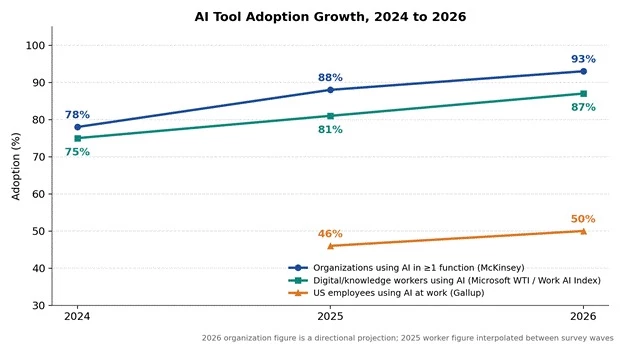
Figure 1. AI adoption trajectories from 2024 to 2026 across organizations, knowledge workers, and US employees.
Reading the chart: the top line tracks organizational adoption from McKinsey's State of AI surveys, which rose from 78 percent in 2024 to 88 percent in 2025, with 2026 shown as a directional projection. The middle line combines Microsoft's 2024 Work Trend Index figure of 75 percent of knowledge workers using generative AI with the Work AI Index's 2026 figure of 87 percent of digital workers. The lower line shows Gallup's stricter measure of US employees overall, which crossed 50 percent for the first time in early 2026. The takeaway is that the adoption curves are converging near saturation among knowledge workers, which means competitive advantage has shifted from having AI to using it well.
The market has settled into six functional categories. Most professionals now run tools from three or four of them; the Work AI Index found 77 percent of workers juggle multiple AI tools weekly, and a third use four or more.
| Category | Purpose | Example Tools (2026) | Notable 2026 Updates |
| Writing & Research | Drafting, summarization, cited research | ChatGPT, Claude, Perplexity Pro | Persistent memory, spreadsheet integration, deep research modes |
| Coding & Development | Code generation, review, agentic tasks | GitHub Copilot, Claude Code, OpenAI Codex, Cursor | Multi-agent orchestration, 1M-token contexts, usage-based billing |
| Design & Creativity | Visual, video, and media creation | Midjourney, Adobe Firefly, Canva Magic Studio, Synthesia | Consistent-style image editing, script-to-video avatars |
| Workflow & Collaboration | Docs, meetings, planning, tasks | Notion AI, Fireflies.ai, Otter.ai, Motion | Custom agents, speaker ID, meeting-to-task automation |
| Automation & Agents | Cross-app automation and reasoning | Zapier, Make, Gumloop, n8n | Agent builders, MCP support, self-improving workflows |
| Speech & Note-taking | Dictation, transcription, capture | Wispr Flow, Otter.ai, Superwhisper | Android launch, voice editing, HIPAA on all plans |
A note on the boundaries: they are blurring fast. Notion now hosts coding agents. Zapier ships its own agents. ChatGPT records meetings. The categories describe the primary job of each tool, not a hard limit on what it can touch.
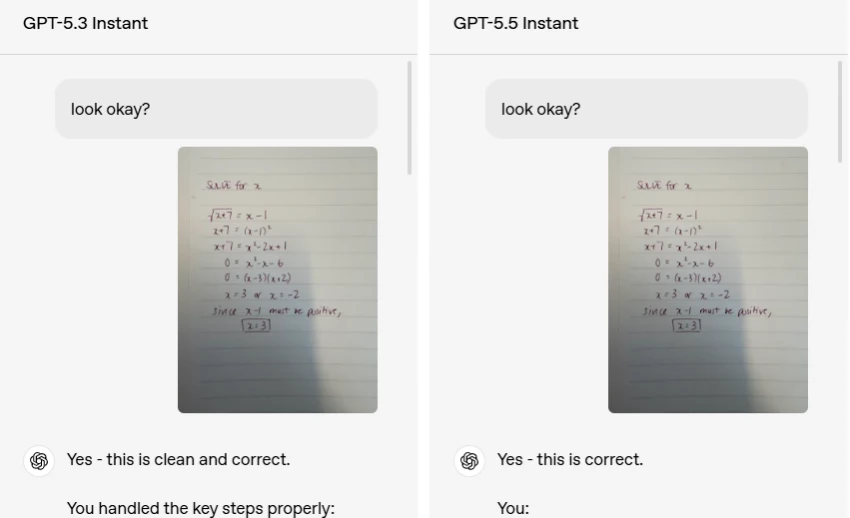
OpenAI shipped at a relentless pace in 2026. GPT-5.5 Instant became the default model in May, with OpenAI reporting 52.5 percent fewer hallucinated claims than its predecessor on high-stakes prompts covering medicine, law, and finance. The rebuilt memory system, which OpenAI's evaluations show improved factual recall from 67.9 to 82.8 percent, now reaches free users, and a new memory sources view shows exactly which past chats and saved facts shaped a personalized answer, with controls to delete or correct them.
The bigger productivity story is placement. ChatGPT for Excel and Google Sheets launched globally in May 2026, putting the assistant in a sidebar where it builds formulas, cleans multi-tab files, and explains data without copy-paste. Codex, its coding agent, gained a desktop app on Windows and macOS plus remote control from mobile. By late June, OpenAI had previewed GPT-5.6 with three durable tiers named Sol, Terra, and Luna, retiring version-number naming entirely.
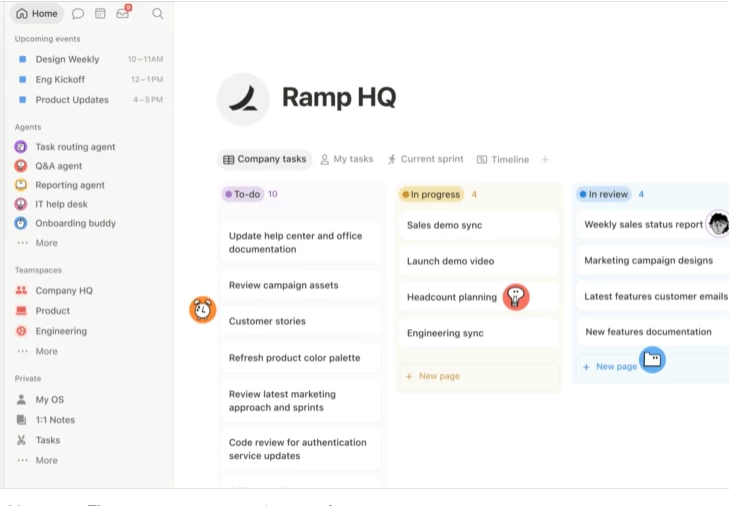
Notion had arguably the most transformative year of any workspace tool. Custom Agents launched in February; users built over one million of them within months. The May 3.5 release introduced the Notion Developer Platform: Workers let teams run custom serverless code on Notion's infrastructure, database sync pulls live data from Salesforce, Zendesk, or Postgres, and an External Agents API brings Claude, Codex, and other third-party agents directly into the workspace. The July 3.6 release added shared multi-agent boards where teammates can assign tasks to agents and @-mention them like colleagues, speaker identification in AI Meeting Notes, and interactive HTML blocks that agents can build, such as ROI calculators.
Under the hood, the AI context window grew from 20 to 50 pages in January, autofill got 3 to 4 times faster on large databases, and agents can now read and write Excel and PowerPoint files. Notion also lets you pick the model behind your agents, including Claude Opus 4.8 and cost-efficient open-weight options.
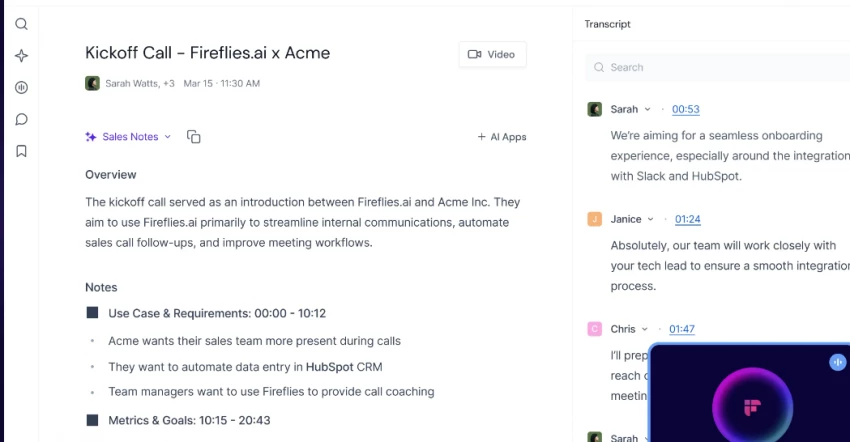
Meeting tools graduated from transcription to action. Fireflies leans into workflow integration: transcripts feed automations that extract action items, create tasks in project tools, and update CRM records, and its Avoma-style conversation analytics track talk ratios and topics. Otter went further up the stack in April 2026, announcing a Conversational Knowledge Engine with dedicated Meeting, Sales, and SDR agents, positioning itself as a meeting intelligence platform rather than a note-taker. Both produce timestamped summaries with assigned action items as a baseline feature, and Notion's own AI Meeting Notes, with its new speaker labels, now competes directly with both.
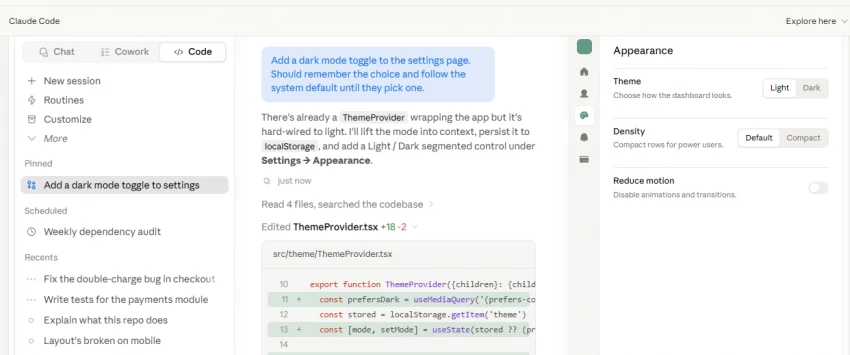
Coding tools saw the sharpest change of any category. In February 2026, GitHub launched Agent HQ, letting developers run Copilot, Claude by Anthropic, and OpenAI Codex side by side inside GitHub, GitHub Mobile, and VS Code. You can assign one issue to all three agents and compare the resulting draft pull requests, or mention @claude in a PR comment to request changes. Access rolled out from Enterprise down to Pro and Business plans within the month, included in existing subscriptions. In June, Copilot moved to usage-based AI credits, while basic completions stayed unlimited on paid plans.
Claude Code, meanwhile, shipped Agent Teams, a research preview where multiple specialized agents coordinate on a codebase, and Claude Opus 4.8 became its default model for Max users with a 1M-token context in beta. The AGENTS.md convention emerged as a de facto standard for giving consistent instructions to whichever agent touches a repository. Controlled research keeps validating the category: Nielsen Norman Group's synthesis puts developer coding output gains at 126 percent per week, the largest documented task-level gain of any profession.
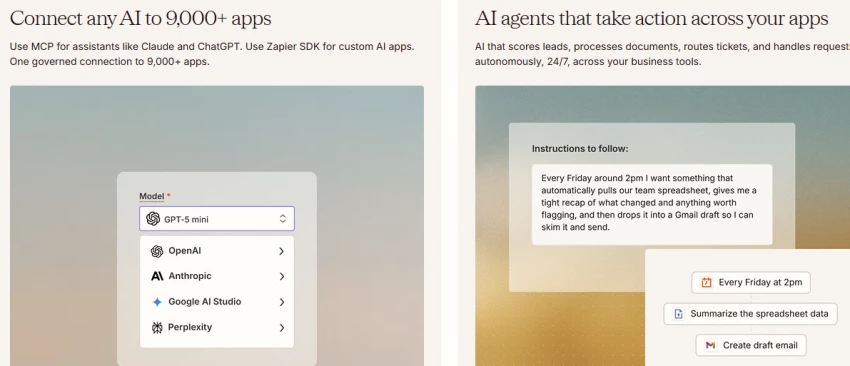
Automation platforms split into two philosophies in 2026. Zapier doubled down on orchestration at scale: its Copilot builds automations from plain-language descriptions, Tables and Interfaces were bundled into standard plans, and Zapier MCP lets external AI agents act across its 9,000-plus app catalog. Gumloop, the AI-native challenger, focused on agents that reason: its agents write and execute their own code in sandboxes, monitor the web with built-in scraping services, trigger on combinations of async conditions, and self-improve over time. Its Gumstack observability layer even monitors tool calls made by Claude Code, Codex, and Cursor. Make remains the pick for complex branching logic, and open-source n8n keeps growing with technical teams that want self-hosting and code-level control.
The practical difference: Zapier is deterministic automation with AI steps, best when the workflow is well defined and must run identically every time. Gumloop is agentic automation, best when the process needs judgment at runtime. Most mature stacks now use one of each.
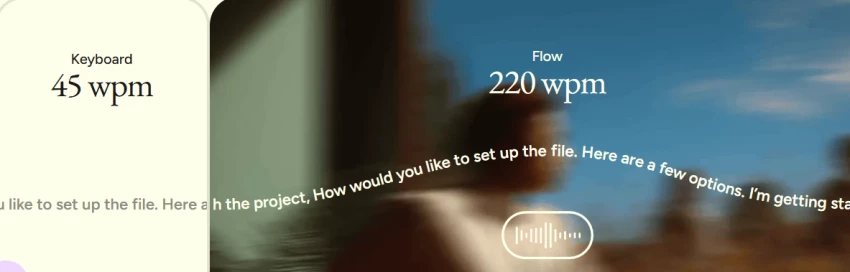
Dictation quietly became a mainstream productivity layer. Wispr Flow launched on Android in February 2026, making it the only major AI dictation tool on Mac, Windows, iOS, and Android simultaneously, with one subscription syncing dictionaries and style preferences across all four. Its pitch is intelligence rather than transcription: it removes filler words, corrects backtracking mid-sentence, and formats output to match the app, so a Slack message comes out casual and a Gmail draft comes out professional. Sessions now run up to 20 minutes, Command Mode edits highlighted text by voice, and HIPAA-compliant zero-retention workflows extended to all plans. Developer support deepened too, with syntax-aware parsing for variables and terminal commands plus native Cursor and VS Code integrations. ChatGPT's own dictation also improved materially in 2026, with at least 10 percent lower word error rates across top languages, a sign that voice is becoming table stakes.
Strip away the hype and the 2026 evidence base is unusually rich: randomized controlled trials, Federal Reserve surveys, and analyses of a billion job ads. The task-level numbers are strong. Workers using generative AI save an average of 5.4 percent of their work hours, about 2.2 hours in a 40-hour week, per the Federal Reserve Bank of St. Louis. McKinsey and Slack data show knowledge workers with production AI agents recover a median 6.4 hours per week. Frequency matters enormously: 33.5 percent of daily AI users save four or more hours weekly, versus 11.5 percent of once-a-week users.
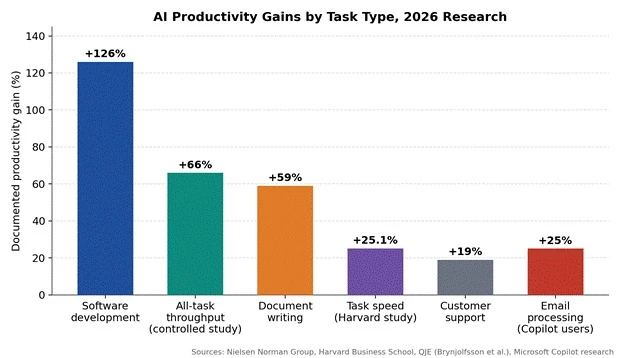
Figure 2. Documented productivity gains by task type from controlled studies and vendor research, 2026.
Reading the chart: each bar shows a measured gain from a specific study rather than a self-reported estimate. Software development leads at a 126 percent increase in weekly coding output (Nielsen Norman Group). A controlled all-task study measured 66 percent higher throughput, document writing runs 59 percent faster, and Harvard Business School's consultant experiment found tasks completed 25.1 percent faster with over 40 percent higher quality ratings. Customer support shows the most instructive pattern: the Quarterly Journal of Economics study of 5,172 support agents found a 15 percent average gain in issues resolved per hour, but novice agents improved around 34 percent while experts gained little. AI raises the floor more than the ceiling, which is the strongest equity argument for broad deployment.
Where the gains leak away is at the organizational level. Stanford and BetterUp researchers coined the term workslop for low-effort AI-generated content: 40 percent of workers received it in the past month, and recipients spend nearly two hours per incident fixing it, roughly 186 dollars per employee per month in lost productivity. The Work AI Index adds coordination neglect to the diagnosis: individual gains fail to compound because organizations underestimate the review, verification, and handoff work AI adds. Only 13 percent of employees say AI has significantly improved their organization's overall performance. Supervision is a real cost, and budgeting for it is what separates high-ROI deployments from tool sprawl.
The matrix below scores six representative tools across the dimensions that matter for a productivity stack. Two check marks indicate best-in-class capability, one check mark indicates solid support, and a cross indicates the tool does not meaningfully cover the area.
| Tool | Writing | Code | Automation | Speech | Collaboration | AI Reasoning |
| ChatGPT (GPT-5.5) | Advanced | Supported | Supported | Supported | Advanced | Advanced |
| Notion AI | Advanced | Not supported | Advanced | Supported | Advanced | Supported |
| GitHub Copilot | Not supported | Advanced | Supported | Not supported | Supported | Supported |
| Gumloop | Not supported | Supported | Advanced | Not supported | Supported | Advanced |
| Fireflies.ai | Supported | Not supported | Supported | Advanced | Supported | Not supported |
| Wispr Flow | Supported | Supported | Not supported | Advanced | Not supported | Not supported |
Rating key: Advanced = strongest capability; Supported = available capability; Not supported = unavailable or not a core feature.
| Tool | Free Tier | Paid Tier | Enterprise | Notes (2026) |
| ChatGPT | Yes | Go / Plus / Pro | Yes | Go at roughly 8 dollars brings memory and higher limits; Excel and Sheets sidebar included |
| Notion AI | Trial credits | Business add-on | Yes | Agents and Workers billed via Notion credits from August 2026 |
| GitHub Copilot | Yes (limited) | Pro from 10 dollars | Yes | Usage-based AI credits since June 2026; completions stay unlimited on paid plans |
| Gumloop | Trial credits | Credit-based | Yes | Single credit currency across agents and workflows; costs scale with node complexity |
| Fireflies.ai | Yes (800 min) | Pro ~10 dollars/seat | Yes | Business tier adds unlimited storage and conversation intelligence |
| Wispr Flow | Yes (2,000 words/wk) | Pro 15 dollars/mo | Yes | One subscription covers all four platforms; HIPAA BAA on every plan |
Pricing verified against vendor pages as of early July 2026, but this is the fastest-moving variable in the category. GitHub's mid-year switch from premium requests to per-token credits is the trend to watch: expect more vendors to move from seat pricing to usage pricing as agent workloads grow.
Five patterns define where the category is heading.
• High-intensity adoption compounds. PwC's 2026 Global AI Jobs Barometer, built on over a billion job ads, found productivity growth 40 percent higher at the companies most exposed to AI, and those same companies are raising wages and headcount faster than the least exposed. Morgan Stanley's survey shows industries that meaningfully embraced AI growing labor productivity 4.8 times faster than the global average. The gains concentrate among firms that redesign workflows, not those that just buy licenses.
• Agents moved from demo to deployment. Gartner reports early adopters of agentic systems seeing 15.2 percent average cost savings and 22.6 percent productivity improvements, and Google Cloud found 52 percent of enterprises had deployed AI agents by late 2025. McKinsey's survey shows 23 percent of organizations scaling agentic systems with another 39 percent experimenting.
•MCP became the connective tissue. The Model Context Protocol went from emerging standard to default plumbing: Notion's MCP usage grew tenfold in a single month, Zapier, Gumloop, and every major coding agent support it, and it is the main reason agents from different vendors can now share tools and data.
• The OS layer joined the race. Android 17, released in June 2026, pushes AI into the operating system itself: Bubbles turn any app into a floating window for multitasking, Screen Reactions record screen and selfie camera together, and Gemini Intelligence performs multi-step background tasks such as parsing an open tab and completing a booking. Apple's answering AI upgrades to Siri arrive with iOS 27 in September.
• The training gap is the new bottleneck. ManpowerGroup's 2026 barometer found 56 percent of the global workforce received no recent AI training. Tools are ubiquitous; skills are not, and that gap explains much of the distance between adoption and measured impact.
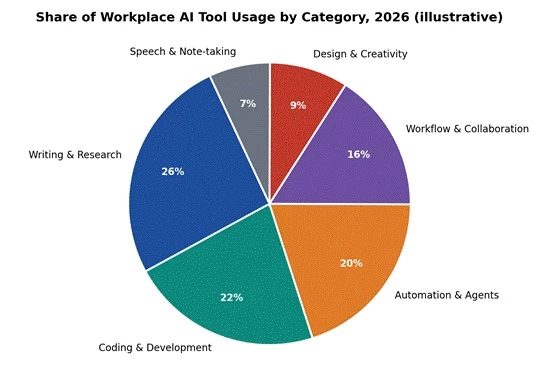
Figure . Illustrative share of workplace AI tool usage by category in 2026.
Reading the chart: this breakdown is illustrative, synthesized from adoption surveys and category revenue reporting rather than a single census. Writing and research remains the largest slice because chat assistants are the default entry point for most workers. Coding and development punches above its headcount share because developers are the heaviest per-capita users. The fastest-growing wedge is automation and agents, which barely registered two years ago; speech and note-taking is small but growing quickly now that dictation works across every platform.
The research community spent 2026 explaining a contradiction. Task-level experiments keep finding large gains, yet the NBER's four-country executive survey found the mean firm-level productivity gain sitting near 0.29 percent. Economists increasingly read this as the classic general-purpose technology pattern, the same lag seen in the 1980s IT revolution: benefits arrive years after adoption, once organizations restructure workflows and build complementary systems.
Two 2026 findings sharpen the picture. METR's survey of technical workers found a median self-reported 1.4 to 2x increase in the value of their work due to AI, but the same organization's earlier controlled study showed experienced developers overestimating their AI speedup by roughly 40 percentage points, and in one experiment experienced developers actually took 19 percent longer with AI tools while believing they were 20 percent faster. Perception and measurement diverge, which is why self-reported gains should be discounted. Second, the skill-compression effect keeps replicating: novice customer support agents gained around 2.4 times more than average workers. AI functions as a leveler that raises the productivity floor, with much smaller or even negative effects for experts on tasks they already do well.
For decision-makers the implication is direct: measure outcomes, not activity. The honest practitioner benchmark circulating in 2026 is that a tool which cannot save 3 to 5 hours per user per week in a specific workflow will not pay for itself once supervision costs are counted.
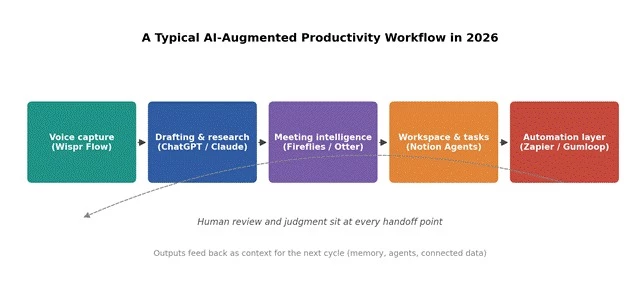
Figure. A typical AI-augmented productivity workflow in 2026, from voice capture to automation.
Reading the diagram: this is the shape of a modern individual workflow. Work often begins with voice, since dictation is roughly four times faster than typing. A general assistant handles drafting and research with persistent memory supplying context. Meetings flow through an intelligence layer that outputs structured action items rather than raw transcripts. Those items land in an agent-equipped workspace like Notion, and an automation layer moves data between the CRM, email, and reporting tools without manual handoffs. The dashed return arrow matters most: every output becomes context for the next cycle through memory and connected data, which is why integrated stacks compound while disconnected tools plateau. The italic note is the discipline that makes it work, because human review at each handoff is what prevents the workslop problem described earlier.
Microsoft's Copilot research found users spending about 30 minutes less on email per week, a 25 percent reduction in processing time. The 2026 pattern goes further: assistants like Superhuman's AI split the inbox into important-today and read-later, draft replies trained on your sent history, and resurface threads awaiting responses. ChatGPT's Gmail connector brings similar context into general chat.
The complete loop is now standard: Fireflies or Otter transcribes with speaker labels, extracts decisions and action items with timestamps, then an automation pushes tasks to your project tool and updates related CRM records. Notion closes the loop inside one product, with meeting notes formatted by workspace-level custom instructions.
Gumloop's flagship pattern reads account data from Salesforce and Apollo, runs AI research on each lead, scores it, and drafts a personalized outreach email before a rep touches it. Zapier handles the deterministic side, syncing enriched records across the stack. Samsara's marketing systems team credits this style of build with saving thousands of manual hours.
The 2026 workflow assigns an issue to multiple agents through GitHub Agent HQ, compares the draft pull requests, and merges the best. Teams keep an AGENTS.md file so every agent follows the same conventions. Reviews improve too: Opus 4.8 class models self-detect mistakes during code review, and McKinsey pegs coding task speedups at 25 to 55 percent even before multi-agent workflows.
Deep research modes in ChatGPT, Claude, and Perplexity now produce cited multi-source reports in minutes. On the extraction side, legal and tax professionals are projected to save around 240 hours annually through AI-assisted document review, the largest sector-level time saving in the 2026 data. ChatGPT's spreadsheet sidebar and Notion's 50-page context window make the last mile, getting findings into working documents, dramatically shorter.
2026 is the year AI productivity tools stopped asking for attention and started doing work. ChatGPT became an office-native assistant with real memory. Notion became a place where humans and agents share a task board. GitHub made agent choice a dropdown menu. Automation platforms learned to reason, and voice finally works everywhere. The tools are no longer the constraint.
The constraint is integration and discipline. Every credible dataset this year tells the same story: task-level gains are large and real, firm-level gains belong to the minority of teams that redesign workflows, train people, and budget for supervision. Strategic depth beats tool count. Pick a broad assistant, add two or three specialized spikes that match your bottlenecks, connect them, and measure hours saved in specific workflows rather than adoption dashboards.
Looking ahead, expect agent-to-agent workflows to mature through MCP, usage-based pricing to spread, and the OS layer to absorb more of what standalone apps do today. The organizations compounding gains in 2027 will be the ones that treated 2026 as an operations project rather than a shopping trip.
Share your thoughts about this article.
Be the first to post a comment!
The same tool can be a 4.7 on one site and a 3.9 on another. Here is what is rea...
Nitin1 month ago
Here is the number worth pinning above your budget: in Gartner Digital Markets r...
Deepak Mehra1 month ago
What Artlist AI is in 2026Artlist began as a royalty-free music library. By 2026...
Deepak Mehra1 month ago
Most AI tool failures do not announce themselves. There is no crash, no angry em...
Nitin1 month ago

The best AI image generator in 2026 is Nano Banana 2 for speed, FLUX.2 for photo...
Parveen Verma1 month ago

“Useful” is a slippery word for a coding assistant. A tool can be brilliant at o...
Sakshi Dhingra1 month ago