
These are not ordinary chatbots, so they should not be compared like ordinary chatbots
AI character chat and roleplay platforms have moved far beyond simple chatbot replies. People now use them to talk to fictional characters, build roleplay stories, test emotional conversations, create fantasy scenarios, or simply pass time with a responsive AI companion. Not every platform handles character depth, memory, safety, adult content, or pricing the same way, which is why comparing Joyland AI, Dopple AI, CrushOn AI, and Pephop AI only as chat apps would be too shallow. The real question is which platform creates the kind of character experience a particular user is actually looking for.
Users choose these tools for interactive characters, fantasy roleplay, emotional conversations, fictional companions, storytelling, or casual entertainment. All four sit in that space, but they differ sharply on freedom, safety, personality quality, and user control. Joyland AI leans into anime-style story roleplay with custom character creation. Dopple AI aims at cleaner, mainstream, fandom-style character chat. CrushOn AI is built around largely unfiltered adult roleplay for users 18 and over. Pephop AI offers flexible custom roleplay with an open content policy, also adults only.
| Tool | Free Plan | NSFW Support | Custom Characters | Memory Quality | Roleplay Depth | Best For |
|---|---|---|---|---|---|---|
| Joyland AI | Yes | Partial | Good | Medium | High | Casual roleplay & character chat |
| Dopple AI | Yes | Limited | Good | Medium | Medium | Interactive AI companions |
| CrushOn AI | Yes | Yes | Excellent | Very High | Very High | Deep immersive roleplay |
| Pephop AI | Yes | Yes | Excellent | High | Very High | Uncensored roleplay & character AI |
All four AI character chat platforms were evaluated using a consistent real-world testing process focused on actual user experience.
Each tool was tested based on:
To ensure fair comparison, identical prompts were used across all platforms:
| Factor | Weight |
|---|---|
| Roleplay Depth | 25% |
| Memory & Continuity | 20% |
| Character Quality | 20% |
| Creative Freedom | 20% |
| Ease of Use | 15% |
AI roleplay platforms tend to fall into different experience zones. The right platform depends on which zone a user is aiming for, not on which app is most popular. The spectrum below maps the rough territory before the detailed sections.
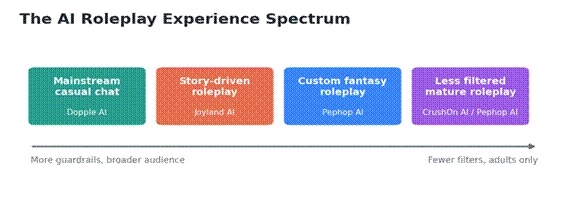
Figure 1. The AI roleplay experience spectrum, from broad-audience casual chat to adults-only unfiltered roleplay.
| Experience zone | User expectation | Platform fit to explore |
| Story-driven roleplay | Long scenes, fictional plots, emotional arcs | Joyland AI, Pephop AI |
| Casual character chatting | Fast replies, fun characters, low setup | Dopple AI |
| Unfiltered / adult-leaning roleplay | Fewer restrictions, mature scenarios (18+) | CrushOn AI, Pephop AI |
| Companion-style conversation | Ongoing emotional or friendly chat | Joyland AI, Dopple AI |
| Character creation | Custom personalities and prompts | All four, verify depth |
| Community character discovery | Public bots and shared characters | All four, verify current library |
Before personality or price, the first decision is what kind of content a user actually wants. Joyland AI may suit users who want character-based chat and story-style interactions. Dopple AI may suit users who want a cleaner, more mainstream character chat experience. CrushOn AI tends to attract users looking for less restricted adult-style roleplay. Pephop AI sits closer to flexible or mature roleplay depending on its current rules. Matching intent to platform first avoids most disappointment later.
| User intent | Better starting point | Caution |
| Light fictional chatting | Dopple AI | May feel limited for deeper roleplay |
| Long character scenes | Joyland AI | Memory and consistency need checking |
| Adult roleplay (18+) | CrushOn AI / Pephop AI | Age, consent, and safety boundaries matter |
| Custom character building | Joyland AI / Pephop AI | Prompt quality strongly affects results |
| Mainstream entertainment | Dopple AI | Less suited for mature roleplay |
| Emotional companion chat | Joyland AI / Dopple AI | Avoid treating AI as a real relationship |
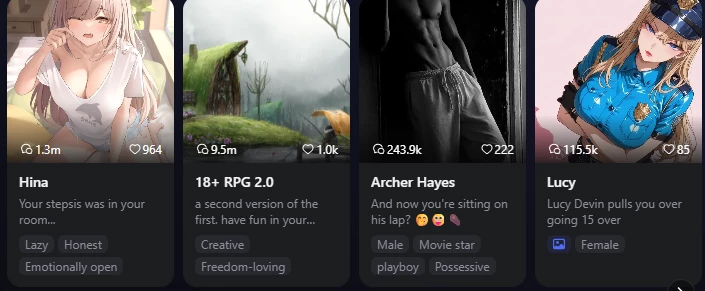
Joyland AI, launched in 2023 and operated by Generatively Inc., is built around anime-style roleplay, interactive storytelling, and virtual companionship. Reviews credit it with a very large character library (figures cited range from tens of thousands to 60,000-plus anime-style characters), persistent personality traits, and a granular Advanced Create tool for custom characters. It runs on web, Android, and iOS, and reporting indicates it does not require ID verification to sign up, with self-declared age gating for its optional NSFW mode.
Joyland AI reads as a fit for fantasy and romance-style fictional chat, character storytelling, and casual companion conversation, with an anime aesthetic running through the character design and interface. Independent reviewers describe extended sessions holding character behavior reasonably well compared with some rivals, which suits scene-building and story arcs.
Personality and scene-building are the standout. The Advanced Create tool lets users define traits, emotional range, backstory, greeting style, and tone, and reviewers note those choices show up quickly in how a character speaks. For users who care about a distinct, consistent character voice, this is the platform's strongest card.
The most consistently reported limitation is memory. Multiple 2026 reviews describe context collapsing after roughly 20 messages, which undermines long storytelling regardless of plan. Other friction points include a restrictive free tier (reports cite around 10 daily credits), unclear character search and filtering, variable quality among user-made characters, and paid tiers (commonly reported at about $9.99 per month Standard and $19.99 per month for the top tier) needed to remove caps and ads. These figures should be confirmed on the current pricing page.
Best-fit use case Joyland AI is a strong candidate for users who want a character-driven, story-style chat platform with flexible custom characters, provided they verify current pricing, model quality, and content rules first, and accept that very long, memory-dependent story arcs may drift. |
_1764143097.webp)
Dopple AI, also launched in 2023, focuses on fandom-based and original character chat: pop-culture personas, anime characters, and custom creations in a fast, casual, text-based format. It leans toward mainstream, entertainment-style interaction rather than mature roleplay, with a freemium model and premium tiers reported in the roughly $5.99 to $9.99 per month range.
Dopple AI tends to feel easier for beginners than mature-roleplay-first platforms. The draw is recognizable characters, conversational replies, and low setup, which makes it approachable for casual fans who want low-stakes chats rather than deep story construction or unfiltered content.
Sources disagree on Dopple AI's adult-content stance: some describe it as strictly SFW with active moderation on every message, while others mention limited mature content behind premium with inconsistent filtering. Either way, users seeking unfiltered adult roleplay, long-form story continuity, or deep freedom will likely find it too restricted, and some reviews note a less polished mobile web experience and occasional glitches during peak hours. The safest reading is to treat its NSFW position as something to verify directly in its current terms of service.
Best-fit use case Dopple AI is the cleaner choice for casual AI character chats, fandom entertainment, and mainstream users who do not want an NSFW-first experience. Confirm its current content policy before assuming either a strict or permissive stance. |

CrushOn AI, operated by Peekaboo Tech Inc. and reported to be based in Cyprus, is an explicitly adult-oriented (18+) character platform that makes largely unfiltered NSFW roleplay a first-class feature, positioned as an alternative to heavily filtered services. It is primarily text-based, with a filtered/unfiltered toggle, conversation memory that scales with subscription tier, multi-character group chats, and a character builder. Reporting indicates a free tier around 100 messages per month and paid plans commonly cited from about $5.99 per month (Standard, roughly 2,000 messages) up toward $20 per month for higher tiers, with frequent changes.
The appeal is freedom. Users who found mainstream platforms increasingly restrictive often move to CrushOn AI because it does not refuse typical adult roleplay and keeps characters in mature territory when the user chooses it. Reviewers also note genuinely strong memory on paid tiers and a deep character library.
Fewer filters raise the stakes on responsibility. Adult content boundaries, strict 18+ enforcement, emotional overuse, chat privacy, and data retention all need attention. Independent coverage notes that encrypted-storage claims are not independently verified and that message caps and moderation behavior vary by tier. Unsafe or extreme roleplay limits, consent framing, and fictional boundaries remain the user's responsibility.
Best-fit use case CrushOn AI fits mature users who understand its boundaries and want less restricted fictional roleplay. It is strictly for adults. This article does not encourage minors, harassment, impersonation of real people, or non-consensual scenarios, and CrushOn AI should never be positioned toward anyone under 18. |
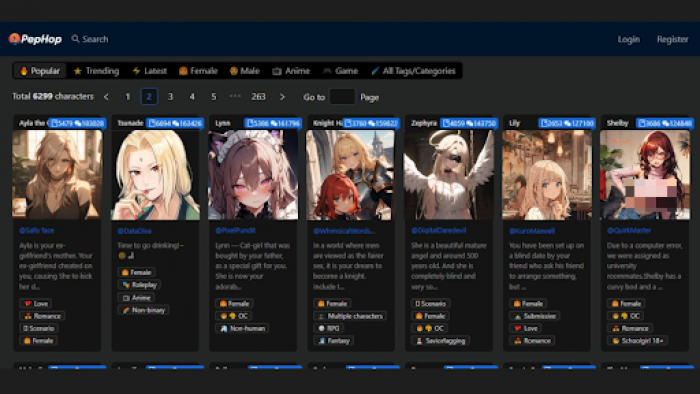
Pephop AI is a browser-based roleplay platform launched in late 2023 by Pephop AI HK Limited, reported to run on GPT-4 with a large character catalog (figures range across sources from roughly 4,600 to 36,500 characters) and a one-tap SFW/NSFW toggle. It supports custom characters, TavernAI/SillyTavern JSON import and export, and adults-only mature content within stated rules, with pricing reported around $4.99 per month (Lite), $9.99 per month (Classic, where memory turns on), and $29.99 per month (Elite).
Pephop AI may appeal to users who want flexible fantasy chat, deep custom characters, and an inexpensive entry into mature roleplay, especially those comfortable importing or exporting character files. Its content policy is relatively clearly stated, including an explicit ban on sexualized depiction of minors.
Memory is the recurring weak point: reviews describe plot and relationship context degrading after roughly 20 messages even on higher tiers, alongside repetition in long conversations, recurring error messages noted in Trustpilot feedback, token-feeling age verification, and no dedicated mobile app. Character consistency, response length, scene control, content boundaries, and user privacy should all be tested on the free trial before paying, and any annual commitment should follow a check of the live pricing page.
Best-fit use case Pephop AI is a reasonable option for flexible, custom, adults-only roleplay at a low entry price, but pricing, rules, moderation, and especially long-session memory must be verified live. Like CrushOn AI, it is strictly 18+ and should never be aimed at minors. |
Comparing all four by conversation depth surfaces a clear pattern: several share strong personality and creativity but stumble on long-session memory. The grid below uses editorial scores derived from documented 2026 reviews and platform features, not lab benchmarks, and should be checked against current behavior.
| Character quality factor | Joyland AI | Dopple AI | CrushOn AI | Pephop AI |
| Personality consistency | Strong | Strong | Strong | Strong |
| Long-scene roleplay | Moderate | Moderate | Good (paid) | Moderate |
| Emotional tone | Good | Good | Good | Good |
| Memory across chats | Weak (~20 msg) | Moderate | Good (paid tiers) | Weak (~20 msg) |
| Response creativity | Good | Moderate | Good | Good |
| Repetition control | Moderate | Moderate | Moderate | Weak |
| Custom character depth | Strong | Good | Good | Good |
The single most important takeaway: if uninterrupted long-form story memory is the priority, test it directly. The ~20-message context drop-off reported for Joyland AI and Pephop AI, and the tier-dependent memory on CrushOn AI, are the kind of detail a free trial will reveal quickly.
A responsible comparison should not only ask which platform feels more entertaining. It should also ask which one is transparent about age limits, data use, moderation rules, subscriptions, and user safety. The checks below carry more weight in this category than in ordinary software.
| Safety area | Why it matters in AI roleplay |
| Age restrictions | Adult roleplay tools must not be positioned for minors; check whether age gating is real or self-declared |
| NSFW controls | Users should know whether filters exist and how to toggle them |
| Consent-based scenarios | Roleplay should avoid non-consensual framing |
| Impersonation | Real people and private individuals should not be misused |
| Emotional dependence | AI characters are not real relationships |
| Data privacy | Chats may contain sensitive personal details |
| Moderation clarity | Users need to know what content is restricted |
| Account deletion | Users should be able to control and delete their data |
| Payment transparency | Subscription and message limits must be clear |
On age verification specifically, reporting suggests several platforms here rely on self-declared age rather than document checks, which makes signup frictionless but places more responsibility on users and households. Encrypted-storage and deletion claims are often stated but not always independently verified, so sensitive personal details are best kept out of any character chat.
AI character chat platforms monetize the things roleplay uses most: message credits, daily free messages, premium models, NSFW access, faster replies, longer memory, character-creation slots, and unlimited-chat subscriptions, often with app-store billing that renews automatically. Because roleplay sessions consume messages quickly, free tiers tend to run out fast.
| Pricing factor | Why users should check it |
| Free message cap | Roleplay sessions can exhaust messages quickly |
| Paid subscription | Long chats may require recurring payment |
| NSFW access | Some platforms lock or throttle mature content |
| Memory / model upgrades | Better responses and longer memory may cost more |
| Character creation limits | Custom-bot users may hit slot restrictions |
| Refund / cancel policy | Worth confirming before buying; some report billing friction |
| App-store billing | Mobile subscriptions can renew automatically |
Reported pricing snapshot
| Platform | Free use | Paid plans | Message limits | NSFW access | Notes |
| Joyland AI | ~10 daily credits | ~$9.99/mo, ~$19.99/mo top | Caps on free; unlimited on paid | Optional NSFW, self-declared 18+ | Memory drop-off reported ~20 msg |
| Dopple AI | Free tier, most characters | ~$5.99 to $9.99/mo | Faster access on paid | Disputed: SFW-leaning, verify TOS | Mainstream, fandom focus |
| CrushOn AI | ~100 msgs/month | ~$5.99/mo Standard up to ~$20/mo | 2,000 msgs on Standard (reported) | Unfiltered, strictly 18+ | Cyprus-based; storage claims unverified |
| Pephop AI | Limited free trial (~20 msgs) | ~$4.99 / $9.99 / $29.99 per mo | Scales by tier | Unfiltered toggle, strictly 18+ | Memory turns on at Classic tier |
The stronger an AI character feels, the more important it becomes to remember that the conversation is generated. A platform may simulate warmth, affection, humor, or concern, but it is not a human relationship. That does not make the experience useless; it simply means users should keep emotional boundaries clear.
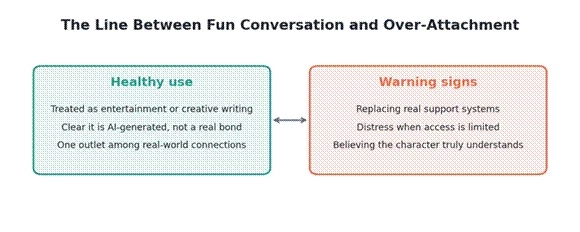
Figure. Healthy use versus warning signs of over-attachment.
AI characters can feel emotionally responsive, and users may overestimate how much the system understands. The chatbot does not actually feel emotions. Companion-style use is fine in balance, but it should not replace real support systems, and minors and emotionally vulnerable users need particular caution. At least one reviewer who tested Joyland AI explicitly advised against the platform for emotionally vulnerable users, noting that attachment and dependency can build over time. Responsible platforms provide safety reminders; users should not rely on those reminders alone.
If chat starts to feel like more than entertainment If an AI companion begins to feel like a replacement for real connection, or if reducing use causes real distress, that is a signal to step back and reach out to people you trust or a qualified professional. These tools are best as one outlet among many, not the only one. |
Homepage copy describes the best case. The sources below reveal the typical case: filter complaints, pricing friction, memory issues, bans, and moderation behavior. Where third-party review data is thin, that gap is stated rather than filled with invented opinion, and platform claims are kept separate from user experiences.
| Source | Signal to look for |
| Real complaints about filters, pricing, memory, and bans | |
| Quora | Beginner doubts and safety concerns |
| Trustpilot | Billing, cancellation, and support complaints |
| Product Hunt | Early-user reactions and feature expectations |
| App stores | Mobile stability and current ratings |
| YouTube | Live demos and real response examples |
| Discord / forums | Community behavior and moderation in practice |
| Privacy policy | Data storage, training use, and deletion |
| Terms of service | Age rules, NSFW rules, and prohibited content |
A few documented patterns are worth separating from marketing. Independent 2026 reviews repeatedly flag the ~20-message memory collapse on Joyland AI and Pephop AI, describe Pephop AI Trustpilot feedback mentioning recurring error messages and a relatively low aggregate score, and note that CrushOn AI's memory is genuinely strong on paid tiers while its encrypted-storage claim is not independently verified. Dopple AI coverage is split on whether it is strictly SFW or partially permissive. These are summaries of published assessments, not fabricated quotes, and no ratings, Reddit threads, or Quora answers were invented for this article.
The four platforms here are not the only options. The landscape below positions common alternatives by how filtered they are and whether they lean toward entertainment or companion use. Adult-oriented entries are noted plainly and not described explicitly.
| Platform | Better known for | Comparison angle |
| Character.AI | Mainstream character chat | More restricted but very widely used |
| Janitor AI | Flexible roleplay | Often compared with mature roleplay tools |
| Chai AI | Mobile AI character chats | Casual companion-style experience |
| Replika | AI companion | More relationship and companion focused |
| Talkie AI | Character-based chat | Visual and mobile character experience |
| SpicyChat AI | Mature roleplay | NSFW-focused alternative (18+) |
| Botify AI | Character and public-figure-style bots | Entertainment chat focus |
| DreamGF / Candy AI | AI girlfriend-style platforms | More adult companion positioning (18+) |
Across seven comparison dimensions, no single platform dominates. Each trades strengths against weaknesses, which is exactly why intent should drive the choice.
AI character chat and roleplay platforms are not one-size-fits-all tools. Some users want light entertainment, some want deep fictional storytelling, and others may prefer more open-ended adult roleplay. That is why the best choice depends less on which platform is most popular and more on what kind of conversation you actually want to have.
From my testing, Joyland AI feels better for story-style character chats, Dopple AI is easier for casual and cleaner conversations, CrushOn AI offers more freedom for adults who want immersive roleplay, and Pephop AI works well for users who like custom characters and flexible scenes.
My advice is simple: start with the free version, test at least one long conversation, check how well the character remembers details, and read the platform’s privacy and content rules before paying. These tools can be fun and creative, but they should be used with clear expectations, especially when emotional chats, mature content, or personal data are involved.
In the end, the best AI character chat platform is the one that gives you the right mix of creativity, safety, memory, and control for your own style of roleplay.
Share your thoughts about this article.
Be the first to post a comment!

Quick answerTo rank in Google AI Overviews: first get into the organic top 10 (7...
Deepak Mehra12 hours ago
Quick picks (if you just want the answer)Best overall: GPT Image 2 (ChatGPT) — #...
Nitin12 hours ago
In 2026, the debate over AI coding assistants has effectively collapsed into a t...
Harpreet Singh13 hours ago

Artificial intelligence is beginning to influence entire transportation networks...
Deepak Mehra2 days ago
Quick answerBlackbox AI is an AI coding assistant used for generating code, debu...
Harpreet Singh3 days ago
I did not set out to write a warning. I set out to find a cheap, fast tool that...
Nitin4 days ago