AI music generation has matured quickly over the last few years, but the reality is more practical than revolutionary. Instead of one tool dominating everything, the space has fragmented into platforms built for different kinds of creators. Some tools are good at generating full songs with vocals and structured verses. Others are better suited for instrumental background tracks for YouTube videos or podcasts. A few focus on more detailed compositional control for film scoring or game soundtracks.
These systems don’t replace musicians, and they don’t remove the need for creative direction. What they do offer is speed and accessibility. If you need a rough demo, a background track, or a starting point for a composition, AI music generators can shorten that process significantly. For content creators working under deadlines, or for non-musicians who simply need usable audio, that efficiency matters.
Based on industry comparisons and creator discussions, platforms like Suno, Udio, AIVA, and Soundraw are consistently mentioned in 2026 as some of the more capable options. Each has strengths and tradeoffs, and choosing between them depends less on hype and more on what kind of music you actually need to produce.

When assessing proficiency, flexibility, and ease of use, Suno is often recognized as the most capable AI music generator available today. The platform’s core strength lies in its balance between a simple prompt-based workflow and deep creative output. Suno can generate fully arranged songs from text prompts, including vocal lines, harmonies, and instrumentation across multiple genres. It also offers tools for remixing and refining tracks, and some versions integrate multi-track editing features resembling a digital audio workstation.
What sets Suno apart from basic loop or beat generators is that it feels like a collaborative experience: the user provides a vision, whether a description like “80s synthpop with upbeat tempo and female vocal harmony”, and the AI composes a draft song structure around it. It supports popular genres such as pop, EDM, ambient, and cinematic music, producing outputs that are closer to fully produced songs.
Although Suno’s free tier offers a limited number of credits per day, premium plans unlock more generation volume, stem export, and commercial licensing rights, making it suitable for both hobbyists and semi-professional creators.
Explore Suno here: https://suno.com/hub/best-ai-music-generator
Another well-regarded AI music platform is Udio, which offers music generation with strong creative control and support for customizable inputs. Unlike tools that generate only background loops or instrumental fragments, Udio can produce more elaborate compositions with structure and flow. It’s often praised in reviews for blending richness with simplicity: users can input style cues, mood descriptions, even lyrical directions, and the system produces a complete musical arrangement.
Udio tends to lean slightly toward experimental textures while still offering conventional musical styles. It’s useful if you’re looking to generate songs that feel less generic and more tailored to a unique vision. This makes it appealing for creators working on original content rather than background tracks alone.
The free tier generally provides daily credits that allow users to try basic generation, while paid plans expand on output quality, file downloads, and commercial rights. However, recent industry developments suggest that licensing and download policies may shift as major music companies engage with these platforms.
Explore Udio here: https://www.udio.com/
AIVA (Artificial Intelligence Virtual Artist) takes a distinctly different approach compared with Suno and Udio. Rather than focusing primarily on vocal or track-centric output, AIVA shines at generating complex compositions ideal for films, games, and dramatic scoring. Its strength lies in structured, orchestral-style music and multi-instrument arrangements tailored for emotional layering, dynamic builds, and thematic coherence.
AIVA supports a vast range of musical styles, over 250 different templates and genres, and allows creators to explore detailed variations on themes, instrumentations, and progressions. This makes it less suitable if your goal is quick pop or background music, but very useful for soundtracks that need depth and cinematic textures.
AIVA typically offers a free trial or limited-use tier, after which paid plans unlock full download rights, extended run time, and commercial usage rights. For creators working on professional projects or needing licensing clarity for streaming or publishing, this tiered structure provides flexibility.
Explore AIVA here: https://www.aiva.ai/
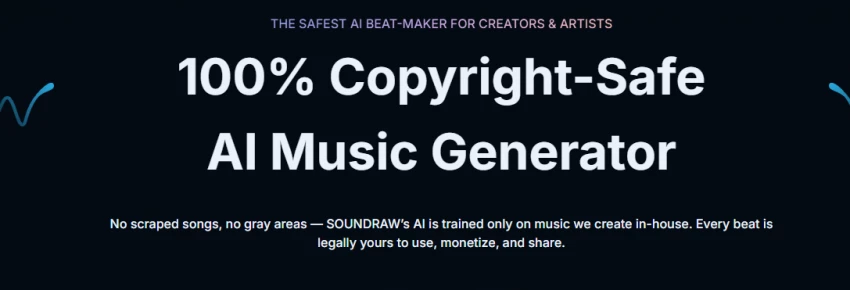
For creators focused on background music, whether for YouTube videos, podcasts, ads, or games, Soundraw offers another practical alternative. Its AI is trained exclusively on original, in-house music profiles, meaning that the tracks generated are royalty-free and carry clear commercial usage rights. This is particularly valuable for creators who worry about copyright issues or Content ID flags on platforms like YouTube.
Soundraw allows customization of mood, tempo, and length, producing tracks that are ready to download in high-quality audio formats like WAV or stems for further editing. Its focus isn’t on deep vocal synthesis, but on dependable, high-fidelity soundtracks that fit a wide range of creative projects.
Free access typically lets you experiment with music generation without download rights, while paid subscriptions unlock full commercial usage and downloadable files across multiple genres and moods.
Explore Soundraw here: https://soundraw.io/
Beyond these primary examples, the broader ecosystem includes tools tailored to specific use cases. For example, platforms like Boomy let beginners make complete songs without any musical training, with options to share and even monetize music across streaming platforms.
Tools like Beatoven.ai emphasize background music optimized for media, allowing creators to seamlessly generate soundtracks and even sound effects using simple prompts.
Emerging tools and open-source frameworks like ACE-Step 1.5 show where the technology is headed next, with models capable of generating long-form compositions locally without relying on cloud systems, a potential game-changer for personalization and style fine-tuning in future tools.
There simply isn’t one AI music generator that ticks every box for every creator. What counts as “best” depends on what you want to do:
For complete songs with vocals and commercial depth, Suno and Udio stand out.
For orchestral and cinematic pieces, AIVA offers structured compositional depth.
For royalty-free background music tailored to content, Soundraw is a reliable choice.
For quick, beginner-friendly generation and easy publishing, Boomy and other alternatives like Beatoven.ai serve simple workflows.
The landscape in 2026 reflects a broad maturity in AI music generation: tools are capable of producing professional-sounding audio, offer clear licensing paths, and serve a range of practical workflows, from podcast jingles to full song demos, all without needing traditional studio infrastructure.
Be the first to post comment!

AI study tools are everywhere right now. Some feel overhyped. Some feel confusin...
Sakshi Dhingra12 hours ago

When I test AI voice generators seriously, I don’t judge them by demo clips. I t...
Sakshi Dhingra1 day ago

When I first discovered Gizmo AI, it immediately positioned itself as something...
Sakshi Dhingra1 day ago

I went into this expecting one “best” AI animation tool. What I found instead is...
Sakshi Dhingra2 days ago

When I started digging into Lenso.ai, I didn’t want surface-level claims. I want...
Sakshi Dhingra2 days ago

Motion graphics is no longer “only After Effects.” Today I can generate motion s...
Sakshi Dhingra4 days ago