Artificial intelligence has fundamentally altered how YouTube content is produced, edited, optimized, and scaled. The conversation is no longer about whether AI can generate videos, because it clearly can. The more important question is how effectively each platform integrates into a creator’s production workflow, how much control it allows, how realistic the output feels, how scalable it is over time, and whether the pricing structure makes sense relative to publishing frequency and monetization goals. Many tools promise instant video generation, but only a few deliver a balance between automation, customization, and long-term usability. Below is a detailed, structured, and realistic breakdown of the leading AI platforms for YouTube video creation, including accurate pricing ranges as of 2026 and practical evaluation from start to finish.
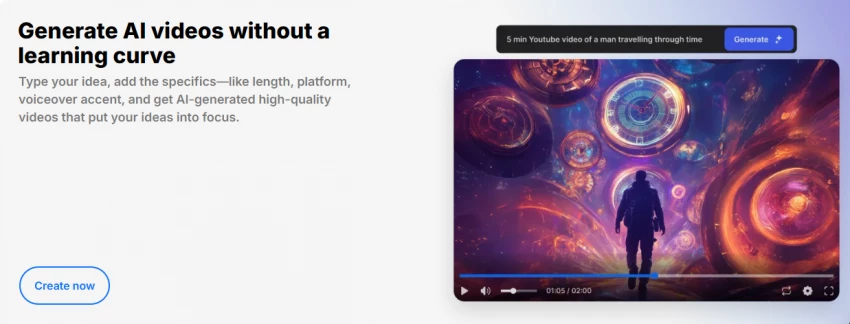
InVideo is structured around automation as its primary advantage. The platform allows creators to input a prompt, topic, or structured script and then generates a scene-by-scene draft video that includes stock footage, background music, AI voiceover, subtitles, and text overlays. Unlike traditional editors that require manual construction of every timeline element, InVideo’s AI engine attempts to interpret the narrative flow of the script and convert it into a cohesive structure. This makes it particularly powerful for list-style videos, educational explainers, motivational compilations, affiliate product breakdowns, and faceless YouTube automation channels.
The stock library integration is one of its strongest technical advantages because it reduces the need to source external visuals. However, because the system relies heavily on stock assets, creators who do not manually refine scenes may end up with repetitive visuals that resemble other automated channels. Advanced users often spend time replacing footage, adjusting pacing, refining transitions, and customizing typography to avoid a generic feel.
From a pricing standpoint, InVideo typically offers a free plan that includes watermarked exports and limited AI generation capacity. Paid plans generally start around $20 to $30 per month for the Plus tier, which removes watermarks and increases export limits. Higher AI or Max tiers commonly range between $40 and $60 per month depending on billing cycle and generation volume. For creators publishing multiple videos weekly, mid-tier or higher plans become necessary to avoid export restrictions.
InVideo is best suited for creators prioritizing speed and volume over cinematic precision. It excels in structured informational content but offers less granular motion control compared to professional desktop editing software.
Canva approaches AI video from a design-first perspective rather than a fully automated production engine. The AI video generator is integrated into its broader ecosystem, which includes thumbnail design, social graphics, brand kits, and presentation tools. This integration creates a seamless branding advantage for YouTubers who value visual consistency across thumbnails, intros, and lower thirds.
Canva’s Magic Design and AI-assisted features allow users to generate initial layouts from prompts, convert documents into video slides, apply auto-captions, remove backgrounds, and resize content for Shorts. However, it does not aggressively automate full script interpretation in the way InVideo attempts. Instead, Canva assists creators during editing rather than replacing the editing process entirely.
Pricing is one of Canva’s most attractive elements. The free tier provides basic access with limited premium assets. Canva Pro, typically priced around $12 to $15 per month per user, unlocks premium stock content, brand kits, advanced AI tools, and higher export flexibility. Because many creators already use Canva Pro for thumbnails and graphics, the AI video functionality becomes a cost-efficient addition rather than a separate major expense.
Canva is particularly effective for educational creators, personal brands, and channels where brand aesthetics and design coherence matter more than aggressive automation speed.
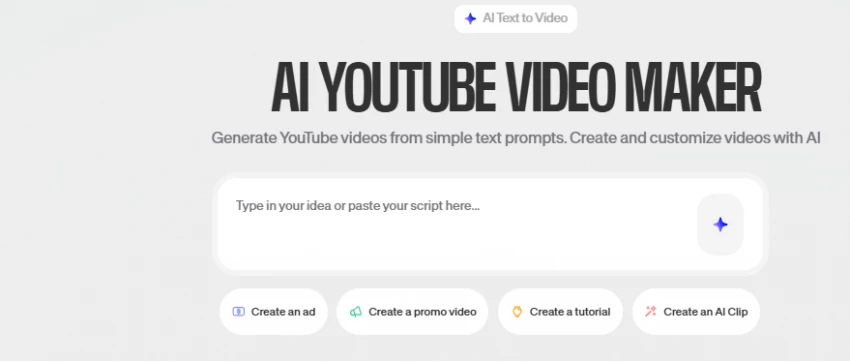
VEED is positioned more as an AI editing accelerator than a full automation generator. It is especially powerful for creators who film themselves, such as educators, SaaS reviewers, analysts, or commentary channels. One of its standout features is transcript-based editing, which allows users to delete words in a transcript and automatically remove the corresponding video segments. This dramatically reduces manual timeline trimming.
Its AI subtitle engine provides relatively high accuracy, and its filler word detection and silence removal capabilities streamline post-production. Background noise reduction and screen recording tools further enhance its utility for tutorial-based YouTube content.
Pricing typically begins with a free plan that includes watermarks and export limitations. Paid plans often start around $18 per month for basic watermark removal and increase to $30 to $40 per month for full AI features, higher export resolution, and brand customization. Business plans scale higher for teams and higher volume output.
VEED is ideal for creators building authority channels where authenticity and personal presence matter. It enhances productivity without replacing the creator’s personality.
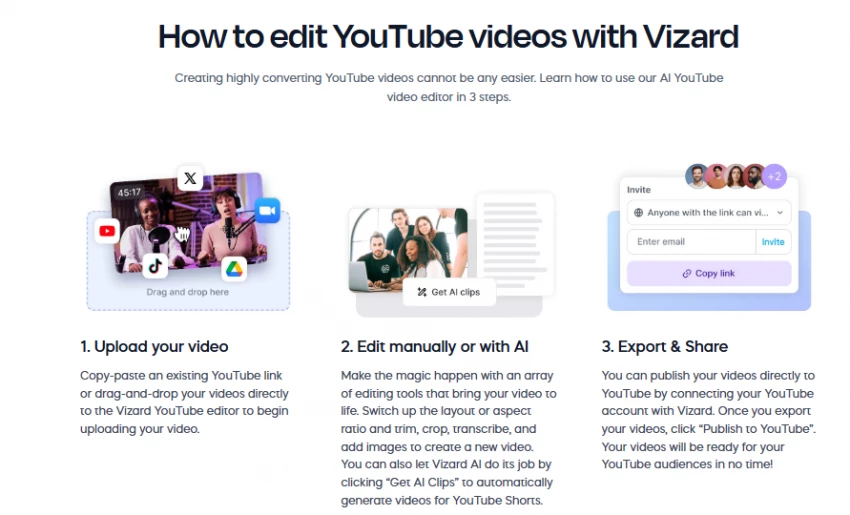
Vizard AI focuses on scaling discoverability by converting long-form YouTube videos into short-form vertical clips. After uploading a full video, the AI identifies highlight segments, automatically reframes them into vertical format, and applies captions optimized for mobile viewing.
The highlight detection system attempts to predict engagement-worthy moments based on pacing and speech analysis. While it significantly reduces manual clipping time, creators still benefit from reviewing and refining outputs to maintain brand alignment.
Pricing typically begins around $15 to $30 per month depending on upload minutes and export capacity. Free tiers are often limited in processing volume.
Vizard is most effective for creators who already publish long-form content and want to leverage Shorts for growth amplification.
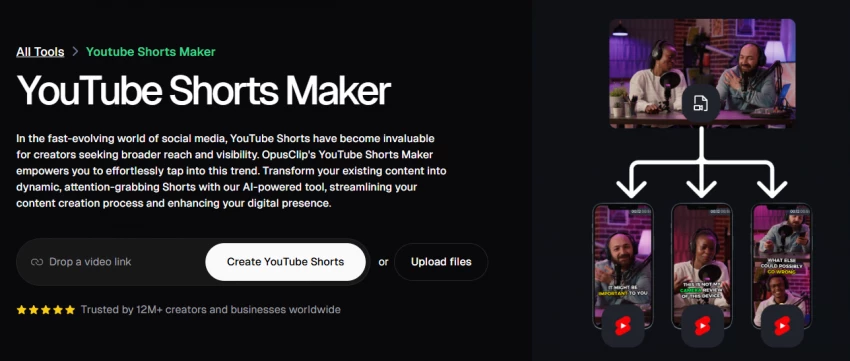
Opus Clip specializes in predicting high-engagement segments within long videos and converting them into vertical Shorts. It uses AI scoring models to estimate retention potential and highlight moments that may perform well algorithmically.
Pricing generally begins near $19 to $29 per month depending on processing minutes. Free plans allow limited experimentation but are insufficient for consistent scaling.
Opus Clip is ideal for creators aggressively pursuing Shorts-driven traffic growth.
| Use Case | Best For | Automation Level | Why Choose It |
| InVideo | Faceless channels, listicles, affiliate videos | High | Converts scripts or prompts into full structured videos with stock, voiceover, and subtitles, saving major production time |
| Canva | Personal brands, educational creators | Medium | Strong brand control with easy editing, ideal for consistent thumbnails and video design alignment |
| VEED.io | Talking-head and tutorial creators | Medium | AI subtitles, transcript-based editing, and fast post-production for authority content |
| Synthesia | Corporate explainers, multilingual videos | High | AI avatar presenters eliminate filming while maintaining professional delivery |
| Vizard AI | Long-form creators scaling to Shorts | High | Automatically detects highlights and converts them into vertical short-form clips |
| Opus Clip | Growth-focused YouTubers using Shorts | High | Uses AI engagement scoring to create viral-ready vertical clips from longer videos |
No single AI tool dominates every aspect of YouTube video creation. InVideo excels in structured automation. Canva strengthens brand consistency. VEED and Gling accelerate editing for personality-driven channels. Synthesia replaces cameras for presenter-style explainers. Vizard and Opus Clip amplify reach through Shorts repurposing.
The most successful creators build integrated AI stacks rather than searching for one universal solution. Pricing should always be evaluated relative to output frequency, monetization stage, and production time saved. When AI reduces ten hours of editing weekly, even a $40 monthly subscription becomes economically rational.
The competitive advantage on YouTube in 2026 does not come from simply using AI. It comes from strategically integrating AI into a deliberate, scalable workflow that balances automation with human originality.
Be the first to post comment!

In an industry increasingly dominated by single, monolithic AI models like OpenA...
Sakshi Dhingra15 hours ago
Instagram Reels have become one of the most powerful organic discovery engines o...
Sakshi Dhingra3 days ago
I don’t judge an AI image generator by “one pretty output.” I judge it by what h...
Sakshi Dhingra4 days ago

AI music generation has matured quickly over the last few years, but the reality...
Sakshi Dhingra5 days ago

AI study tools are everywhere right now. Some feel overhyped. Some feel confusin...
Sakshi Dhingra5 days ago

When I test AI voice generators seriously, I don’t judge them by demo clips. I t...
Sakshi Dhingra6 days ago