In 2026, the name “EditPro” has become increasingly visible across creative communities, app marketplaces, social media boards, and even cybersecurity reports. For many creators, the branding suggests a powerful AI-driven editing platform capable of automating complex photo and video workflows. However, once you begin analyzing its presence across multiple platforms such as the official website at https://editprotip.com/, its Google Play listing, visual discovery platforms l, collaborative documentation, and professional discussions, a more layered picture emerges.
The name appears in multiple contexts, and not all of them refer to the same product. This overlap has created confusion among users who are trying to determine whether EditPro is a genuine AI-powered editing suite, a template-based creative resource hub, or something else entirely.
Understanding this distinction requires careful examination.
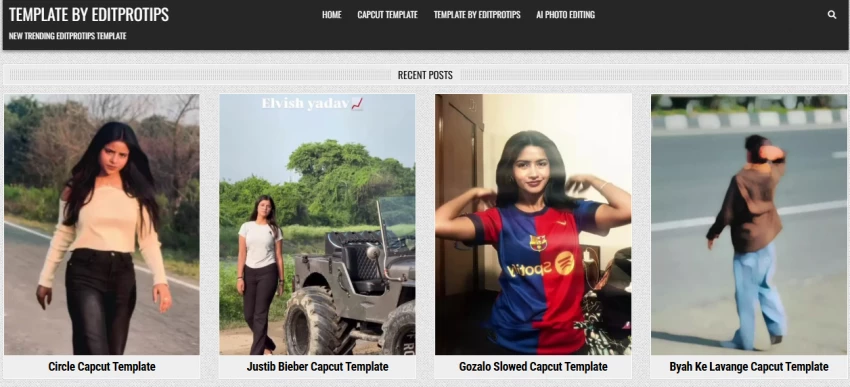
A close look at https://editprotip.com/ reveals that the platform is heavily centered around CapCut templates and trending short-form video edits. The homepage prominently displays preset-based editing styles, viral transitions, and aesthetic overlays commonly used by Instagram and TikTok creators. What is noticeably absent is any clear demonstration of proprietary AI rendering infrastructure, cloud processing engines, or downloadable editing software.
The site operates more like a template curation and inspiration hub rather than a standalone AI editing platform. It appears to guide users toward applying specific styles inside existing editing tools instead of hosting its own editing engine.
This distinction is crucial. True AI editing platforms typically showcase backend rendering systems, export capabilities, integrated AI tools, and feature walkthroughs. EditPro’s presentation suggests guidance and templates rather than a complete editing environment.
The Google Play listing under the package com.proeditingai.appadviceguide further clarifies positioning. The app description indicates that it functions primarily as a guide, offering editing tips and advice rather than serving as a full-fledged AI editing application.
There is no strong evidence in the app listing of built-in rendering pipelines, GPU-based processing, or integrated AI generation. This reinforces the conclusion that the Edit Pro Tips app is designed as an informational and workflow-support tool rather than a complete generative AI platform.
Users expecting a mobile AI video generator similar to CapCut’s AI suite or Runway’s cloud engine may find that the app serves more as an advisory companion than an editing powerhouse.
Across third-party blogs such as https://dailyinfotime.com/editpro-tips-ai/, EditPro AI is described with ambitious terminology. It is framed as an advanced creative assistant capable of smart object removal, generative image and video creation from prompts, lighting adjustments, background replacement, and cinematic style transfer.
Technically speaking, these features are not unrealistic in 2026. AI editing tools across the industry now provide diffusion-based image reconstruction, prompt-driven object swapping, and automated enhancement features powered by advanced transformer models.
However, there is limited transparent documentation confirming that EditPro itself operates proprietary AI infrastructure. The positioning appears to align more with AI editing trends rather than evidence of a standalone model architecture owned and operated by the brand.
This suggests that the EditPro AI narrative may represent workflow philosophy rather than independent generative technology development.
When a brand like EditPro Tips shows up across Pinterest, DeviantArt, collaborative docs, Unreal Engine forums, and Reddit, it usually means one thing: it’s being carried more by community distribution than by a single “official product experience.” That’s not automatically good or bad, but it changes how you should interpret the name. Instead of behaving like a classic software company where the product is the center and the community follows, EditPro Tips looks more like an ecosystem label that travels through creator channels, templates, workflow notes, and “here’s what worked for me” posts.
Pinterest and DeviantArt are not places where serious software proof typically lives. They’re places where aesthetic language travels: visual references, style trends, “this is the look,” “this is the transition,” “this is the vibe.” That’s why EditPro Tips showing up there is meaningful even if it doesn’t prove the existence of a proprietary AI editor. The brand’s presence in those environments generally signals that it is being used as a style tag, something creators associate with a certain type of edit, template, or creative outcome, rather than a deeply technical product that users evaluate via benchmarks, export pipelines, or feature parity.
In practice, creators often treat these platforms like lookbooks. A pin or a DeviantArt profile doesn’t need to prove how the edit was made; it just needs to make people want the edit. Then traffic flows downstream to “how to achieve it,” which is where template hubs and guide apps win. That’s exactly the kind of funnel an “EditPro Tips” identity fits.
I should also be transparent about access: Pinterest and DeviantArt frequently block automated viewing, and in this session I couldn’t fetch the Pinterest pin (unexpected status) and DeviantArt returned a 403. So I’m not claiming anything beyond what these platforms typically represent and what your own excerpt already indicates.
The Reddit thread you referenced isn’t about EditPro specifically; it’s an older “editor pro tips” discussion where professionals exchange fundamentals: redundancy and backup discipline, story-first decision-making, keyboard-driven efficiency, scripting/automation skills, and craft knowledge versus software knowledge.
This matters because it shows the cultural filter that experienced editors use when they hear broad AI claims. In that thread, the strongest recurring themes aren’t “cool effects” or “instant magic,” but reliability, workflow rigor, and decision quality. So when an AI-branded editing resource like EditPro Tips enters the conversation, professionals tend to ask different questions than casual creators do. They want to know whether it improves real throughput without breaking the fundamentals: does it reduce repetitive work safely, does it keep projects organized, does it protect assets, does it maintain story coherence, and does it avoid introducing hidden risks (like unreliable exports or unsafe downloads).
That’s why, in your article, this Reddit reference can be used as the “reality check” lens: the editing community’s definition of “pro tips” is often less about trendy templates and more about durable workflow principles that keep projects safe and coherent.
When you put these channels together, EditPro Tips looks less like a single, verifiable AI editing engine and more like a distributed creator brand that spreads through templates, aesthetic inspiration, workflow notes, and community-posted “tips.” HackMD supports that interpretation directly by emphasizing templates, prompts, guides, and smart techniques rather than describing a proprietary editor. The Unreal thread reinforces the “tips + link-out” pattern rather than a documented tool integration. And the Reddit thread shows why professionals will treat any big AI claim skeptically unless it proves reliability and workflow value beyond surface-level effects.
Another major issue is naming overlap. The term “Edit Pro” appears in unrelated contexts across platforms such as https://www.capterra.in/software/1071434/Edit-Pro and https://www.softwareadvice.ie/software/523611/Edit-Pro. These listings refer to editorial workflow or transcription software, not AI generative video tools.
Similarly, review pages like https://www.editorworld.com/editors/review/EditPro?page=5&srsltid=AfmBOopemiCTBtYxuE0lEbli4vklCwOOOzsDSwj00maLmafZkv5JzMp3 discuss editing services unrelated to AI video creation.
This overlap significantly contributes to confusion. Users researching “EditPro AI” may unintentionally land on entirely different products that share only a similar name.
A critical dimension of this analysis involves cybersecurity. The report published at https://cooltechzone.com/threats/beware-of-edit-pro-ai-pretends-to-be-a-real-ai-video-generator-but-actually-installs-infostealer-malware highlights that some downloads marketed under the “Edit Pro AI” name may be malicious.
According to that investigation, certain standalone installers disguised as AI video generators were distributing infostealer malware. This underscores a serious risk associated with downloading software from unofficial sources.
Because the name EditPro is widely used and loosely branded, malicious actors may exploit this ambiguity to distribute harmful software. This makes it essential for users to download apps only from verified marketplaces such as the official Google Play Store listing.
To properly evaluate EditPro’s positioning, it must be compared to the broader AI editing industry. In 2026, AI is deeply integrated into creative workflows. Businesses report productivity improvements averaging around 25 percent when AI editing tools are properly implemented. Enterprise AI adoption exceeds 80 percent across at least one operational function. More than 70 percent of Gen Z creators use AI-assisted editing tools regularly.
Generative editing is no longer experimental. It includes object removal, prompt-driven scene transformation, lighting correction, texture matching, and batch content optimization.
The techniques promoted under the EditPro AI umbrella align with these trends. For example, trimming the first and last seconds of AI-generated videos helps remove shimmer artifacts common in diffusion models. Providing detailed object descriptions when replacing items improves lighting realism. Applying base enhancement before artistic filters prevents over-processing. Batch adjustments maintain cohesive branding.
These are legitimate AI workflow strategies. However, they are industry-standard practices rather than proprietary innovations.
When evaluating EditPro realistically, it is important to separate expectation from positioning. The strongest value EditPro appears to provide is not deep technical rendering infrastructure, but creative acceleration. In other words, it helps users move from idea to publishable social content faster, particularly in short-form environments where speed and trend relevance matter more than frame-level precision.
For social media creators working within ecosystems like Instagram Reels, TikTok, and YouTube Shorts, the editing workflow is often less about multi-layer compositing and more about timing, transitions, aesthetic alignment, and audience retention hooks. These creators frequently rely on templates, preset transitions, stylistic overlays, and trending audio synchronization. In this environment, EditPro’s template-driven approach and AI-inspired workflow tips can reduce friction. Instead of building edits from scratch, users can apply structured presets that already align with current algorithm-friendly styles.
This is where EditPro’s strengths become visible. It simplifies decision-making. It narrows creative overwhelm. It provides a shortcut to achieving a particular aesthetic without requiring technical depth in masking, node-based grading, or keyframe animation. For influencers and content marketers who publish frequently, this kind of workflow compression can be valuable. The benefit is not superior cinematic quality but improved publishing speed and stylistic consistency.
Another strength lies in workflow psychology. Many beginner creators struggle not because they lack tools, but because they lack clarity. Having a structured guide that explains how to enhance lighting before applying filters, how to trim artifact-prone AI-generated frames, or how to maintain batch consistency across posts can meaningfully improve output quality. These are not revolutionary engineering features, but they are practical guardrails that prevent common mistakes such as over-processing, inconsistent color grading, or awkward transitions.
However, when the evaluation shifts toward professional-grade production, the limitations become clear.
High-end video production is built around control. Editors working on documentaries, commercial campaigns, cinematic YouTube projects, or branded content typically require multi-track timeline precision, advanced color grading scopes, LUT management, audio mixing layers, motion tracking, 3D compositing, and export bitrate customization. These capabilities are deeply embedded in platforms such as DaVinci Resolve, Adobe Premiere Pro, Final Cut Pro, and other enterprise-level tools.
There is currently no strong indication that EditPro provides this level of granular control. It does not present detailed documentation of rendering engines, hardware acceleration, codec management, or project file architecture. Without those components, it cannot reasonably compete with established professional editing suites.
Another limitation relates to infrastructure transparency. Major AI SaaS platforms openly discuss their model integrations, cloud processing pipelines, API architecture, and subscription tiers. They explain whether they use diffusion models, transformer-based systems, or custom in-house engines. EditPro, by contrast, positions itself around AI editing techniques but does not clearly demonstrate proprietary model ownership or infrastructure depth. This does not invalidate its usefulness as a resource brand, but it does limit its classification as a true AI rendering platform.
There is also a scalability question. Professional teams working on high-resolution projects often require collaborative editing environments, version control, shared asset libraries, and structured export pipelines. These environments demand backend stability and enterprise-grade support. EditPro’s branding suggests workflow simplification rather than collaborative infrastructure.
In essence, EditPro’s strength lies in creative enablement rather than technical dominance. It helps creators produce visually engaging short-form content quickly. It aligns well with trend-driven ecosystems where audience retention and visual punch matter more than cinematic precision. It reduces entry barriers for beginners and social-first creators.
Its limitation is depth. It does not present strong evidence of offering advanced editing architecture, deep AI model infrastructure, or professional production-grade control systems. It functions more as a workflow accelerator and aesthetic guide than as a fully independent AI editing engine.
For a beginner or influencer publishing daily content, this may be sufficient. For a filmmaker, commercial editor, or post-production studio, it likely falls short of required standards.
That distinction is not a criticism; it is simply a positioning reality. EditPro appears optimized for speed, inspiration, and accessibility rather than technical supremacy.
When viewed strictly through the lens of the question “AI workflow or just templates?”, the most accurate conclusion is that EditPro Tips leans far more toward the template-and-workflow side of the spectrum than toward being a fully independent AI editing engine.
EditPro occupies a hybrid space in the modern AI editing conversation. It borrows the language of artificial intelligence, speaks in terms of smart editing, generative workflows, and automation efficiency, and aligns itself with contemporary AI editing trends. However, the observable structure of the platform suggests that its primary function is to guide creators rather than power rendering itself. The emphasis appears to be on curated templates, editing techniques, prompt suggestions, and workflow simplification rather than on operating a proprietary AI model with its own cloud-based generation infrastructure.
The techniques promoted under the EditPro label—such as trimming artifact-prone frames in AI-generated clips, enhancing base images before stylizing, using detailed prompts for object replacement, and maintaining batch consistency across posts, are legitimate and aligned with real industry practices. These are sound workflow strategies used across modern AI editing tools. But they are methods, not engines. They represent how to use AI effectively, not proof of owning AI at the architectural level.
That distinction defines the verdict.
EditPro Tips appears to function primarily as a resource-driven ecosystem that packages inspiration, templates, and workflow education under AI-oriented branding. It simplifies creative decisions for social media creators working in fast-moving environments like Instagram Reels and TikTok, where speed and trend alignment matter more than technical post-production depth. For beginners or high-frequency content creators, this kind of guidance can genuinely reduce friction and improve output consistency.
However, there is no clear evidence that EditPro operates a standalone generative AI rendering system comparable to established AI SaaS platforms. It does not publicly demonstrate deep infrastructure components such as proprietary diffusion models, cloud GPU rendering architecture, or enterprise-grade export control systems. For creators seeking advanced generative editing capabilities, cinematic compositing precision, or high-end post-production control, more established AI-integrated editing platforms will likely provide stronger technical depth.
Another important factor in the final evaluation is safety and clarity. The overlap of the “EditPro” name across unrelated services, combined with documented reports of malware clones using similar branding, means users should approach downloads cautiously. Verifying official sources and avoiding untrusted executable installers is essential.
So, in direct response to the title’s question: EditPro Tips is not purely “just templates,” but it is much closer to an AI-guided template ecosystem than to a full-scale AI editing engine. Its strength lies in workflow acceleration, creative structure, and trend alignment. Its limitation lies in infrastructure depth and professional-grade control.
For the right audience, social media creators looking for faster output and aesthetic direction, it can be useful. For users expecting an autonomous, high-powered generative editing platform built on proprietary AI models, expectations should be calibrated accordingly.
Are the AI Pro Edit Pro Tips legitimate editing strategies?
Yes, the strategies associated with EditPro AI, such as trimming artifact-prone sections, writing detailed prompts for object replacement, enhancing before stylizing, and maintaining batch consistency, reflect recognized AI editing best practices across modern tools.
Is EditPro good for video editing?
EditPro appears suitable for beginners and social media creators looking for templates and workflow advice. It may not be sufficient for professional editors requiring full control over advanced editing processes.
What is the Edit Pro Tips app?
The Edit Pro Tips app available on Google Play functions primarily as a guide or advisory application. It does not appear to operate as a standalone AI rendering engine but instead provides editing recommendations and creative guidance.
Be the first to post comment!
When I first started deploying large language models, I assumed that choosing th...
Sakshi Dhingra3 days ago
Few software websites have survived as many internet eras as Softonic. Launched...
Suraj Malik3 weeks ago
PDF files are everywhere, from business contracts and academic papers to invoice...
Suraj Malik3 weeks ago

The Xender APK has remained relevant for one simple reason: it solves a very rea...
Sakshi Dhingra3 weeks ago
In January 2026, something happened in AI that didn’t feel like a product launch...
Suraj Malik4 weeks ago
1. Meaning of Fidzholikohixy :Fidzholikohixy refers to a conceptual product...
Cheshta Upmanyu1 month ago