Fidzholikohixy sounds like the name of a new productivity platform. Search for it, however, and things quickly become less clear.
Some websites describe Fidzholikohixy as a unified workflow framework. Others present it as an imaginary productivity ecosystem combining automation, collaboration, analytics, and project management. There is also online discussion suggesting the term itself may simply be an internet-created or SEO-driven concept.
That distinction matters.
Based on the publicly available information we reviewed, Fidzholikohixy should not currently be treated as a verified software product with an established company, official feature set, pricing structure, or documented development history.
It makes more sense to treat it as a conceptual model for thinking about connected digital workflows.
And viewed that way, there is actually something useful to discuss.
Research note: This article is based on publicly available information and workflow research. GeniusFirms has not conducted hands-on testing of a Fidzholikohixy product because we could not verify a commercially available product to test.
Meaning of Fidzholikohixy
Fidzholikohixy refers to a conceptual productivity framework or next-generation workflow ecosystem, not a single app or software you install. In current usage, it describes an idea: bringing fragmented work functions—tasks, automation, collaboration, and analytics, into one unified system.
The core idea is simple:
Instead of managing work across dozens of disconnected tools, Fidzholikohixy represents a centralized structure where everything related to work lives, connects, and informs each other.
It’s often discussed as a model or approach that organizations aim for when designing smarter, more efficient workflows.
Why Fidzholikohixy Exists?
Modern work is fragmented.
A typical knowledge worker may switch between:
email for communication
a to-do app for tasks
a calendar for scheduling
chat tools for quick decisions
spreadsheets or dashboards for reporting
This constant context switching slows people down and increases mistakes.
Fidzholikohixy exists to address problems like:
duplicated work across tools
information scattered in multiple places
manual updates and follow-ups
lack of visibility into progress
Simple example: If a task is discussed in chat, assigned in a task tool, tracked in a spreadsheet, and reviewed in a meeting, you’re managing the same work in four places. A unified workflow model aims to remove that redundancy.
Reality Check: Is Fidzholikohixy a Real Product?
This is the part that deserves more attention than most explanations give it.
We could not verify a clear official company, recognized software platform, established developer documentation, or authoritative primary source defining Fidzholikohixy.
Online descriptions also vary considerably.
One article may describe it as workflow automation. Another may describe a productivity ecosystem. Others treat it as a fictional platform used to explain the direction modern productivity software is moving toward.
That inconsistency means readers should be careful about treating individual descriptions as official features.
For example, saying that Fidzholikohixy “has an automation engine” suggests an actual product has been examined. There is not enough evidence to make that conclusion.
A more accurate statement is that automation is one of the capabilities commonly associated with the idea.
That difference may sound small, but it separates explanation from invention.
The Problem Behind the Concept Is Real
Fidzholikohixy may be difficult to verify, but the workflow problem attached to it is easy to recognize.
Modern workers regularly move between communication tools, documents, project-management software, calendars, spreadsheets, dashboards, and increasingly AI assistants.
Microsoft's Work Trend Index found that the average employee in its Microsoft 365 dataset spent 57% of working time communicating and only 43% creating. The same research found that 68% of respondents said they lacked enough uninterrupted focus time.
Asana has described a related problem as “work about work”: time consumed by searching for information, chasing updates, switching tools, managing priorities and coordinating activity instead of completing skilled work.
That is where the Fidzholikohixy concept becomes more useful.
It gives us a way to ask a better question:
Does our technology stack make the work easier, or are we spending more time managing the technology stack?
That is a much more practical idea than pretending there is a mysterious new platform that solves everything automatically.
How Fidzholikohixy Works?
Even as a framework, its operation is usually explained in a clear sequence.
Core Functional Layers-
Unified dashboard – one place to see tasks, messages, timelines, and data
Shared workspaces – teams collaborate in real time
Built-in insights – progress and performance are visible without manual reporting
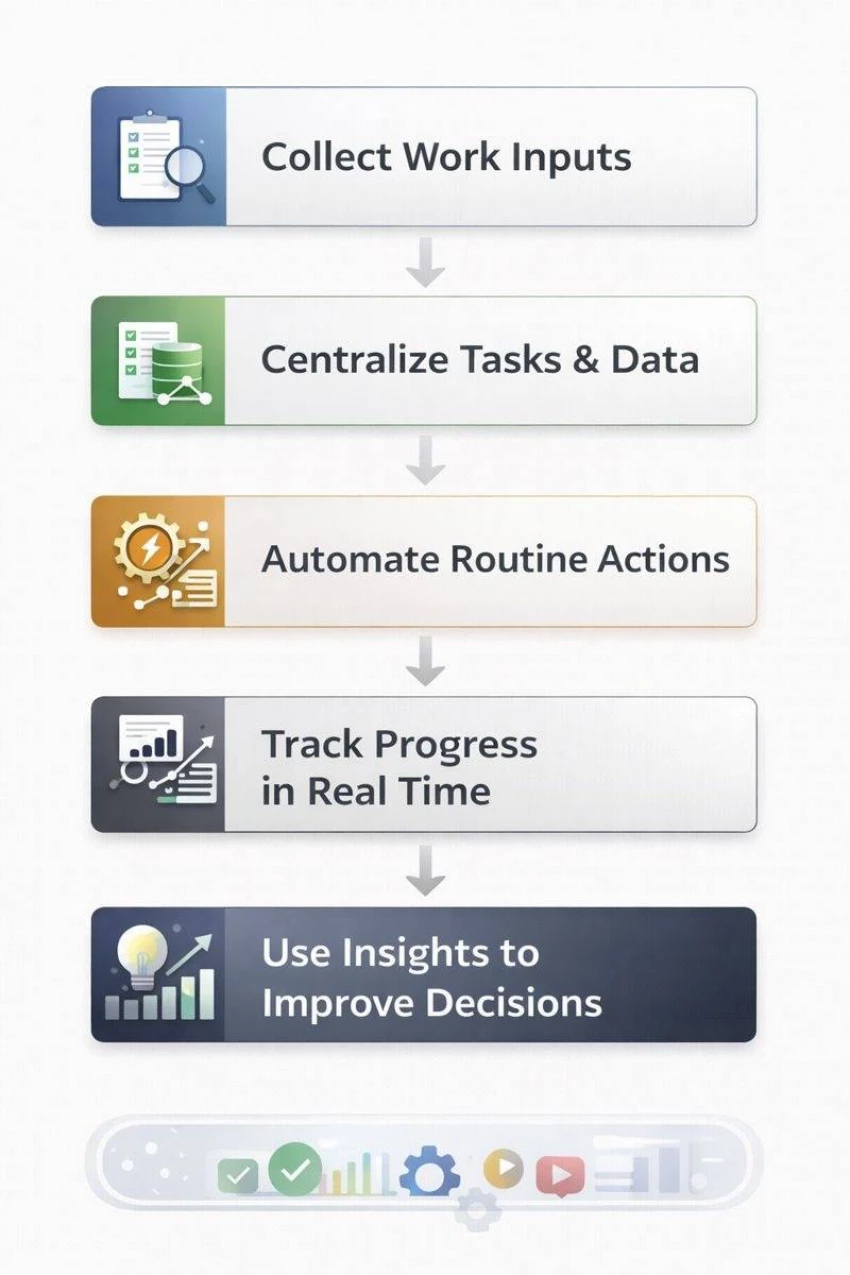
Simple Workflow Flow-
This flow replaces scattered tools with a single source of truth.
The Five-Question Fidzholikohixy Test
Because there is no verified official specification for Fidzholikohixy, a practical framework is more useful than an invented feature list.
At GeniusFirms, we think the concept can be reduced to five questions.
Question
Strong workflow
Weak workflow
Where does the truth live?
Everyone knows the authoritative source
Several conflicting versions exist
Does context follow the work?
Decisions, files and tasks remain connected
People repeatedly search chat and email
Which repetitive actions are automated?
Predictable administrative steps
Employees manually copy the same information
Can another person understand the status quickly?
Ownership and progress are visible
Updates depend on meetings or messages
Does each tool have a clear role?
Every tool solves a defined problem
Apps overlap and duplicate work
If a system performs well across these five questions, it is already moving toward the workflow model that online discussions associate with Fidzholikohixy.
If it performs poorly, adding another productivity app probably will not solve the problem.
It may make it worse.
Why Smarter Workflows Matter?
Centralized workflows improve productivity because they:
● reduce context switching
● lower the risk of missed updates
● improve coordination across teams
● make accountability clearer
When everyone sees the same system, fewer things fall through the cracks. Decisions are based on current data, not outdated reports.
Key Benefits of Using the Fidzholikohixy Model
Core Benefits-
One central work hub instead of many tools
Less manual updating and follow-up work
Clear visibility into tasks and progress
Flexible structures that adapt to different teams
Benefit Summary Table-
Benefit
What It Improves
Centralization
Fewer disconnected tools
Automation
Saves time on repetitive work
Visibility
Better tracking and accountability
Flexibility
Works across teams and roles
Is Fidzholikohixy Safe?
The concept itself is safe, it’s just an idea or framework.
However, users should be cautious of:
● unknown websites claiming to be “official” Fidzholikohixy software
● unverified downloads or extensions
● vague tools with no documentation or company details
Basic Safety Guidelines-
● use well-known platforms
● check HTTPS and privacy policies
● avoid installing anything that lacks transparency
Pros & Cons of Fidzholikohixy
Pros-
1. Unified Workflow Vision:
What this means in practice: Instead of treating tasks, communication, automation, and reporting as separate systems, the Fidzholikohixy approach promotes one connected workflow. This makes it easier to see how work moves from idea → execution → outcome.
Why it matters: Teams spend less time figuring out where things live and more time actually doing the work.
2. Encourages Automation:
What this means in practice: Routine actions such as status updates, reminders, handoffs, or data syncing—are designed to happen automatically rather than manually.
Why it matters: Automation reduces repetitive effort, lowers the risk of human error, and frees up time for higher-value tasks like planning and problem-solving.
3. Improves Collaboration:
What this means in practice: Work is shared in a central space where updates, discussions, and progress are visible to everyone involved.
Why it matters: Teams stay aligned without constant meetings or follow-ups, and collaboration becomes more transparent and less dependent on individual memory or manual updates.
4. Reduces Fragmentation:
What this means in practice: Instead of jumping between multiple apps for related work, information is linked and contextualized within one workflow.
Why it matters: Less context switching leads to better focus, fewer missed details, and a clearer understanding of priorities.
Cons
1. Not a Single Installable Product:
What this means in practice: Fidzholikohixy is a conceptual framework, not an app you can download and start using immediately.
Why it matters: Teams must build or approximate the approach using existing tools, which requires planning and intentional setup rather than instant adoption.
2. Can Feel Abstract to Beginners:
What this means in practice: Because it describes how systems should work together, new users may struggle to understand it without concrete examples or guidance.
Why it matters: Without clear onboarding or documentation, people may find it difficult to translate the idea into daily habits or workflows.
3. Depends on Existing Tools:
What this means in practice: The framework relies on integrating current platforms (task managers, communication tools, automation services) rather than replacing them outright.
Why it matters: The quality of the experience depends heavily on how well those tools integrate and how consistently the system is maintained.
4. Requires Thoughtful Setup:
What this means in practice: Designing a unified workflow means deciding:
● what gets automated
● where data lives
● how teams interact with the system
Why it matters: Poor setup can lead to confusion instead of clarity, so success depends on careful planning and periodic refinement.
The Future of Fidzholikohixy
Unified workflow ecosystems are gaining attention due to:
remote and hybrid work
growing automation needs
demand for real-time visibility
Plausible future directions include:
smarter automation using AI
deeper analytics built into workflows
tighter integrations across platforms
Rather than disappearing, frameworks like Fidzholikohixy are likely to influence how future productivity systems are designed.
Centralized Workflow vs Fragmented Tools
The difference becomes easier to see when the two approaches are compared directly.
Fragmented workflow
Connected workflow
Tasks are separated from decisions
Decisions remain attached to work
Employees manually transfer information
Predictable transfers are automated
Several versions of a status exist
One authoritative status is maintained
Reporting requires collecting updates
Reporting draws from active work data
Employees repeatedly search for context
Context travels with the task
New software is added whenever a problem appears
Processes are reviewed before tools are added
The connected side of this table is the most useful interpretation of Fidzholikohixy.
It turns a vague internet term into something readers can actually apply.
Final Takeaway
Fidzholikohixy should currently be approached as a conceptual internet term rather than a verified software platform.
There is not enough reliable primary-source information to confidently assign it official features, pricing, ownership or a product roadmap.
That does not make the entire discussion useless.
Strip away the unusual name and the underlying idea becomes straightforward: connect information, tasks, communication and automation so people spend less time coordinating work and more time completing it.
For teams trying to apply the concept, the most useful question is not:
“Where can I download Fidzholikohixy?”
It is:
“Where does our workflow lose context, duplicate effort or require a human to move information that software could move safely?”
Answer that question well, and you are already applying the strongest part of the framework.